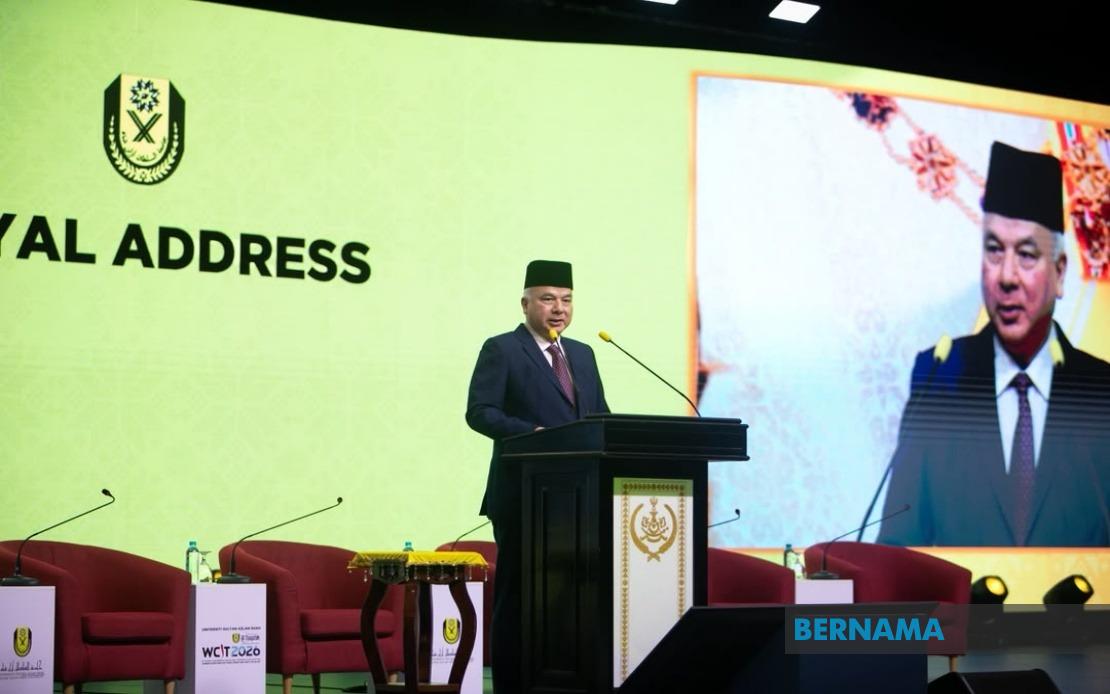
In a significant intervention on national security, Sultan Nazrin Shah, the Sultan of Perak, has shifted focus away from conventional definitions of defence toward what he describes as the most reliable safeguard: a socially cohesive nation. Speaking at the 8th World Conference on Islamic Thought and Civilisation in Ipoh on July 21, the royal ruler stressed that while traditional security measures such as border protection, cybersecurity, and counterterrorism efforts remain necessary, they cannot be the complete foundation of a nation's safety. His analysis carries particular weight in Malaysia's contemporary context, where deepening social divisions and rising sectarian tensions have become recurring political concerns.
Sultan Nazrin's remarks point to a deepening challenge facing Malaysia and the broader Muslim world: the weaponisation of religious identity by political actors. He specifically cautioned against the manipulation of faith to serve narrow partisan interests, a practice that undermines national unity and creates fractures within society. The manipulation of religious sentiment for divisive purposes represents a form of internal threat that no border fence or surveillance system can adequately counter. This concern resonates across Southeast Asia, where several nations have grappled with religious polarisation being leveraged to consolidate political power or mobilise voter bases, often at the expense of intercommunal harmony.
The Sultan articulated a vision of national integrity that extends beyond conventional notions of institutional strength or economic performance. True security, in his formulation, requires that every citizen—regardless of their ethnic background or religious affiliation—perceives themselves as having a genuine and equal stake in the nation's future. Without this sense of belonging, the most sophisticated security apparatus becomes merely a temporary fix, postponing rather than preventing the deeper crisis that emerges when segments of the population feel excluded or marginalised from the national project. This framing challenges policymakers to view social integration not as a peripheral concern but as a foundational pillar of state security.
Crucially, Sultan Nazrin separated the concepts of security and integrity, arguing they cannot be divorced from one another. A state that successfully defends its borders while internally corrupted and unjust has not genuinely achieved security—it has only delayed the reckoning that inevitably follows. This distinction matters significantly for Malaysia, where public discourse frequently emphasises external threats and national defence while sometimes minimising the corrosive effects of institutional corruption or unequal treatment under law. The Sultan's argument suggests that unless governance becomes more transparent and equitable, no amount of military expenditure will produce genuine security.
The Sultan rejected the notion that national unity can be maintained through uniformity or the suppression of dissent. Instead, he positioned resilient unity as emerging from circumstances where all communities see themselves fairly represented across multiple domains—in legislation, economic opportunity, educational institutions, and positions of leadership. This vision aligns with research in political science suggesting that inclusive societies experience greater stability and resilience. For Malaysian policymakers, the implication is clear: token gestures toward representation fall short of what is required. Rather, substantive participation across institutional structures, particularly in sectors where certain groups have been historically underrepresented, becomes a security imperative.
Switching focus to education, Sultan Nazrin outlined how human capital development must adapt to contemporary and future challenges, specifically naming automation, climate change, and the transition toward knowledge-intensive economies. The educational framework he describes goes beyond simply expanding school and university capacity. It requires strengthening scientific and mathematical capabilities while simultaneously investing in humanities and arts—disciplines often sidelined in pursuit of immediate economic returns. This balanced approach acknowledges that societies require both technical competence and cultural depth to navigate complex problems.
The Sultan's educational vision includes a crucial emphasis on vocational and technical pathways, arguing they deserve equivalent status and investment as traditional academic routes. In Malaysia's context, this represents a departure from cultural attitudes that have sometimes stigmatised technical trades as second-tier career options. Elevating these pathways addresses both practical economic needs—Southeast Asia faces skills gaps in critical trades—and addresses equity concerns by validating multiple routes to productive adulthood. Young people pursuing skilled trades would be valued equally with those entering medicine or engineering, a cultural shift with profound implications for social cohesion and opportunity distribution.
As artificial intelligence becomes increasingly embedded in economic and social systems, Sultan Nazrin contended that traditional pedagogical methods focused on rote memorisation and standardised testing have become obsolete. When information retrieval is instantaneous and nearly free, the scarce capacity becomes critical thinking, ethical reasoning, and creative problem-solving—precisely the human capabilities that remain irreplaceable by machines. This observation has particular resonance in Malaysia and Southeast Asia, where many education systems still rely heavily on examination-driven approaches designed for earlier industrial economies.
The Sultan identified Islamic education, properly conceived, as naturally aligned with cultivating these essential contemporary capacities. Rooted in both revealed knowledge and rational inquiry, a well-designed Islamic educational framework can develop precisely the critical and creative faculties required in an AI-augmented world. This framing offers Malaysian educators a way to integrate contemporary skill development with religious and moral instruction, rather than treating them as competing priorities. For policymakers, it suggests that modernising education need not mean abandoning Islamic pedagogical traditions, but rather reinterpreting them through a contemporary lens.
Sultan Nazrin's address, delivered alongside Deputy Prime Minister Datuk Seri Fadillah Yusof and Perak Menteri Besar Datuk Seri Saarani Mohamad, represents a notable articulation of values from the highest institutional levels. The gathering at the WCIT conference, focusing on pride and unity within Islam, provided an appropriate platform for these remarks. Yet the arguments extend beyond religious discourse into fundamental questions about state legitimacy, governance, and social sustainability. For Malaysian observers, the Sultan's emphasis on inclusive belonging as a security foundation offers both a diagnosis of existing vulnerabilities and a pathway toward more resilient governance structures. Whether these principles will translate into concrete policy shifts across education, economic distribution, and institutional representation remains an open question, but his intervention clarifies what comprehensive national security actually requires.

