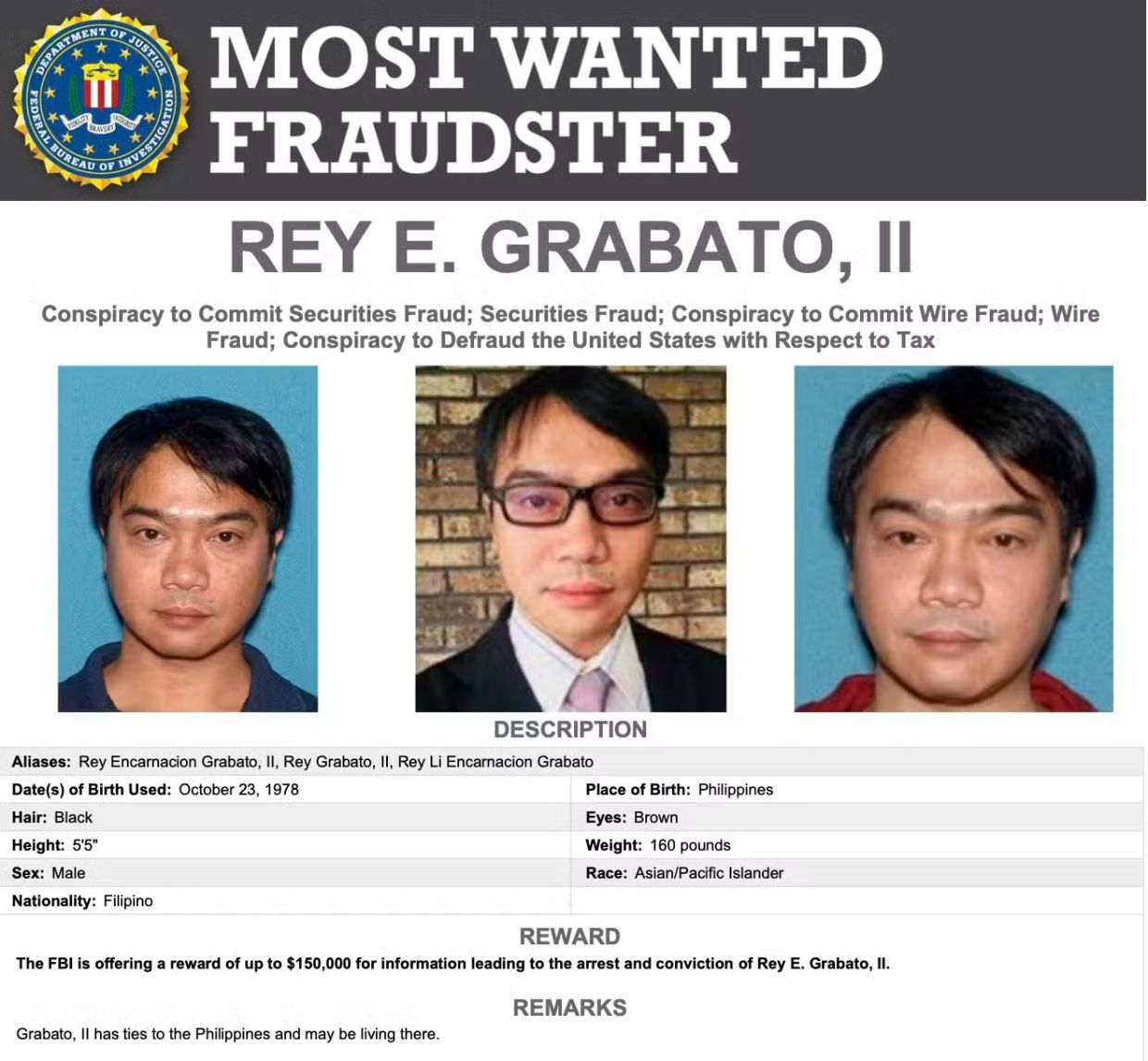
A son of the mayor of Mina, Iloilo has been added to the FBI's Most Wanted Fraudsters list for his alleged involvement in an expansive investment fraud operation that authorities say siphoned more than US$650 million from roughly 2,000 investors across the United States. Rey E. Grabato II, whose father Rey P. Grabato serves as mayor of the municipality and whose mother Lydia Encarnacion Grabato previously held the same position, now faces federal prosecution and a reward of up to US$150,000 for information leading to his arrest and conviction.
The fugitive is being pursued for securities and wire fraud charges, conspiracy to defraud the United States in connection with tax violations, and his role as former president and majority owner of National Realty Investment Advisors LLC, or NRIA. Investigators allege that between February 2018 and January 2022, Grabato and his co-conspirator Thomas Nicholas Salzano orchestrated a classic Ponzi operation designed to extract capital from unsuspecting investors, with particularly high concentrations of victims in New Jersey and across numerous other states.
The scheme relied on sophisticated marketing tactics to cultivate investor confidence. Federal prosecutors detail how NRIA mounted an aggressive nationwide promotional campaign spanning thousands of emails alongside extensive television, radio, and billboard advertising. The company held numerous investor presentations designed to convince participants that they were committing capital to a legitimate real estate venture through the NRIA Partners Portfolio Fund I LLC. The marketing narrative emphasized NRIA's supposed financial strength and track record of generating substantial returns, messaging carefully calibrated to attract middle-class investors seeking stable income streams through alternative investments.
In reality, the operation generated minimal to negligible profit, forcing operators to rely entirely on incoming capital from new participants to satisfy withdrawal requests and promised returns to earlier investors. This fundamental dependency on perpetual recruitment to maintain the illusion of viability is the defining characteristic of Ponzi schemes. Beyond the fraudulent investment promises, prosecutors allege that Grabato and associates systematically misappropriated millions in investor funds for personal use, compounding the deception with outright theft.
The conspiracy extended beyond the investment fraud into tax obstruction. Grabato faces additional accusations of participating in a separate scheme spanning from November 2007 through August 2022 designed to prevent the Internal Revenue Service from collecting approximately US$26 million in outstanding tax liabilities owed by parties connected to the operation. This multi-year obstruction effort suggests a deliberate pattern of evading both investor protection authorities and federal tax enforcement mechanisms.
A federal arrest warrant was issued for Grabato on October 12, 2022, following his indictment in the US District Court for the District of New Jersey. At the time authorities identified him as residing in Hoboken, New Jersey, while also maintaining connections to the Philippines. Unlike his alleged co-conspirator Thomas Nicholas Salzano, who was apprehended in October 2022, Grabato remained a fugitive, suggesting he may have fled to avoid arrest. The FBI notes that Grabato has used multiple aliases including Rey Encarnacion Grabato II, Rey Grabato II, and Rey Li Encarnacion Grabato, likely in attempts to evade detection across financial systems and international jurisdictions.
The inclusion of Grabato on the FBI's Most Wanted Fraudsters list reflects the bureau's elevated focus on locating high-profile fraud fugitives. The FBI established this specialized list in June as a dedicated mechanism for highlighting individuals accused or convicted of major fraud offences who remain at large or have eluded apprehension. The designation carries significant investigative resources and international cooperation potential, particularly relevant for suspects with connections spanning multiple countries.
Grabato's addition places him among a growing cohort of individuals with Filipino connections on the list, highlighting the transnational dimensions of modern financial crime. Fellow Filipino-linked fugitives include Michael Lizaso Marasigan, a dual Filipino and American citizen with ties to both Guam and the Philippines, who was convicted in May 2025 on charges involving illegal gambling, money laundering, and wire fraud. Also remaining at large are John Michael Dimitrion and his wife Julieanne Baldueza Dimitrion, who pleaded guilty in 2009 to orchestrating a mortgage fraud scheme in Hawaii but failed to appear for sentencing in July 2010.
The case carries particular implications for Southeast Asian readers given the regional context of financial crimes and investment fraud schemes that frequently target diaspora communities and cross-border capital flows. The involvement of a local government official's family member underscores how corruption and financial criminality sometimes implicate political actors, whether directly or through family connections, raising governance accountability questions in Philippine municipalities. For Malaysian investors and financial regulators, the case exemplifies the transnational investment fraud mechanisms that regularly target sophisticated middle-class participants across Southeast Asia with promises of stable real estate returns.
The scale of the alleged fraud—involving 2,000 victims and exceeding US$650 million—demonstrates the operational capacity of modern Ponzi schemes to accumulate massive losses before regulatory and law enforcement intervention. The multi-year operational window from 2018 through 2022 suggests that despite increasing regulatory attention to alternative investments, significant schemes continue operating through aggressive marketing while exploiting information asymmetries between promoters and retail investors.
Authorities are actively seeking information regarding Grabato's current location and activities. The US$150,000 reward incentivizes credible reporting, particularly from individuals within financial systems, immigration networks, or business communities who may encounter or have knowledge of the fugitive. The FBI encourages anyone with relevant information to contact local FBI offices, the nearest US embassy, or appropriate consulates, with the Philippines-based US embassy representing a particularly relevant reporting channel for individuals in the region.
The case remains emblematic of evolving fraud tactics that combine technological marketing sophistication with traditional deception patterns, exploiting legitimate-appearing institutional frameworks to extract capital across state and national boundaries. As financial systems become increasingly interconnected and capital flows more complex, regulatory and law enforcement agencies across Southeast Asia must remain vigilant regarding similar schemes targeting regional investors through promises of stable alternative investment returns.

