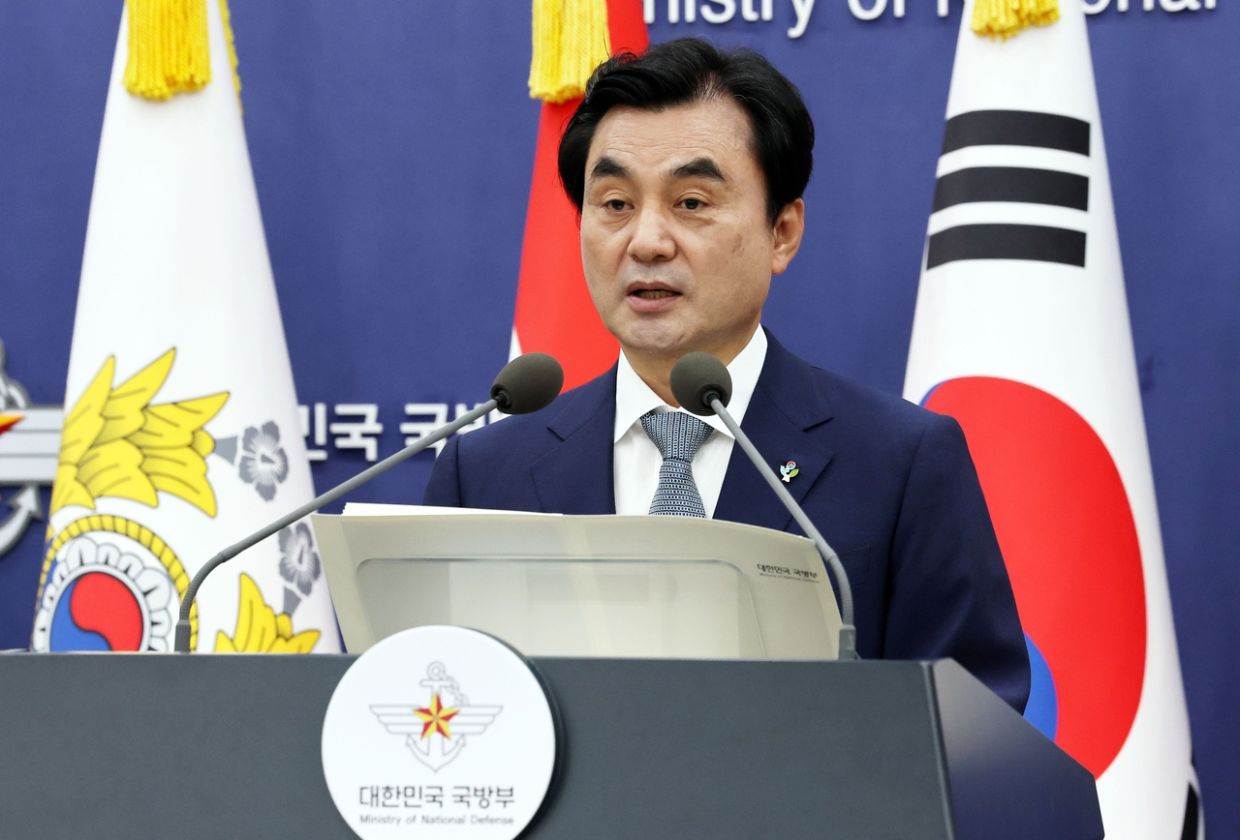
South Korea is fundamentally restructuring its approach to unmanned warfare, committing to acquire more than 20,000 low-cost drones and dramatically accelerating deployment of the K-Lucas, its domestically developed long-range loitering munition system. Defence Minister Ahn Gyu-back announced the sweeping strategic overhaul on Friday, June 26, positioning the initiative as a response to the rapid evolution of modern battlefield tactics demonstrated in recent conflicts and the persistent threat posed by North Korea's expanding unmanned capabilities.
The timing of Seoul's announcement reflects a global pattern of military adaptation following the lessons learned from Russia's invasion of Ukraine, where budget drones have fundamentally altered conventional warfare doctrine. The widespread use of inexpensive unmanned systems has demonstrated that military effectiveness no longer depends exclusively on expensive, sophisticated platforms. Instead, the ability to deploy numerous expendable drones has become central to tactical success, forcing militaries worldwide to reconsider their procurement strategies and operational concepts. Minister Ahn directly acknowledged this shift, stating that low-cost drone proliferation is "fundamentally reshaping modern warfare" and necessitating a corresponding realignment of South Korean defence policy.
North Korea's accelerating development of diverse unmanned aerial systems adds particular urgency to Seoul's initiative. The regime has demonstrated a commitment to expanding its drone arsenal, creating mounting concerns not only for military installations but also for critical civilian infrastructure and population centres. Unlike traditional military threats, these systems present a decentralized danger that is inherently difficult to defend against using conventional air defence networks. The Korean peninsula's geographic configuration, with the heavily fortified inter-Korean border, makes the South particularly vulnerable to unmanned incursions designed to gather intelligence or conduct strikes against strategic targets.
The defence ministry's acquisition plan envisions procuring more than 20,000 expendable unmanned systems by 2030, encompassing short-range reconnaissance drones and small loitering munitions alongside the strategic K-Lucas platform. These numbers represent a dramatic expansion of unmanned capability across multiple operational ranges and mission profiles. The plan includes provisions for deploying counterdrone systems and small unmanned aircraft defence mechanisms in forward-line areas adjacent to the demilitarized zone beginning in 2026, essentially creating a layered defence architecture against aerial threats both conventional and unmanned in nature.
The K-Lucas system itself represents South Korea's indigenous capability for long-range precision strikes using loitering munitions—effectively domestically manufactured equivalents to systems that have achieved prominence in recent international conflicts. By accelerating the deployment timeline for this platform, Seoul signals its intention to develop asymmetric advantages against potential adversaries while reducing reliance on imported systems and strengthening the domestic defence industrial base. The strategic strike capability embedded in the K-Lucas programme underscores a fundamental shift from purely defensive posture to one incorporating offensive unmanned options.
Minister Ahn outlined an ambitious mid- to long-term vision incorporating directed-energy weapons, including laser and high-power microwave systems, alongside procurement of low-cost interceptor drones. This multi-layered approach acknowledges that countering inexpensive drones requires scalable, cost-effective defensive mechanisms rather than expensive air defence systems designed to counter manned aircraft. The integration of energy-based systems with traditional kinetic defence reflects an understanding that future conflicts will demand flexible, adaptable defensive architectures capable of responding to diverse unmanned threats simultaneously.
Critically, the defence ministry is pursuing legislative reforms to accelerate the acquisition of advanced drone technologies by streamlining certification processes and enabling military testing of commercially available systems under operational conditions. Deputy Minister for National Defence Policy Kim Hong-cheol emphasised that traditional procurement methodologies cannot keep pace with the rapid technological evolution occurring in unmanned systems development. By creating pathways for civilian technologies to be rapidly militarized, Seoul aims to compress the timeline between technological innovation and military deployment, preventing adversaries from maintaining advantages in specific unmanned capabilities. This legislative approach also promises to stimulate domestic industry innovation by creating predictable pathways for commercial drone manufacturers to reach military customers.
The Defence Ministry will transform the Drone Operations Command into the National Defence Drone Headquarters, fundamentally altering its organisational role and authority structure. The new headquarters will function as a policy and capability development organisation rather than an operational command, with procurement support and military-industrial cooperation responsibilities. Operational planning and execution authority will transfer to the Army, Navy, Air Force and Marine Corps respectively, enabling each service branch to develop unmanned tactics tailored to its specific mission requirements while the centralised headquarters maintains oversight of broader capability development and acquisition strategies.
This reorganisation arrives following months of controversy surrounding the Drone Operations Command, which faced investigation over allegations that it conducted drone operations over Pyongyang in October 2024 as part of political machinations by former President Yoon Suk Yeol and former Defence Minister Kim Yong-hyun. Personnel allegedly destroyed evidence including flight logs and disposed of equipment following the martial law declaration in December 2024. Despite speculation that the command could be dissolved entirely, the ministry determined that the growing strategic importance of unmanned systems, robotics and artificial intelligence in modern conflict requires maintaining a centralised coordinating authority, albeit with substantially diminished operational authority.
The restructuring reflects a pragmatic compromise addressing political concerns while acknowledging operational necessity. Each service will independently develop drone operational concepts adapted to its particular warfare domain—ground operations, naval engagement, air combat and amphibious operations—creating a decentralised tactical approach unified by centralised strategic guidance. This distribution of operational authority should prove more resilient than a concentrated command structure and may provide greater flexibility in responding to evolving threats.
The defence ministry's initiative also encompasses an extraordinarily ambitious personnel development programme targeting the training of 500,000 "drone warriors," with the strategic objective of enabling all service members to operate unmanned systems as a "second personal weapon" equivalent to standard infantry equipment. This vision represents a profound shift in military doctrine, positioning unmanned capabilities as fundamental to individual soldier capability rather than specialised technical functions performed by discrete units. The democratisation of drone operation across the entire military workforce, if achieved, would fundamentally alter the force structure and tactical options available to commanders.
The broader implications for regional security dynamics warrant careful consideration. South Korea's aggressive pursuit of unmanned warfare capabilities, combined with comparable initiatives underway in Japan and other regional powers, suggests an accelerating regional militarisation focused on autonomous and unmanned systems. These technological developments occur against a backdrop of rising US-China strategic competition and ongoing North Korean weapons development, potentially triggering further arms competition cycles. For Malaysia and other Southeast Asian nations, South Korea's strategic choices provide a preview of how regional military establishments may evolve in coming decades as unmanned systems proliferate and costs continue declining.
President Lee Jae Myung is scheduled to chair a separate meeting on fostering future security innovation companies, where officials will discuss measures to strengthen South Korea's defence and space industries amid changing security challenges. This parallel initiative underscores the civilian industrial component of Seoul's broader defence modernisation strategy, recognising that sustained technological advantage requires continuous innovation rather than static procurement approaches. The integration of commercial technology development with military applications represents a comprehensive national strategy positioning South Korea to maintain technological superiority while building export industries in defence sectors.

