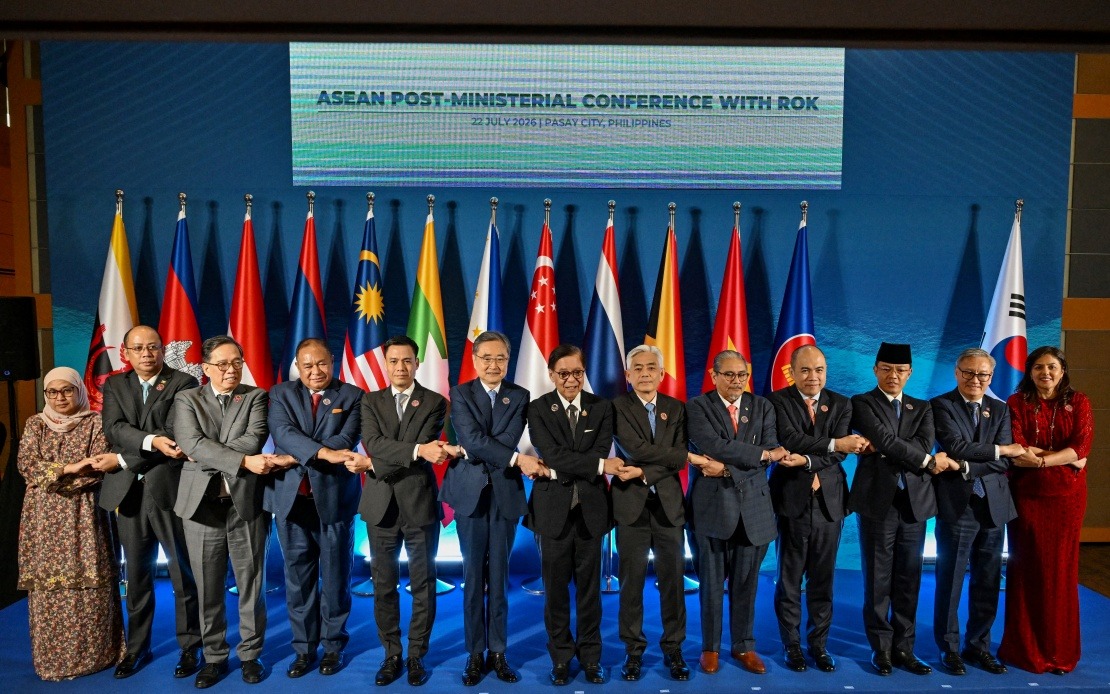
South Korea and ASEAN have intensified their strategic relationship by formally launching several joint initiatives designed to address emerging regional challenges and opportunities. During a meeting of foreign ministers in Manila on Wednesday, Seoul and the 10-member regional bloc renewed their commitment to the Comprehensive Strategic Partnership vision whilst introducing concrete cooperation frameworks in technology, culture, and maritime affairs.
Foreign Minister Cho Hyun, who co-chaired the bilateral gathering alongside his Thai counterpart, characterised the partnership as essential for navigating a region undergoing profound economic and geopolitical transformation. The minister emphasised that both parties now function as indispensable collaborators within an environment marked by substantial shifts in global supply chains and unprecedented technological acceleration. This assessment reflects Seoul's strategic calculation that engaging ASEAN nations directly serves its broader objectives of securing economic partnerships and reinforcing stability across East and Southeast Asia.
The Comprehensive Strategic Partnership framework, originally introduced by South Korea at last year's Korea-ASEAN summit, rests upon three foundational pillars intended to guide cooperative efforts over the coming years. The first pillar emphasises people-centred cooperation, addressing grassroots engagement and human mobility. The second focuses on growth and innovation, encompassing economic integration and technological advancement. The third concerns peace and stability, acknowledging the shared interest in maintaining a secure regional environment conducive to prosperity.
At the centre of Seoul's latest initiative stands the Korea-ASEAN AI Partnership Initiative, a comprehensive programme designed to accelerate artificial intelligence adoption throughout the bloc. The initiative encompasses three complementary components: establishing conducive AI ecosystems across member states, promoting collaborative research and cultivating locally-trained AI talent, and ensuring the responsible and secure deployment of AI technologies. By leveraging what Seoul describes as its full-stack AI capabilities—spanning hardware, software, and applications—South Korea positions itself as a technological mentor and partner rather than merely a market competitor.
Beyond technological cooperation, Seoul introduced measures to strengthen cultural and creative industries across ASEAN, reflecting growing recognition of soft power's role in contemporary international relations. The initiatives on combating online scam crimes address a pressing security concern affecting numerous countries in the region, where sophisticated fraud operations increasingly target citizens across borders. Additionally, the proposed joint maritime safety academy would institutionalise cooperation on a critical issue given ASEAN's dependence on sea trade routes and shared maritime interests in the South China Sea.
The bilateral FTA framework constitutes another crucial dimension of deepening economic ties. South Korea and ASEAN initially concluded an agreement covering goods in 2006, subsequently expanding it to encompass services in 2007 and investment provisions in 2009. Last month, both parties officially commenced discussions aimed at substantively upgrading this arrangement, with negotiations focusing on emerging sectors including the digital economy and critical minerals—domains where technological sophistication and resource security increasingly intersect. These negotiations signal recognition that earlier agreements, whilst foundational, require modernisation to reflect contemporary economic realities.
The volume of bilateral trade underscores the partnership's material significance for Seoul's broader economic strategy. South Korea exported approximately US$122.5 billion worth of goods to ASEAN member states during 2025, positioning the bloc as Seoul's third-largest trading partner globally. This substantial commercial relationship generates incentives for both parties to resolve impediments to trade flows and identify fresh avenues for mutually beneficial exchange. For Malaysia and other ASEAN economies, deepening technological and commercial integration with South Korea offers pathways to upgrading industrial capabilities and accessing advanced technologies.
ASEAN member states formally welcomed Seoul's strategic vision and expressed readiness to participate actively in implementing the outlined initiatives. This collective endorsement, delivered through the Thai foreign minister and supported by bilateral discussions between Cho and counterparts from the Philippines and Thailand, demonstrates consensus around the partnership's value despite occasional divergences in individual states' foreign policies. The willingness to engage on AI, cultural cooperation, and maritime safety reflects broader recognition that regional challenges increasingly demand pooled resources and coordinated responses.
Foreign Minister Cho utilised the Manila meetings to advance Seoul's distinct agenda regarding the Korean Peninsula, presenting South Korea's approach toward achieving peaceful coexistence and mutual development with North Korea. He requested continued ASEAN backing for these policies, emphasising that the peninsula's stability carries implications extending beyond Korea's immediate interests to encompass broader regional security architecture. ASEAN member states reciprocated by reaffirming support for Seoul's Korean Peninsula initiatives and underlining their assessment that peninsular stability constitutes a prerequisite for sustainable regional peace and prosperity.
The multilayered nature of South Korea's ASEAN engagement—spanning trade, technology, security, and cultural dimensions—reflects a sophisticated approach to regional partnership building that goes considerably beyond transactional commercial relationships. By positioning itself as a technology provider, cultural contributor, and security partner simultaneously, Seoul cultivates multiple channels of influence and interdependence. For Malaysian policymakers and observers, this comprehensive partnership model suggests that deepened ties with Korea extend beyond bilateral arrangements to encompass opportunities for regional collective action addressing shared development priorities and emerging transnational challenges.
The negotiations to upgrade the bilateral FTA particularly warrant attention from Malaysian stakeholders, as enhanced provisions governing digital trade, investment protections for technology sectors, and critical minerals access could reshape competitive dynamics throughout Southeast Asia. South Korea's technological sophistication and manufacturing capabilities position it advantageously within upgraded frameworks, whilst ASEAN nations possess natural resources and expanding consumer markets that justify Seoul's substantial engagement efforts. As formal negotiations commence, ASEAN governments including Malaysia will confront choices regarding which sectors to prioritise for liberalisation and how to manage potential disruptions to domestic industries from enhanced Korean competition.

