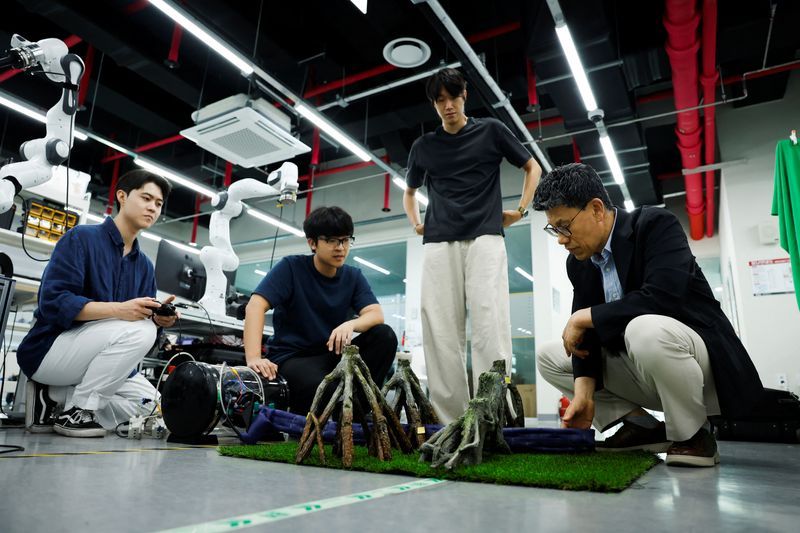
A collaborative effort between scientists at South Korea's Korea Advanced Institute of Science and Technology (KAIST) and Stanford University has produced a breakthrough in robotic dressing technology, with researchers demonstrating a garment that can clothe a person independently in roughly a tenth of a minute. The innovation, unveiled in Daejeon, harnesses soft pneumatic actuators—essentially flexible, air-pressurised artificial vines—that are integrated directly into clothing fabric, allowing the material to climb and conform to the wearer's body much like ivy scaling a wall without requiring the person to remain stationary or seek assistance from others.
The engineering behind this system draws its inspiration from nature's climbing mechanisms. Rather than attempting to manipulate the entire garment as a single unit, the robotic components grow outward from their anchoring point, advancing progressively along curved surfaces of the body while remaining stable throughout the dressing process. This growth-based approach proves particularly advantageous because it enables the technology to navigate complex body contours, transition through tight spaces, and maintain traction on surfaces with varying characteristics—whether slippery, adhesive, or inclined—without the need for intricate computational control systems.
Kim Nam Gyun, a postdoctoral researcher at KAIST who led the research effort, recalls the initial spark of inspiration emerging from an everyday frustration. While cycling through unexpected rainfall, he recognised the practical challenge of donning rain protection whilst maintaining control of a moving vehicle, leading him to conceptualise a garment capable of self-application during activity. This human-centred problem-solving approach informed the development philosophy, resulting in a system fundamentally different from conventional robotic assistance that typically requires users to remain perfectly still during dressing operations.
The mechanics of the self-dressing process involve a sophisticated yet elegant principle: as the pneumatic vines receive pressurised air, they advance by sequentially pushing fabric outward and upward along the wearer's frame. Rather than pulling material across the body like traditional clothing, the system essentially turns the garment inside-out as it progresses, allowing it to envelop the wearer gradually from one region to another. This inversion-based approach contributes significantly to the technology's stability and efficiency, enabling complete coverage of a full suit in approximately ten seconds—a timeframe that competitors in the robotics field would find remarkably swift.
For Southeast Asian economies increasingly focused on healthcare innovation and industrial advancement, this technology presents intriguing implications. Nations across the region that are developing semiconductor and electronics manufacturing sectors could potentially deploy such systems in cleanrooms, where personnel currently spend considerable time preparing with protective gear before entering controlled environments. The efficiency gains would directly reduce preparation intervals and improve workflow productivity, matters of genuine consequence in competitive manufacturing landscapes. Similarly, healthcare systems struggling with staffing pressures in ageing societies might benefit from technologies that help elderly individuals maintain independence in daily living tasks.
Beyond these immediate commercial applications, the research demonstrates the continued relevance of mechanical engineering innovation even as artificial intelligence receives prominent attention in technology discourse. Ryu Jee-Hwan, a KAIST professor of civil and environmental engineering, emphasises that whilst software algorithms increasingly dominate technology headlines, sophisticated hardware solutions remain equally vital for solving tangible real-world challenges. This perspective carries weight in the Southeast Asian context, where manufacturing capabilities and engineering expertise represent significant competitive advantages that should not be overshadowed by the region's growing but still-developing software sectors.
Emergency response represents another domain where the technology could prove transformative. Firefighters, hazmat teams, and disaster response personnel frequently face time pressures when deploying protective equipment, and any system capable of reducing dressing intervals whilst ensuring complete coverage could meaningfully enhance operational readiness. The hands-free operation proves particularly valuable in scenarios where responders might be simultaneously managing equipment, communicating with team members, or assessing rapidly evolving situations. The technology's compatibility with movement—the wearer need not stand motionless—aligns well with the dynamic requirements of emergency contexts.
The research also holds significance for disability support and ageing population care. Malaysia and other Southeast Asian nations face demographic shifts that will substantially increase the proportion of elderly residents requiring assistance with activities of daily living. Technologies that enable independence and reduce caregiver burden represent important healthcare infrastructure innovations. Rather than requiring constant physical intervention from caregivers, individuals with limited mobility or dexterity could leverage self-dressing systems, potentially improving both dignity and reducing strain on already-stretched care systems.
The underlying pneumatic architecture deserves particular attention because it avoids reliance on complex artificial intelligence systems or intricate sensor networks. The simplicity of the approach—relying on mechanical principles and air pressure rather than elaborate algorithms—suggests excellent scalability potential. Manufacturers in countries like Malaysia, Thailand, and Vietnam with existing expertise in precision mechanical assembly could potentially produce these systems more readily than competing robotics technologies requiring substantial software expertise and continuous algorithmic refinement. This accessibility dimension could democratise advanced robotics applications across the region more effectively than alternatives locked behind proprietary software ecosystems.
Looking forward, researchers indicate that the technology remains in active development phases, with investigations ongoing into enhanced materials, improved pressure regulation systems, and expanded application domains. The research was formally published in IEEE Robotics and Automation Letters, a peer-reviewed scholarly journal, lending credibility to the findings and likely inspiring follow-up investigations by robotics teams globally. For Malaysian and Southeast Asian technology observers, this development signals that collaborative international research initiatives can yield solutions specifically addressing practical human needs—a model that regional institutions might emulate through partnerships with leading universities and research organisations worldwide.

