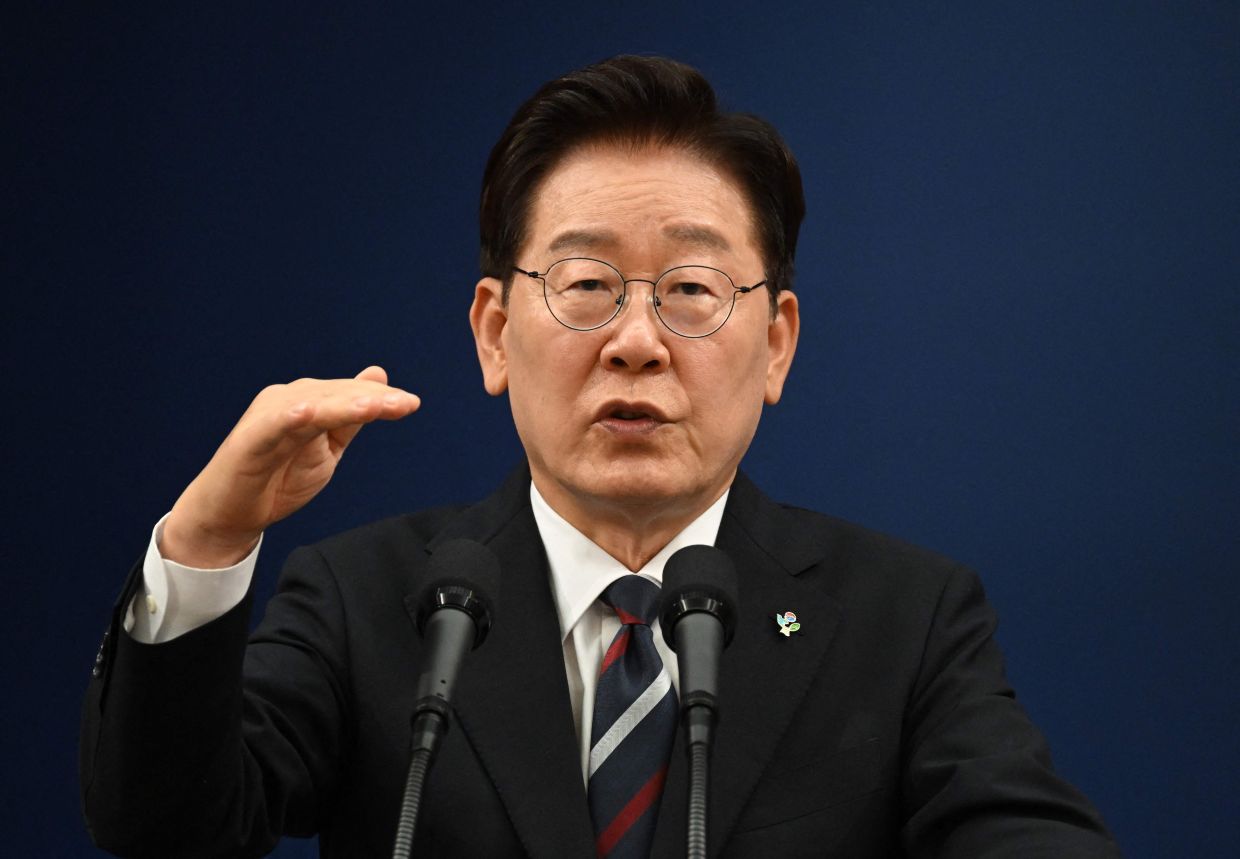
South Korean President Lee Jae Myung faces a significant political setback as his approval rating has tumbled below the 50 per cent mark for the first time since assuming office on June 4, 2025. The latest Realmeter polling data, released on June 22, reveals that just 46.7 per cent of respondents now view his performance favourably, marking a steep decline of 4.8 percentage points from the preceding week. More troublingly for the presidential office, disapproval ratings have now surpassed approval for the first time during his tenure, with 49.7 per cent expressing negative views compared to 46.7 per cent positive ones, though the figures remain within the survey's margin of error.
The erosion of public confidence represents a dramatic reversal of fortune for Lee, whose approval rating stood at a robust 60.5 per cent just eight weeks earlier in mid-May. The downward trajectory has been remarkably consistent, with the rating declining from 59.3 per cent in one week to 59.1 per cent the next, then sliding further to 55.2 per cent before this week's sharp drop. This five-week consecutive decline signals mounting dissatisfaction that extends beyond isolated incidents or temporary controversies, suggesting deeper structural problems affecting how voters perceive presidential leadership. The speed of the decline is particularly notable, as Lee has experienced a loss of approximately 14 percentage points in public support over just two months into his presidency.
Analysts point to two primary culprits for the deteriorating approval ratings. The first involves the ballot shortage crisis that marred South Korea's June 3 local elections, an administrative failure that triggered widespread public criticism and demands for accountability. The election management fiasco has become a rallying point for opposition voices and a symbol of governmental incompetence in the minds of many voters. Compounding this administrative mishap is the increasingly fractious internal dynamics within Lee's own Democratic Party of Korea, which is now consumed by leadership disputes ahead of the August 17 convention to elect a new party chair. This intra-party conflict sends troubling signals to the electorate about the coherence and stability of the ruling coalition at a moment when unified governance is essential.
Geographic analysis of the polling data reveals that Lee's support has haemorrhaged most severely in traditionally conservative regions, areas that might have been expected to provide a stable foundation for his presidency. In the conservative strongholds of Daegu and North Gyeongsang Province, his approval rating collapsed by 9.9 percentage points to just 34.6 per cent. This represents a particularly grave situation, as losing ground in naturally sympathetic terrain suggests that even core political constituencies have begun questioning his leadership. The Greater Seoul metropolitan area, encompassing Incheon, Gyeonggi Province, and the capital itself, has also witnessed sharp declines, with approval dropping 7.6 percentage points in both Incheon and Gyeonggi to 44.8 per cent, and declining similarly to 39.8 per cent in Seoul proper. These figures indicate that moderate voters and residents of the country's most economically significant region are withdrawing their support.
Demographic breakdowns illuminate which voter segments have proven most sensitive to recent developments. Moderate voters, traditionally a crucial swing constituency, have reduced their approval by 4.9 percentage points to 47.5 per cent. Meanwhile, liberal voters, who typically form the Democratic Party's base, have shown greater resilience but still experienced a 3.2 percentage point decline to 80.4 per cent approval. Conservative voters have remained relatively steadfast in their disapproval, with support at just 19.8 per cent. The pattern suggests that recent events have particularly undermined Lee's appeal to centrist voters who often make the difference in closely contested political environments. Additionally, Realmeter identifies growing anxiety among moderate voters regarding widening asset market disparities, a concern that may resonate deeply in a region where wealth inequality has become an increasingly salient political issue.
Comparative historical context provides useful perspective on how rapidly Lee's standing has deteriorated relative to his predecessors. Former President Yoon Suk Yeol experienced a similar crossover point where disapproval exceeded approval, but this milestone occurred only six weeks into his term in June 2022. Park Geun-hye required approximately 16 months in office before reaching this threshold in June 2014, while Moon Jae-in took 19 months before experiencing this same inflection point in December 2018. By this measure, Lee has arrived at this critical juncture more quickly than Park and Moon but more gradually than Yoon, suggesting an intermediate trajectory of political decline that, while still concerning for the administration, has unfolded somewhat less catastrophically than at least one recent predecessor.
The Realmeter survey, conducted from June 15 through June 19 among 2,517 voters using an automated response system, also captured sentiment regarding the broader political party landscape. The conservative People Power Party maintains a narrow 2.2 percentage point lead over the Democratic Party, with support at 42.3 per cent compared to 40.1 per cent for Lee's party. However, this margin has tightened considerably from the previous week, indicating that the beneficiary of recent political turbulence remains unclear. The People Power Party has faced its own mounting pressures stemming from controversies surrounding the June 3 election, including contentious debates over whether to conduct a complete electoral rerun and abolish early voting procedures. These internal disputes, combined with calls for leadership resignation, have fractured conservative voter cohesion and accelerated the exodus of younger voters in their 20s and 30s, demographics increasingly alienated from both major parties.
Younger conservatives have proven especially volatile in their allegiances. The People Power Party's approval rating among voters in their 20s plummeted 10.5 percentage points to 48.6 per cent, while support among those in their 30s declined 5.1 percentage points to 47.4 per cent. This generational drift represents a structural vulnerability for the conservative political establishment, as younger voters who abandon party loyalty often remain disengaged from conservative politics for extended periods. The Democratic Party has partially arrested its earlier momentum loss through what the pollster characterises as effective crisis management, particularly following a bipartisan agreement to launch a National Assembly investigation into election administration failures. By projecting unity behind the government's recovery efforts, despite factional tensions, the party has managed to stabilise support among its base voters.
The presidential office has responded to the sobering polling numbers with a statement emphasising humility and responsiveness. Cheong Wa Dae acknowledged the rating fluctuations as reflective of public assessment regarding both economic conditions and the overall conduct of state affairs, pledging to pay closer attention to citizen concerns and expectations. This measured response attempts to strike a balance between accepting the democratic verdict while suggesting that the administration retains confidence in its underlying direction. However, the trajectory of Lee's approval suggests that rhetorical acknowledgement of public concerns may prove insufficient if the underlying issues driving disapproval—particularly the election mismanagement and party infighting—remain unresolved in the coming weeks.
For Malaysia and other Southeast Asian democracies, Lee's situation offers instructive lessons about the speed with which electoral missteps and internal party dysfunction can erode presidential legitimacy. The case demonstrates that administrative failures, even when compartmentalised to specific events like election management, can create broader narratives of governmental incompetence that permeate voter consciousness. Additionally, the internal weakening of both major political parties simultaneously creates a governance vacuum that may prove difficult to fill, potentially leading to further political instability or voter alienation. As South Korea navigates its political turbulence, regional observers will be monitoring whether Lee's administration can stabilise its public standing or whether the current downward trajectory signals a more fundamental crisis of political confidence.