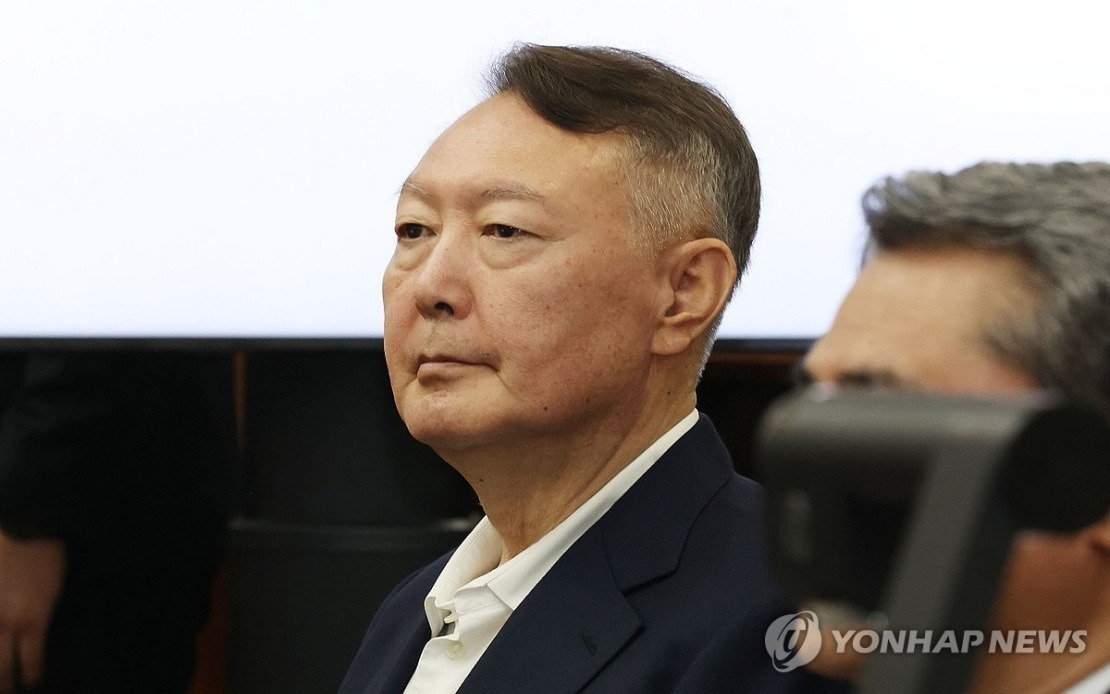
South Korea's former President Yoon Suk Yeol faces a two-year prison sentence after a Seoul court found him guilty of accepting illegal political funds in July, adding to the mounting legal troubles that have engulfed the conservative leader since his presidency ended. The Seoul Central District Court convicted him of violating campaign finance laws by receiving 14 opinion polls worth around 270 million won (approximately US$180,100) without charge from Myung Tae-kyun, a politically connected entrepreneur described by prosecutors as a self-proclaimed power broker. The ruling represents a significant legal setback for the 73-year-old former leader and further entangles him in the complex web of corruption allegations that have dominated Korean political discourse throughout 2024 and into 2025.
The specifics of the case reveal how sophisticated money laundering schemes can operate within political systems. Prosecutors alleged that Yoon and his wife, former first lady Kim Keon Hee, colluded with Myung to receive the polling data between April 2021 and March 2022. The arrangement, according to special counsel Min Joong-ki's investigation team, involved an implicit quid pro quo: Yoon would publicly support former Representative Kim Young-sun's nomination as a parliamentary candidate for the conservative People Power Party in June 2022 by-elections, while Myung provided extensive polling services valued at no charge. This transactional relationship crossed the line from acceptable political networking into what Korean courts viewed as unlawful campaign finance manipulation.
The court's reasoning centered on recognizing that Yoon had indeed received tangible benefits that technically qualified as political funds under Korean election law, even though opinion polls differ substantively from direct cash transfers. The judiciary distinguished between the value of the service provided and its formal classification, determining that free polling constitutes an in-kind contribution requiring disclosure and adherence to campaign finance regulations. The court ordered Yoon to forfeit 13.96 million won in addition to his prison sentence, a financial penalty reflecting the estimated value of the unreported benefit. Meanwhile, Myung Tae-kyun received an 18-month prison term for his role in orchestrating the arrangement, though this fell short of the three-year sentence prosecutors had sought.
Significantly, the conviction diverges sharply from a parallel case involving Yoon's wife, whose acquittal in April by the Seoul High Court created a puzzling inconsistency in the legal treatment of what appeared to be the same underlying conduct. That appellate court determined that Kim Keon Hee could not be considered as having profited from the opinion polls because Myung had distributed similar polling services to numerous other individuals and organizations. The reasoning suggested that widespread distribution of the service somehow negated its character as an illegal campaign contribution, a position the special counsel team contested by appealing the decision. This divergence between Yoon's conviction and his wife's acquittal raises troubling questions about consistency in how Korean courts approach campaign finance violations and whether family members engaged in joint conduct should receive differential treatment.
The verdict must be understood within the broader context of Yoon's extraordinary legal predicament. In February, a separate court had sentenced him to life imprisonment for his role in orchestrating a failed martial law declaration in December 2024, a move that shocked Korean democracy and triggered immediate impeachment proceedings. That conviction for insurrection represents the most serious charge he faces and encapsulates the fundamental questions about Yoon's commitment to constitutional governance. The opinion poll case, while appearing more mundane than the martial law scandal, nonetheless demonstrates a pattern of disregard for legal boundaries that stretches back through his political career. Combined, these convictions paint a portrait of a leader accustomed to operating outside normal political constraints.
For Southeast Asian observers, the Yoon case offers instructive lessons about the fragility of institutional checks on executive power. While South Korea's judicial system ultimately convicted a former president—a demonstration of institutional resilience—the severity of his actions underscores how quickly democratic norms can unravel when political leadership prioritizes its own interests over constitutional principles. Malaysia and other regional nations with histories of political instability can recognize in Yoon's trajectory the dangers of allowing personality-driven politics to supersede rules-based governance. The question haunting Korean democracy is not whether courts will punish Yoon's misconduct, but whether the underlying political culture that permitted such behavior will fundamentally change.
The political dimensions of these trials extend beyond individual accountability to shape South Korea's governance trajectory for years to come. Conservative voters who supported Yoon remain divided between those accepting judicial outcomes and those viewing prosecutions as politically motivated persecution of their preferred leader. This polarization complicates efforts to rebuild public confidence in institutions and move forward. The special counsel team's aggressive prosecution, while legally justified, has intensified perceptions that Korean justice operates within a partisan framework rather than above politics. The difficulty lies in distinguishing between legitimate accountability and politically motivated vendetta when the accused held power and could plausibly portray himself as a victim of opponents' manipulation.
International implications deserve attention as well. South Korea's handling of executive accountability carries symbolic weight within the international community and among democracies grappling with comparable challenges. How the nation manages Yoon's appeals, balances punishment with rehabilitation, and restores democratic norms will influence perceptions of Korean democracy globally. The sentencing also occurs amid broader regional conversations about democratic resilience and the concentration of executive power—issues that resonate across Asia as countries navigate populist movements and institutional pressures.
The road ahead remains uncertain, particularly regarding appeals and the ultimate scope of Yoon's incarceration. Courts have not yet finalized his convictions, and he retains the right to challenge verdicts through appellate processes. The question of whether he will actually serve prison time depends on how appellate courts ultimately rule and whether he might eventually receive a presidential pardon—a possibility that remains politically contentious. What seems clear is that Yoon's political career has effectively ended, regardless of legal outcomes. The former president who campaigned on strong conservatism and restored dignity now faces the prospect of becoming a convicted felon, a trajectory that few observers predicted during his initial presidency.

