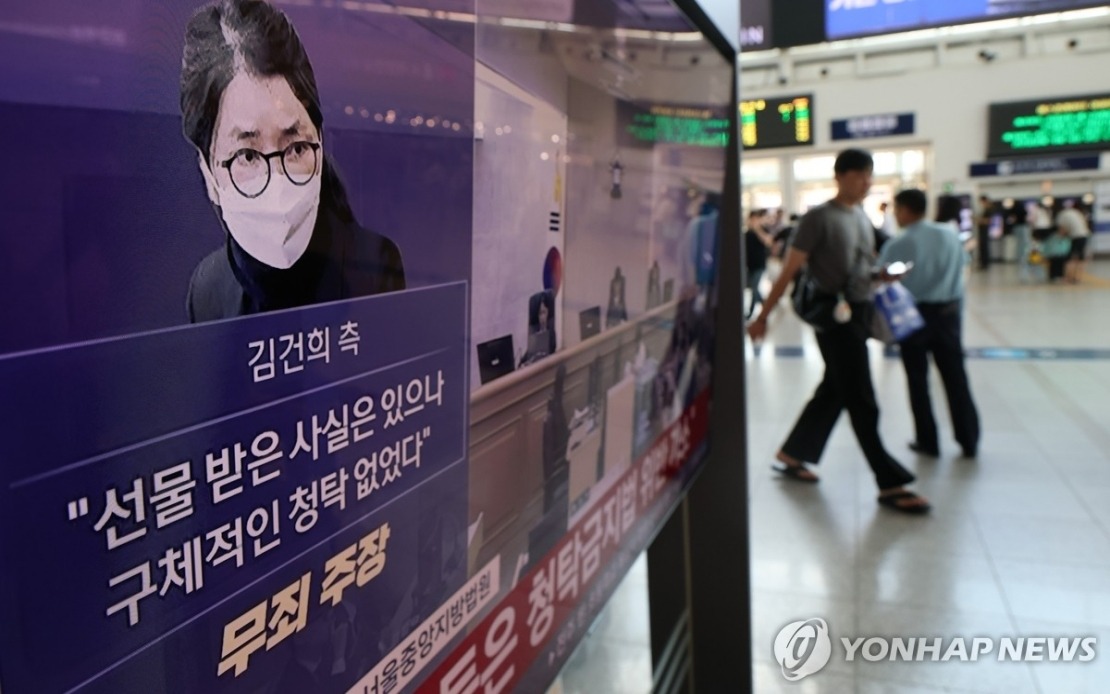
South Korea's former first lady Kim Keon Hee received a seven-year prison sentence from Seoul Central District Court on Friday for systematically accepting expensive gifts in return for securing government positions and advancing the interests of wealthy individuals and corporate figures. The conviction marks a significant development in ongoing corruption investigations affecting the family of ousted President Yoon Suk Yeol, underscoring the persistent tensions surrounding political accountability in the country's governance structures.
The Seoul court found Kim guilty on all charges related to accepting gifts valued at approximately 300 million won throughout her time as first lady. These items included a Van Cleef & Arpels necklace and additional jewellery from a construction company chairman, a Dior handbag worth 5.4 million won, a golden turtle ornament, and a Vacheron Constantin timepiece gifted by various business associates. The exchanges occurred primarily between May 2022 and April 2025, spanning the period when her husband held the presidency until his removal from office.
Presiding Judge Cho Sun-pyo delivered a scathing assessment of Kim's conduct during proceedings that were broadcast live to the public. The judge emphasised that the defendant fundamentally misused the distinguished position of first lady by treating it as a private mechanism for personal enrichment rather than recognising the broader social and institutional responsibilities inherent to that role. This characterisation reflects broader concerns within South Korean society about maintaining integrity within high offices and the public trust vested in presidential families.
One particularly notable transaction involved Kim receiving a valuable Van Cleef & Arpels necklace and other jewellery pieces from a construction company chairman between March and May 2022. In exchange, she facilitated securing a government appointment for the son-in-law of the same corporate executive. Additionally, she accepted a golden turtle ornament in April 2022 from Lee Bae-yong, the former head of the National Education Commission, in return for supporting his appointment to the position. In February 2023, investigations revealed that she had also received a painting by internationally recognised artist Lee Ufan from a former prosecutor, allegedly in return for assisting him in obtaining a nomination for an election.
The court's judgment emphasised that Kim's subsequent attempts to evade accountability demonstrated her complete awareness of the illegality underlying these transactions. She had either returned certain gifts once investigations commenced or falsely claimed personal ownership and purchase of the items in question. Such defensive manoeuvres, the judge noted, constituted compelling evidence that she understood the criminal nature of her actions but deliberately engaged in concealment strategies to avoid detection and prosecution.
Special Counsel Min Joong-ki's investigative team had initially sought a prison term of seven and a half years, making the court's award of seven years a partial vindication of their prosecutorial position. Kim's legal representatives announced their intention to file an appeal, suggesting the case may proceed through additional appellate proceedings that could prolong legal proceedings and potentially modify the sentence. The construction company chairman received a suspended one-year sentence, whilst the businessperson who gifted the watch was given a suspended ten-month term. A pastor involved in one transaction faced a fine of 8 million won rather than incarceration.
This verdict represents merely one chapter in an expanding constellation of legal troubles affecting the former presidential family. Kim had already received a separate four-year prison sentence from an appeals court in a different corruption case, compounding her legal exposure. The accumulation of multiple convictions raises questions about the adequacy of institutional checks and oversight mechanisms governing the conduct of high-ranking officials and their spouses within South Korea's political system.
Additionally, Kim faces forthcoming trial proceedings regarding alleged involvement in a separate scandal involving the Unification Church. Investigations suggest that church members were allegedly coerced into joining the Democratic Party, now the main opposition force, ahead of the 2022 presidential election. The purported objective was manipulating the party's primary election to favour her husband Yoon's presidential candidacy, which he ultimately secured. This additional legal battle raises concerns about potential electoral interference and the boundaries between political campaigning and institutional abuse.
For Malaysian and regional observers, the Kim Keon Hee case illuminates persistent vulnerabilities within even established democracies regarding corruption involving state actors and their families. South Korea, despite its reputation for institutional development and legal frameworks, has witnessed multiple scandals involving presidential spouses utilising their positions for personal gain. The case underscores that corruption risks extend beyond traditional Asia-Pacific political narratives, affecting countries across the region regardless of development status. The transparency and eventual prosecution mechanisms demonstrated in South Korea's judicial response, whilst imperfect, reflect institutional capacity that requires continuous reinforcement to maintain public confidence in democratic governance and the rule of law.

