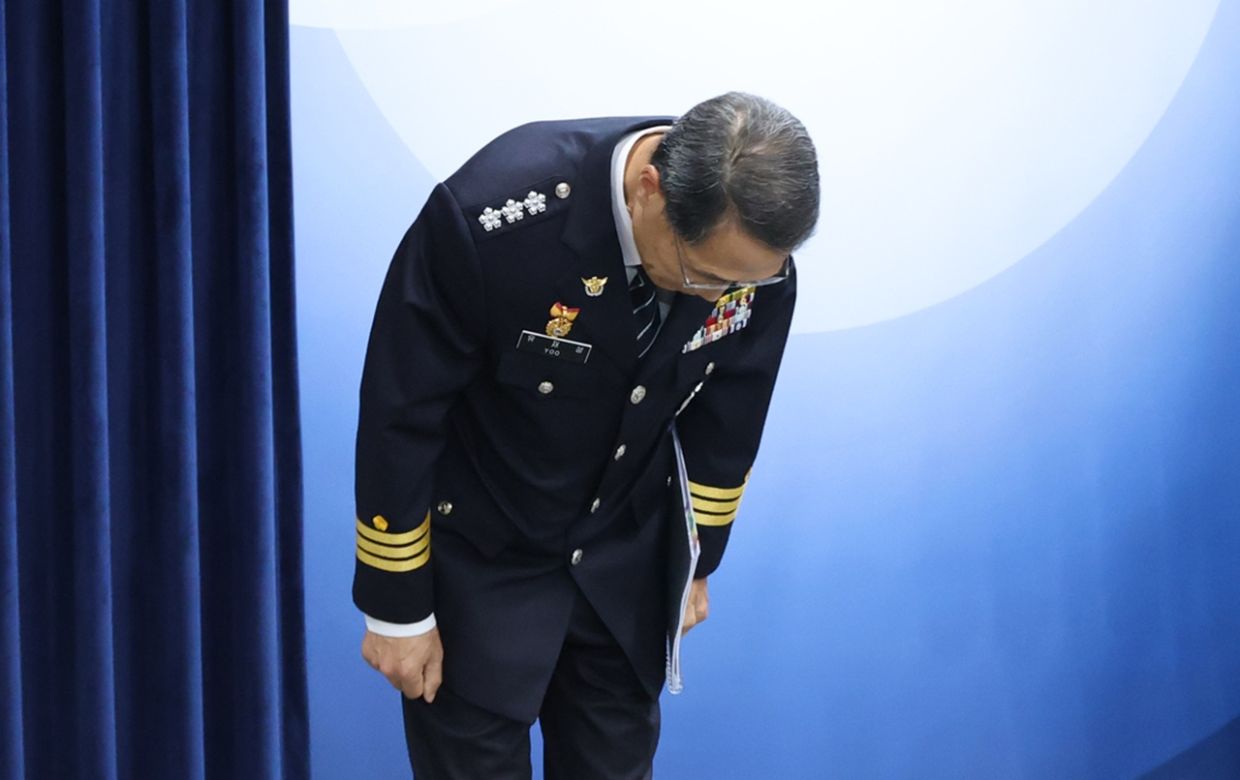
South Korea's police force faces a critical test of institutional accountability after the country's acting National Police Agency Commissioner General, Yoo Jae-sung, announced a sweeping reform package designed to address allegations of investigative misconduct and improper ties between officers. The initiative comes in response to mounting public anger over the handling of a case involving suspect Jang Yoon-gi, who was arrested for the alleged murder of a teenage girl in Gwangju in May, with investigators accused of leaking sensitive information to the suspect's father—himself a serving police officer—and failing to preserve crucial evidence.
The scandal has exposed deep systemic vulnerabilities within South Korea's law enforcement apparatus, particularly regarding how cases involving socially vulnerable populations are managed and how hierarchical relationships can compromise investigative integrity. At a press briefing on July 20 at the Government Complex Seoul, Yoo acknowledged the severity of public concerns and framed the current crisis as a potential inflection point for institutional renewal. He declared that the police would harness this moment to fundamentally restructure their investigative methodologies and rebuild eroded public confidence through concrete institutional changes rather than rhetorical commitments alone.
The centrepiece of the proposed reforms involves establishing an investigative reform task force by the end of July, a body deliberately designed to incorporate independent expertise and outside perspectives that have traditionally been absent from police internal review mechanisms. The task force will comprise seven to ten members, with external experts comprising more than half of the panel, ensuring that recommendations emerge from a genuinely pluralistic rather than self-interested institutional viewpoint. This structural choice addresses a fundamental problem identified in the Jang case: the tendency of internal police investigations to prioritise organisational protection over genuine accountability and public interest.
Simultaneously, the National Police Agency plans to establish an internal affairs investigation unit operating under the separate National Office of Investigation, creating a degree of institutional distance that may insulate serious misconduct inquiries from protective networks within the police hierarchy. This unit will possess authority to investigate significant duty-related crimes allegedly committed by police personnel regardless of rank—a provision that represents a departure from traditional Korean policing culture, where seniority has historically provided informal immunity from rigorous scrutiny. The willingness to investigate officers at all levels signals recognition that institutional problems are not confined to junior ranks but may reflect systemic patterns requiring structural intervention.
Perhaps most significantly, the proposed reforms contemplate creating a new civilian oversight body under the Korean National Police Commission, comprising approximately 100 civilian investigators tasked with examining allegations of human rights violations and investigative misconduct. Yoo emphasised that this body's effectiveness depends on legislative revision of the Police Act, with a related amendment already submitted to the National Assembly. The commissioner stressed that for such oversight to generate meaningful consequences rather than remaining symbolic, the body's investigative findings must carry weight sufficient to trigger personnel actions and disciplinary measures—a recognition that oversight without enforcement capacity becomes merely performative.
The civilian oversight proposal addresses a structural flaw that became apparent in the Jang case: the absence of truly independent mechanisms to hold police investigations accountable to standards of procedural fairness and evidentiary integrity. In Malaysian and broader Southeast Asian contexts, such institutional weaknesses remain endemic to police systems across the region, making South Korea's attempt to introduce civilian oversight particularly instructive. The proposition that citizens rather than police hierarchies should ultimately evaluate investigative conduct represents a philosophical shift toward democratic accountability over organisational autonomy—an orientation not universally embraced across regional policing systems.
Beyond investigative architecture, the reform package addresses a complementary problem: the structural conditions that enabled collusion between Jang's father and investigating officers. The task force will examine personnel reform mechanisms aimed at preventing improper ties between officers and local communities, recognising that investigative misconduct often flows from networks of personal loyalty and mutual obligation rather than explicit corruption. Additionally, the reforms will target improvements to procedures specifically governing how cases involving socially vulnerable populations—like the teenage victim in the Gwangju case—receive investigative attention and resource allocation.
Yoo's acknowledgment that the police would "faithfully carry out duties without clinging to position" served as an implicit rebuke to those expecting his resignation, a response that may strike some as insufficiently contrite given the scandal's severity. However, it also signalled determination to implement reforms from within rather than cede control to external actors—a pragmatic recognition that institutional change requires sustained engagement from committed insider advocates. The commitment to engage rank-and-file officers before implementing Interior Ministry plans to expand the police rotation system demonstrated sensitivity to operational realities; nationwide rotations at superintendent level already impose administrative burdens, and expanding such systems to lower ranks would generate substantial costs and practical difficulties.
The rotation system expansion raises questions about resource allocation and fairness that extend beyond policing into broader government personnel management. Currently, official residences accompany transfers for superintendents and above, yet extending this benefit to lower ranks would require substantially increased budgetary allocation at a time of fiscal constraint. Yoo's acknowledgment that any rotation expansion must balance public trust restoration with officer welfare suggests recognition that institutional reforms risk undermining morale if they impose unreasonable burdens on personnel already working under significant stress.
Regarding Jang's father specifically, the police indicated they would defer concluding their internal inspection until the special investigation team reached final conclusions, a procedural approach that protects the integrity of parallel investigations. This measured stance contrasts with the urgency surrounding implementation of broader systemic reforms, suggesting differentiation between individual accountability processes and structural institutional change. The distinction matters: while individual cases may resolve through conventional disciplinary channels, systematic vulnerabilities require deliberate redesign of organisational architecture.
For Malaysian observers and policymakers across Southeast Asia, South Korea's struggle with police institutional reform offers both cautionary and instructive lessons. The Jang case demonstrates how hierarchical organisational cultures combined with inadequate oversight mechanisms can undermine investigative integrity even in relatively developed democracies with significant institutional resources. The emphasis on civilian participation in oversight bodies, the creation of investigative units insulated from protective networks, and the explicit codification of procedural protections for vulnerable populations represent responses that acknowledge policing as fundamentally affecting public trust and social stability.
The success of South Korea's reform package ultimately depends on sustained political support, adequate resource allocation, and willingness to tolerate genuine independence of newly created oversight mechanisms rather than gradually incorporating them into existing hierarchies. Whether civilian investigators will genuinely challenge police conduct or gradually become absorbed into protective networks remains an open question. Nonetheless, the explicit commitment to transparency, external expertise, and personnel accountability establishes institutional frameworks within which pressure for meaningful change can operate—structures that remain aspirational rather than established in many regional jurisdictions.

