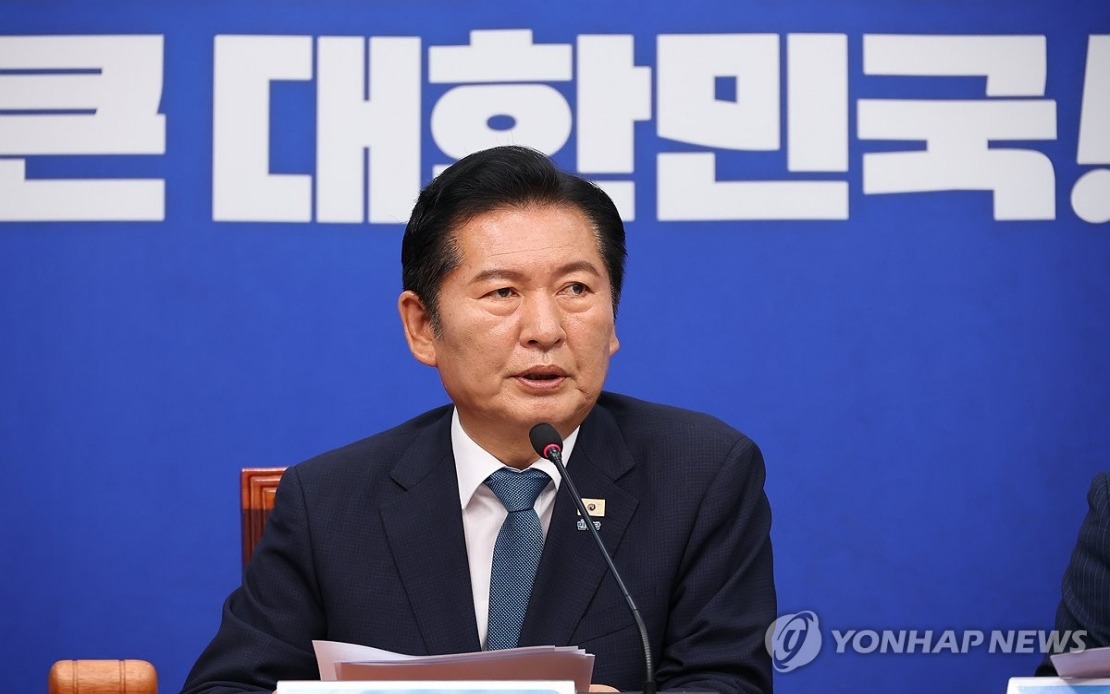
Jung Chung-rae, a veteran South Korean lawmaker, has stepped down from his position as chairman of the ruling Democratic Party, a manoeuvre widely interpreted as strategic positioning ahead of the party's national convention scheduled for August 17. The resignation was announced during a meeting of the party's supreme council at the National Assembly in Seoul, marking a significant moment in South Korea's political landscape as the party navigates internal power struggles and questions about its direction under President Lee Jae Myung's administration.
In his statement to party colleagues, Jung reflected on his tenure with measured language that underscored his commitment to party unity. He acknowledged the personal toll of his leadership, describing sleepless nights spent in introspection about his political trajectory and tenure as chairman. His remarks suggested someone attempting to reframe his departure as a principled decision rather than a forced exit, setting the tone for what is likely to be a contentious campaign season within the party structure.
Central to Jung's explanation was his assertion that he had consistently backed President Lee's administration and worked to align the party, government, and presidential office as a cohesive unit. This emphasis on loyalty appears designed to counter narratives that have emerged from within the party questioning his leadership approach. Jung acknowledged the difficulties he faced, referring obliquely to resistance from both internal party factions and external critics, yet framed his tenure as one of quiet perseverance in pursuit of party interests.
The resignation arrives amid growing tension between Jung and pro-Lee party members who argue that his leadership style prioritizes his own political base over collaboration with the president on major policy matters. This faction has questioned whether Jung has been sufficiently aligned with Lee's agenda, suggesting that party leadership should reflect the president's political priorities more directly. Such internal divisions are not uncommon in South Korean politics, where party hierarchies often mirror deeper ideological and factional differences that date back years.
The August convention is shaping into a complex three-way contest that will significantly impact South Korea's political direction. Prime Minister Kim Min-seok, positioned as a trusted ally of President Lee, is expected to be a major contender. His candidacy represents continuity with the presidential agenda and appeals to those seeking stronger executive-legislative coordination. Song Young-gil, a former DP leader, is also preparing to enter the race, having indicated to the president his intention to participate. Park Jie-won, a DP lawmaker, disclosed during an interview with CBS radio that Song has contemplated potentially aligning his candidacy with Kim's, suggesting the possibility of strategic consolidation among anti-Jung forces.
Jung's departure creates a power vacuum that raises important questions about the party's identity and priorities. His resignation means that DP floor leader Han Byung-do will assume the role of acting party leader until the convention, a transition that could affect legislative strategy and party messaging in the coming weeks. This interim arrangement places Han in a delicate position, as he must maintain party cohesion while factional candidates prepare their campaigns.
For Malaysian and Southeast Asian observers, this Korean political development offers insights into the dynamics of ruling coalitions in democratic systems across the region. The tension between a party chairman and a president reflects broader questions about power distribution within governing coalitions. In Malaysia's own political context, where party leadership and prime ministerial authority sometimes diverge, the South Korean experience demonstrates both the opportunities and challenges such arrangements present.
The Democratic Party's internal struggles also illuminate how political parties navigate between supporting presidential initiatives and maintaining independent institutional interests. Jung's emphasis on his loyalty to Lee, combined with criticism that he has not been sufficiently responsive to presidential direction, reveals the thin line between maintaining party autonomy and subordinating party interests to executive preferences. This balance is crucial in any parliamentary or semi-presidential system where party health directly affects government stability.
Looking ahead to the August convention, the election outcome will likely determine whether the Democratic Party consolidates around presidential priorities or maintains a more independent institutional voice. A victory for Kim or a Kim-Song alliance would suggest party realignment toward closer executive coordination. Conversely, Jung's re-election would signal that party members value his more autonomous approach to leadership, potentially creating renewed friction with the presidential office.
The broader political implications for South Korea extend beyond internal party mechanics. The strength and direction of the ruling party significantly affects President Lee's ability to execute his agenda and manage legislative relationships. A united, presidential-aligned party provides greater capacity for governing, while factional division complicates policy-making and can enable opposition obstruction. For regional stability, smooth executive-legislative relations in major economies matter considerably, as political dysfunction can sometimes translate into unpredictable foreign policy directions.
Meanwhile, the Democratic Party's upcoming contest occurs against the backdrop of broader public concerns about South Korea's economic performance, security challenges on the Korean peninsula, and social polarization. Party leadership will need to demonstrate not just internal competence but also relevance to voter concerns. The August convention will reveal whether the ruling party views this leadership transition primarily through factional lenses or whether it has genuinely grappled with public expectations and policy priorities.