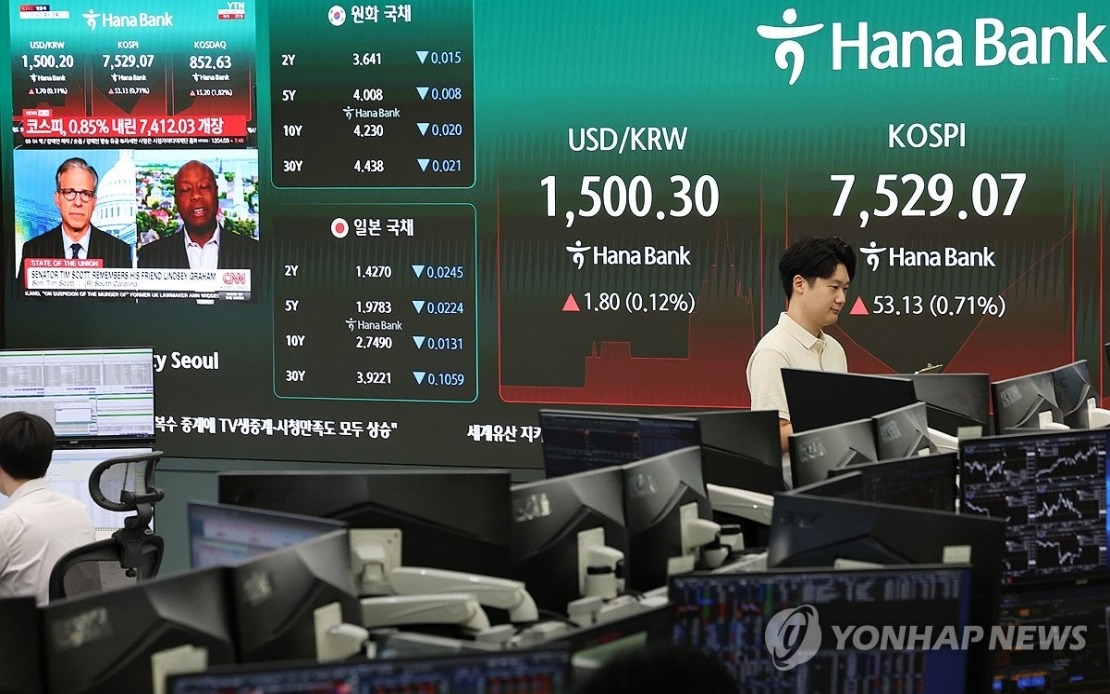
The Korea Exchange triggered a marketwide circuit breaker during afternoon trading on Monday as investor confidence eroded following a sharp sell-off in the benchmark Korea Composite Stock Price Index. Trading in KOSPI-listed equities was suspended for twenty minutes following the index's dramatic descent, marking the seventh time this year that such automatic safeguards have been deployed to prevent panic-driven market volatility.
The circuit breaker mechanism activated shortly after 1:28 p.m. local time, when the KOSPI fell more than 8 percent from the previous day's closing level. This threshold-based halting system represents a critical stabilisation tool employed by stock exchanges across the region to allow investors a moment to reassess positions during periods of heightened uncertainty. The automatic suspension provides market participants with breathing room to digest news flows and recalibrate their investment strategies rather than succumbing to immediate reactive selling.
Understanding the frequency of circuit breaker activations offers insight into the volatility pressures confronting Asian equity markets this year. Seven triggers through mid-July suggests that South Korea's stock market has faced multiple episodes of significant disruption, each stemming from distinct external shocks. This pattern reflects the interconnected nature of global capital flows and the sensitivity of export-dependent economies to geopolitical disturbances that threaten international commerce and stability.
The immediate catalyst for Monday's decline centred on renewed military posturing between Washington and Tehran over control of critical maritime passages. The Strait of Hormuz, through which roughly one-fifth of globally traded petroleum transits, represents a strategic chokepoint whose security directly impacts energy prices and supply chain reliability worldwide. When tensions spike in this region, investors across Asia brace for potential disruptions to fuel supplies, elevated shipping costs, and broader economic headwinds that could constrain growth trajectories.
For Malaysia and other Southeast Asian nations, developments affecting Persian Gulf stability carry outsized significance beyond their geographic distance. The region's heavy reliance on Middle Eastern crude oil means that any escalation threatening Hormuz traffic immediately pressures import costs and government energy budgets. Additionally, Malaysian manufacturers and traders operating within global supply chains worry that geopolitical friction could trigger fresh logistical complications and price volatility in raw material procurement.
The sell-off witnessed on South Korea's exchange reflected a broader regional pattern visible across Asian markets when geopolitical risk spikes. Investors typically shift capital toward perceived safe havens, reducing equity allocations and concentrating positions in defensive assets or developed markets deemed less vulnerable to external shocks. This flight-to-safety dynamic, while individually rational from each market participant's perspective, creates self-reinforcing downward pressure on equity valuations across emerging and developed Asian bourses.
South Korea's economy demonstrates particular vulnerability to energy price shocks given its minimal domestic petroleum reserves and substantial manufacturing base requiring stable electricity and fuel availability. The nation's major conglomerates, including companies in semiconductors, automotive, and petrochemicals, maintain complex international supply networks that function optimally only under conditions of predictable energy costs and shipping reliability. Extended periods of elevated Hormuz tensions therefore threaten not merely stock valuations but underlying corporate profit trajectories.
The circuit breaker system itself, while effective in halting panic selling, raises questions about market efficiency and price discovery during crisis periods. Some market participants argue that artificial trading halts merely delay inevitable repricing of risk, while others contend they provide essential circuit breaks preventing cascading sell-offs that bear no relationship to underlying fundamentals. The seventh activation this year suggests the KRX considers such safeguards justified given the frequency of external shocks buffeting equity markets.
Looking forward, investors across the region should anticipate continued sensitivity to geopolitical developments affecting energy security and maritime trade routes. The structural importance of Middle Eastern petroleum to Asian economies ensures that Strait of Hormuz tensions will remain a recurring source of market volatility. Malaysian investors holding exposure to South Korean equities or operating businesses dependent on regional trade flows should monitor not merely the circuit breaker triggers themselves but the underlying catalysts driving such volatility, as these point toward systemic risks extending well beyond stock exchange mechanics.

