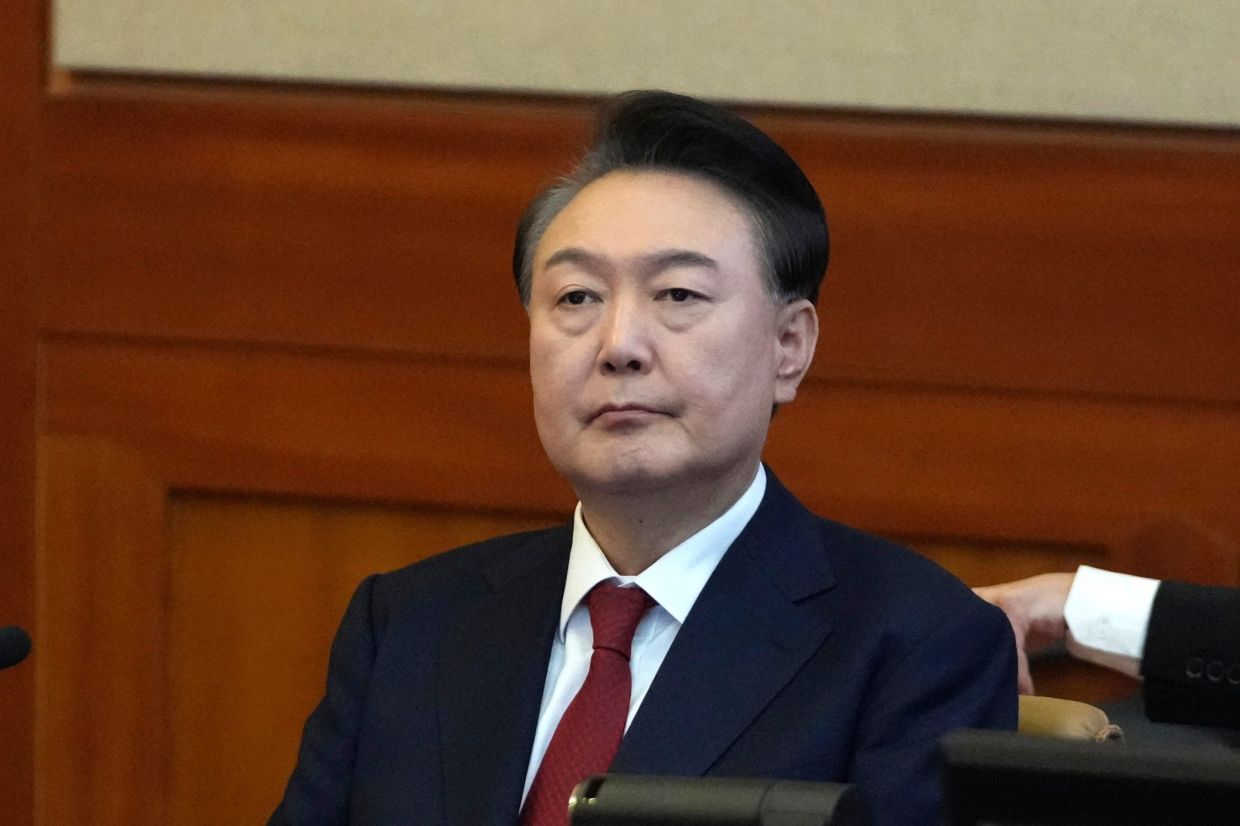
South Korea's Supreme Court has affirmed a seven-year prison sentence imposed on former president Yoon Suk Yeol for offences stemming from his bungled martial law declaration in December 2024, marking another significant legal defeat for the embattled ex-leader who remains incarcerated while facing multiple convictions. The court's final ruling, delivered on Thursday (July 9), closed off the last avenue of appeal in this particular case, with judges rejecting arguments from both the prosecution, which had sought a ten-year term, and Yoon's legal representatives.
The litany of accusations against Yoon in this case revealed the extent to which his martial law declaration involved systematic efforts to circumvent normal constitutional procedures. Prosecutors and courts found that Yoon had deliberately circumscribed cabinet consultations by assembling only a hand-picked group of ministers before announcing martial law, thereby obstructing the full deliberative process mandated by law. He was also convicted of orchestrating the creation of a fraudulent martial law decree that bore forged signatures purportedly from the prime minister, a document designed to lend spurious legitimacy to the extraordinary power grab.
Beyond the initial declaration itself, Yoon's conduct in the hours and days following the announcement demonstrated consciousness of wrongdoing. Prosecutors proved that he issued misleading statements to international media outlets, apparently seeking to control the narrative before the global audience, whilst also ordering military officials to expunge records from secure communication systems—actions prosecutors characterized as obstruction of justice. Furthermore, when lawmakers convened in emergency session and moved to nullify the martial law order, Yoon deployed presidential security personnel to impede his own arrest, an act that compounded the original constitutional violation with active resistance to lawful authority.
The judicial timeline reveals the consistency with which courts, moving from lower levels to the appellate system and finally to the Supreme Court, assessed the evidence and determined guilt. A district court initially sentenced Yoon to five years in January after convicting him on the majority of charges. In April, the appeals court not only upheld this conviction but added a guilty verdict on the charge of disseminating false information to international media and increased the sentence to seven years. When both sides appealed to the Supreme Court—the final arbiter in South Korean law—the bench found no errors in the lower courts' reasoning, signalling broad institutional consensus about Yoon's culpability.
Yoon's legal team responded to the Supreme Court's dismissal of their appeal with statements of "deep regret," contending that the judiciary had failed to conduct sufficiently thorough deliberation before reaching its conclusion. They announced plans to challenge the ruling on constitutional grounds and indicated they would lodge formal complaints, moves that suggest they intend to exhaust remaining procedural avenues, though the Supreme Court's decision is technically final within the criminal justice system. This defiant posture mirrors Yoon's broader refusal to acknowledge the legitimacy of the courts' findings, positioning himself as a victim of political persecution rather than a former executive whose actions violated constitutional norms.
The December 2024 late-night televised address in which Yoon announced martial law shocked a nation that had not experienced such a suspension of civilian governance since South Korea's democratic transition. The declaration itself lasted merely six hours, as lawmakers demonstrated the resilience of parliamentary institutions by rushing to convene in emergency session and voting overwhelmingly to nullify Yoon's order before his emergency powers could take effect. Yet this brief window proved consequential—it triggered widespread public protests, sent financial markets into sharp decline, and surprised key international partners including the United States, who found themselves caught unprepared by the constitutional crisis.
Yoon remains simultaneously imprisoned on conviction for multiple offences related to the martial law episode. In a separate case, a court sentenced him to thirty years in prison for allegedly flying drones into North Korean airspace to "manufacture" a security crisis that would justify his martial law declaration—a finding that suggested Yoon's actions were not merely a spontaneous constitutional aberration but part of a calculated strategy. The ex-president has consistently maintained that his martial law decree was motivated purely by national interest and was necessary to eliminate what he characterized as "anti-state forces" and respond to purported threats emanating from North Korea. These justifications have found no traction with the judiciary, which assessed his actions as unlawful regardless of his purported motives.
The political consequences of Yoon's failed power grab extended well beyond his own legal jeopardy. The martial law crisis precipitated his removal from office in April 2025—less than four months after the ill-fated declaration—triggering presidential elections that fundamentally altered South Korea's political landscape. Voters delivered the presidency to Lee Jae Myung of the centre-left Democratic Party, marking a substantial shift in the country's political direction and arguably serving as a popular repudiation of Yoon's conservative stewardship and his final, desperate constitutional gambit. The transition also left questions about South Korea's institutional stability, given how close the nation came to losing democratic rule even temporarily.
For Malaysian observers and Southeast Asian analysts, South Korea's experience offers instructive lessons about the fragility of constitutional governance and the critical importance of institutional checks that can rapidly counteract unconstitutional power seizures. Unlike some comparable scenarios in the region, South Korea's parliament acted decisively to halt the executive overreach, lawmakers were willing to convene in emergency conditions, and the judiciary proceeded to hold the former president criminally accountable through ordinary legal mechanisms. The cases against Yoon demonstrate that modern democracies possess institutional remedies for constitutional violations, though the reputational damage to democratic institutions and the broader political crisis remain substantial even after legal resolution.
The Supreme Court's final affirmation of Yoon's conviction also underscores the importance of an independent judiciary willing to reject arguments from powerful former executives. The courts rejected Yoon's defence strategies at multiple levels and found no basis to overturn lower court findings, suggesting that despite Yoon's continued assertions of innocence and claims of unfair persecution, the South Korean judicial system maintained institutional integrity throughout the proceedings. However, the case remains politically contentious, with Yoon's supporters continuing to question the courts' impartiality and the broader question of whether South Korea's constitutional system emerged stronger or weaker from the crisis remaining subjects of ongoing debate within the nation.

