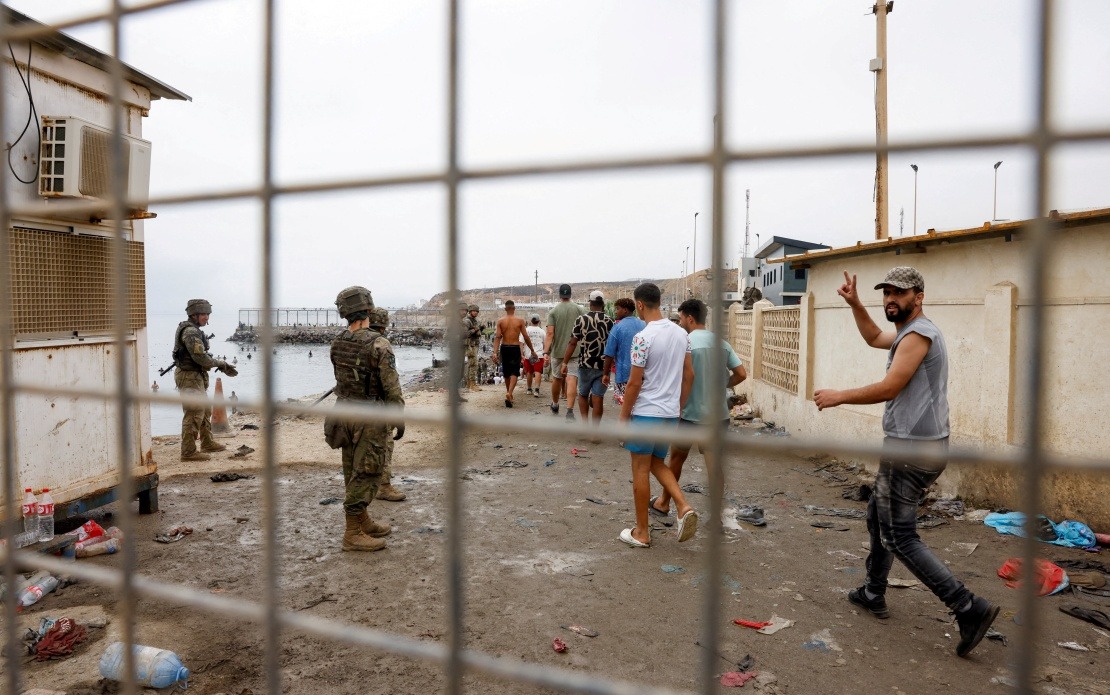
The Spanish government moved swiftly to contain the narrative surrounding a sudden migration surge into Ceuta, asserting that the crisis had largely resolved itself through voluntary returns to Morocco. Foreign Minister Jose Manuel Albares took to social media on Friday to declare that the situation had stabilised, characterising widespread reporting as deliberate distortion aimed at undermining public confidence in Spain's border management capabilities. His statement came as authorities worked to process the thousands of arrivals that had occurred over the preceding day.
The spike in crossings created significant logistical challenges within Ceuta, the small Spanish enclave perched on Morocco's northern coast. Basic services quickly became overwhelmed as the influx taxed the city's commercial infrastructure. Supermarkets, shops, and restaurants found themselves unable to meet the sudden demand, leading many of the newly arrived migrants to reconsider their situation. The lack of adequate provisions, combined with swift Spanish administrative action, encouraged substantial numbers to reverse their journey and return across the Moroccan border.
Authorities deployed significant security resources to manage the situation and prevent further maritime incursions. The Civil Guard and Spain's Army Regulares Group No. 54 were positioned strategically along Tarajal beach to intercept boats attempting to ferry additional migrants across the water. This show of force served dual purposes: deterring further sea crossings while demonstrating to the Spanish public that the government retained operational control over its borders. The military presence underscored Madrid's determination to prevent a repeat of the unprecedented movement that had caught officials somewhat unprepared.
The bilateral repatriation agreement between Spain and Morocco played a crucial role in facilitating the return of migrants. This diplomatic framework, forged through years of negotiation between the two neighbours, enabled relatively rapid processing of those willing to leave Ceuta voluntarily. The existence of such structured channels—even amid political tensions—highlighted the practical necessity of cooperation on migration matters in the Mediterranean region. For Malaysian observers, this bilateral approach mirrors regional mechanisms elsewhere, including discussions among ASEAN nations on managing irregular movement.
Albares emphasised that Ceuta's status as part of the Schengen Area remained intact and that cross-border movement to mainland Spain remained strictly controlled through police checkpoints. His assertions were designed to reassure both Spanish citizens and other European Union partners that the migration incident had not created a backdoor into the bloc. The integrity of Schengen—a foundational principle of free movement within the EU—represented a matter of considerable political sensitivity, and Madrid wanted to dispel any suggestion that this crisis had compromised European border security architecture.
The government's rhetorical framing of events proved significant. Prime Minister Pedro Sanchez characterised the mass arrival not as a humanitarian or migration issue but explicitly as a security breach, describing it as "an attack" and "a violation of Spain's territorial integrity." This language elevated the incident beyond routine border management and positioned it within a national security framework. Such securitisation of migration challenges has become increasingly common across Europe, reflecting broader political anxieties about sovereignty and control. Sanchez pledged rapid restoration of normalcy, signalling to voters that the government maintained command over events.
The death toll associated with the broader migration crisis cast a darker shadow over the Ceuta incident. Spanish authorities confirmed that at least 57 people had perished during migration attempts in the region. These fatalities underscored the lethal risks inherent in irregular migration routes across the Mediterranean and through North African transit zones. The tragic human cost of migration pressure, often invisible in policy discussions focused on border integrity, represented the genuine stakes underlying disputes about territorial sovereignty and movement rights.
For Southeast Asian governments and observers, the Ceuta episode offered several instructive lessons. The region faces its own migration pressures stemming from economic disparities, political instability, and climate-driven displacement. Malaysia, as a major receiving country for irregular migrants and asylum seekers, operates within similarly constrained circumstances. The Spanish approach—combining enforcement, diplomatic negotiation, and managed processing—reflected pragmatic choices that acknowledge both the reality of migratory pressure and the political imperatives of maintaining public confidence in state capacity.
The speed with which the situation stabilised raised questions about whether the initial surge represented a coordinated movement, a spontaneous opening, or something more deliberately orchestrated. Some analysts suggested Moroccan authorities might have permitted or facilitated the crossing as a pressure tactic in bilateral relations with Spain. Such possibilities reminded policymakers that migration flows often become entangled with diplomatic leverage and bilateral tensions. Understanding migration as potentially weaponised or instrumentalised represents an uncomfortable but necessary dimension of contemporary border politics.
Spain's rapid messaging campaign sought to restore confidence in its institutional capacity precisely when critics might have questioned governmental competence. By asserting near-total resolution of the crisis and dismissing reports of institutional failure, Madrid attempted to regain narrative control. However, the incident had exposed vulnerabilities in Ceuta's defences and raised persistent questions about how external shocks to border stability might recur. For the broader Mediterranean region and Europe's southern frontier, the episode suggested that migration pressure remained a dynamic and unpredictable challenge capable of overwhelming even developed nations' administrative systems.

