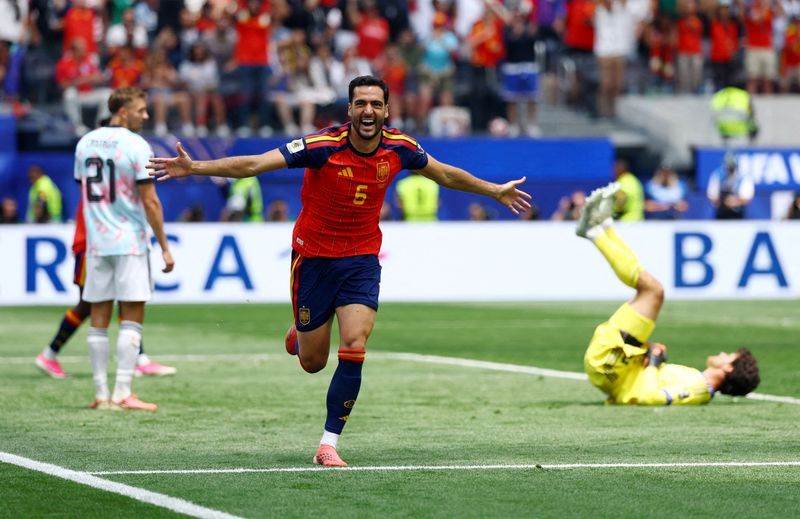
Spain advanced to the World Cup semi-finals with a 2-1 quarter-final victory over Belgium on Friday at Los Angeles Stadium, courtesy of a moment of individual brilliance from substitute Mikel Merino that proved decisive in a tightly contested encounter. Merino, introduced in the 86th minute, capitalised on a goalkeeping error to snatch the winner just moments after taking the field, delivering Spain a passage to Dallas where they will confront tournament favourites France on Tuesday in a compelling last-four clash.
The pivotal moment came when Belgian goalkeeper Senne Lammens, thrust into the action after Thibaut Courtois suffered an injury during the match, failed to properly secure a low effort from Pau Cubarsi. The ball squirted loose in front of the goalkeeper, affording Merino the simplest of opportunities to finish and seal Spain's progression. The sold-out crowd, predominantly Spanish supporters enduring the intense Los Angeles heat, erupted in celebration as the ball nestled in the net.
Spain had taken the lead midway through the first half when Paris St Germain midfielder Fabian Ruiz capitalised on a goal-mouth scramble to fire past Unai Simon. The Spanish midfielder's strike came moments after Courtois had produced an outstanding diving save, leaving the Belgian keeper unable to gather the rebound cleanly. Ruiz's finish vindicated coach Luis de la Fuente's tactical gamble to start the midfielder in place of Pedri, a decision that initially raised eyebrows among observers but demonstrated the manager's confidence in his selection.
Belgium quickly equalised through Charles De Ketelaere, whose perfectly timed run allowed him to meet Timothy Castagne's cross with a precise header that found the far corner. The goal marked the first time Spain had conceded in the tournament, underlining Belgium's capacity to remain competitive despite significant personnel constraints heading into the contest. The equaliser breathed considerable life into the Belgian camp as both teams contested the remainder of the half in oppressive conditions.
Belgium's task was considerably complicated by injuries that decimated their squad availability. Captain Youri Tielemans was withdrawn from the starting lineup shortly before kickoff after sustaining a warm-up injury, forcing manager Domenico Tedesco to deploy Hans Vanaken in his stead. More significantly, the absence of midfielder Amadou Onana, sidelined by a serious anterior cruciate ligament injury sustained during their previous knockout victory over the United States, removed crucial defensive steel from the Belgian midfield.
Spain emerged from the interval with renewed intensity and purpose. The European champions controlled possession with characteristic precision whilst maintaining constant pressure on a Belgian defence increasingly stretched by the attacking impetus. Young winger Lamine Yamal, the tournament's electrifying 18-year-old talent, proved a constant menace down the flank, stretching the Belgian backline and creating space for Spain's attacking players to operate. The accumulating pressure proved relentless as Spain methodically dismantled their opponents' defensive shape.
Merino's clinical finish completed a remarkable personal tournament narrative. The attacking midfielder has now achieved an unprecedented feat in World Cup history, becoming the first player ever to score the winner in two separate knockout stage matches whilst operating as a substitute. His previous such contribution came in Spain's opening knockout victory against Portugal, where he demonstrated the same predatory instinct and composure under pressure. His post-match comments reflected the confidence of a player executing his role with precision: "If you go into a match well-prepared, things tend to happen again," Merino remarked, underscoring the importance of meticulous preparation.
Belgium's veteran contingent of Kevin De Bruyne and Romelu Lukaku battled valiantly in search of a second equaliser, creating occasional attacking opportunities that threatened Spain's composure. However, the numerical disadvantage imposed by injuries and a Spain team that had found their rhythm proved insurmountable. Despite some late pressure and promising moments, Belgium could not breach the Spanish defence with sufficient conviction to force extra time.
Spain's progression represents a significant statement of tournament intent. The Iberian side last reached a World Cup semi-final in 2010, when they ultimately triumphed to claim the trophy. Should they overcome France—itself navigating a demanding knockout pathway—Spain would position themselves favourably for a return to the final. De la Fuente acknowledged the magnitude of the challenge ahead: "We're going to work hard to try and beat France. They'll be just as worried as we are," the manager said, demonstrating measured optimism tempered by respect for their formidable opponents.
The semi-final encounter between Spain and France carries profound implications for European football at this competition. France, despite their status as tournament favourites, have navigated their own testing route through the knockout rounds. Spain's electric attacking football, predicated on possession control and technical precision, will present a markedly different tactical challenge to that experienced by previous French opponents. The geographic setting in Dallas will provide neutral ground, yet Spanish supporters' presence throughout North America suggests a potential emotional advantage.
Merino's performance encapsulated Spain's broader tournament philosophy: structured, patient build-up play punctuated by clinical finishing when opportunities materialise. His readiness to capitalise instantly upon entering the contest reflects meticulous preparation and football intelligence that characterises Luis de la Fuente's squad. As Spain prepare for their semi-final encounter, the momentum generated by Friday's victory provides psychological impetus heading into one of football's most significant fixtures.
The celebrity presence at Los Angeles Stadium—including musicians Courtney Love and Noel Gallagher, American actor Brad Pitt, and Spanish thespians Penélope Cruz and Javier Bardem—underscored the tournament's global cultural resonance. Yet beyond the glamour, Spain's methodical progression through the knockout stages confirms their status as serious contenders capable of winning the competition. With two matches separating them from ultimate glory, Merino's predictable capacity to deliver in decisive moments suggests Spain possess the talent and temperament to realise their ambitions.

