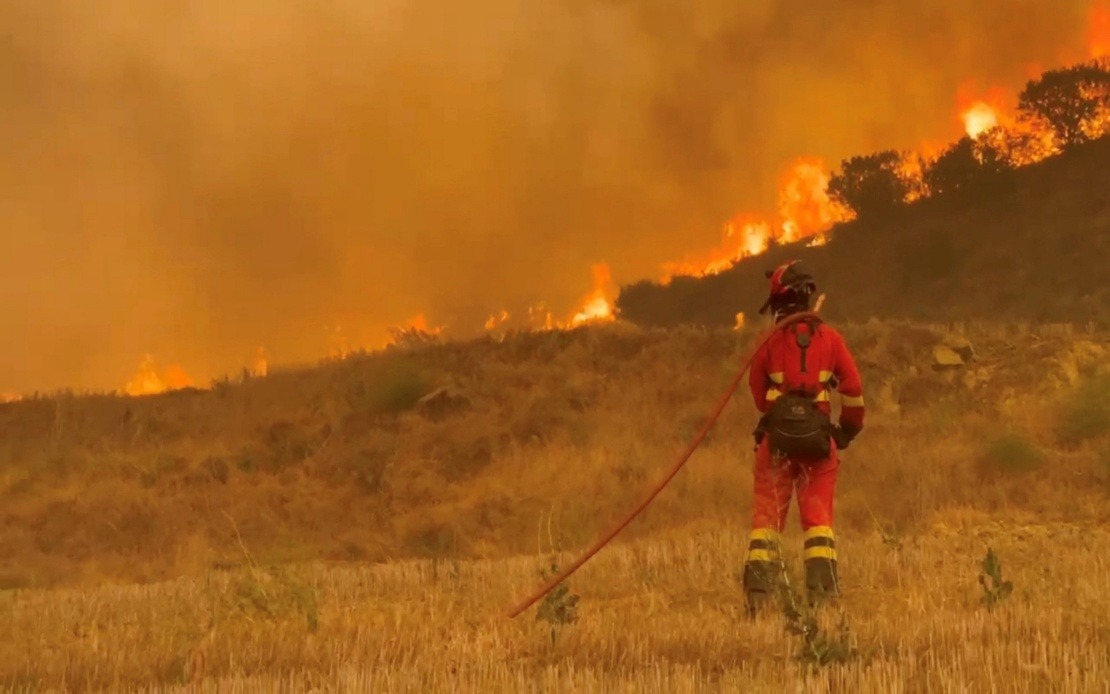
Spain is grappling with its most severe wildfire crisis in recent months, with the Cinco Villas region in northeastern Zaragoza province ablaze after a fire erupted on Wednesday. The disaster has consumed approximately 12,000 hectares of land, making it the nation's largest fire outbreak this year, and has triggered the displacement of more than 1,100 residents from surrounding communities. The rapidly spreading inferno remains largely uncontrolled, with emergency services warning that conditions deteriorated significantly overnight into Friday as the flames continued their destructive march across the landscape.
The fire's reach extends across a perimeter spanning roughly 60 kilometres, demonstrating the sheer scale of the emergency that has overwhelmed regional resources. Six municipalities—five within Zaragoza and one in the adjoining province of Navarre—have been evacuated as a precautionary measure, with authorities maintaining strict lockdown protocols in the most vulnerable areas. The intensity of the blaze has necessitated the closure of several major roads, further isolating affected communities and complicating supply routes for emergency personnel and evacuees requiring assistance.
Response efforts have been substantial but tested by the fire's aggressive behaviour. Authorities deployed approximately 400 ground-based firefighters and a fleet of 19 aircraft on Thursday alone, with crews concentrating their efforts overnight on defending residential areas in Uncastillo, a town facing direct threat from the advancing flames. The deployment of such extensive resources underscores both the severity of the crisis and the strain it places on Spain's emergency services infrastructure. Despite these interventions, containing the fire has proven extraordinarily difficult, a testament to the challenging environmental conditions driving its spread.
Spain's wildfire crisis extends beyond Zaragoza, with multiple additional blazes threatening different regions simultaneously. In the northern province of Guadalajara, another significant fire near La Mierla has destroyed approximately 900 hectares and prompted authorities to order evacuations and protective lockdowns in neighbouring settlements. The situation prompted regional officials to formally request assistance from Spain's Military Emergency Unit, which dispatched around 100 military personnel to reinforce civilian firefighting operations. A third active fire near Lozoyuela, situated north of Madrid, continues to smoulder with neither full containment nor complete control achieved, according to emergency service assessments.
The cascading nature of these simultaneous disasters reveals vulnerabilities in the nation's emergency response capacity during periods of extreme weather stress. Law enforcement has made one arrest related to the Madrid-region fire, with Civil Guard authorities apprehending a suspect accused of deliberately igniting the blaze. The regional government has indicated its intention to participate as a civil party in any subsequent legal proceedings, signalling a commitment to pursue accountability for fire-related losses. Investigators will likely examine whether criminal negligence, malice, or accident drove the ignition, though such determinations may take months to finalise.
Environmental conditions have aligned catastrophically to enable the fires' rapid proliferation across Spanish territories. Meteorological factors including exceptionally high temperatures, gusty winds, and critically low humidity levels have created textbook conditions for wildfire acceleration and spread. Agricultural and landscape conditions have amplified vulnerability, as abundant vegetation accumulated during a wet spring now provides dense fuel for flames. These biophysical factors, while cyclical in nature, reveal how even moderate droughts can trigger catastrophic fire seasons when combined with seasonal wind patterns and accumulated biomass.
Expert analysis increasingly attributes Spain's worsening wildfire patterns to systemic factors extending beyond immediate weather variations. Climate change research indicates that rising average temperatures, extended drought cycles, and shifting precipitation patterns are fundamentally altering fire risk profiles across Mediterranean regions, of which Spain is a significant component. Additionally, the progressive abandonment of rural farming and forestry practices has created vast tracts of unmanaged landscape where vegetation accumulates unchecked, transforming countryside into tinderbox territory. These structural challenges suggest that even successful firefighting responses address only symptoms of deeper ecological imbalances.
For Southeast Asian observers, Spain's wildfire emergency offers instructive parallels regarding climate vulnerability and landscape management. Malaysia and neighbouring nations similarly face escalating transboundary haze challenges, particularly during El Niño phases when regional drought conditions intensify agricultural and land-clearing fires. The Spanish experience demonstrates how climate dynamics increasingly overwhelm reactive emergency responses, suggesting that preventive landscape management and enforcement against deliberate fire-setting require elevation to strategic national priorities. Regional cooperation mechanisms comparable to Spain's military unit deployments may warrant expanded development across ASEAN frameworks.
The restoration of electricity to affected communities represents a partial recovery of essential services, though many residents remain displaced and agricultural losses continue accumulating. Road closures persist in the Cinco Villas region, maintaining barriers to normalcy and complicating rebuilding efforts. The economic implications extend beyond immediate property destruction to encompass agricultural productivity losses, tourism disruption, and prolonged emergency response expenditures that strain regional budgets. Insurance claims and disaster recovery funding will occupy Spanish authorities throughout coming months as communities begin assessing comprehensive damage tallies.
Looking forward, Spain faces both immediate containment challenges and longer-term strategic decisions regarding landscape resilience. The current crisis will likely prompt governmental review of emergency response protocols, equipment sufficiency, and inter-regional coordination mechanisms. Simultaneously, policymakers will confront uncomfortable questions about rural depopulation, agricultural sustainability, and whether current preventive vegetation management strategies prove adequate for climate-altered fire regimes. International climate commitments may require accelerated forest management reforms and clearer accountability frameworks regarding uncontrolled burning practices that contribute to seasonal haze affecting neighbouring nations.

