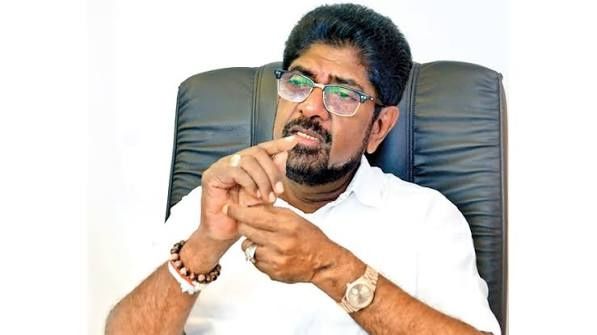
Keheliya Rambukwella, a former Sri Lankan government minister, was taken into custody on Tuesday, August 18, following allegations that he conspired to steal a rare and historically significant carved granite moonstone from the palace of Veera Parakrama Narendrasinghe, the kingdom's last Sinhala monarch who ruled until 1739. The anti-corruption watchdog Commission to Investigate Allegations of Bribery or Corruption announced the detention, marking another chapter in an intensifying probe into the conduct of high-ranking officials during the island nation's recent period of severe economic turmoil.
The stolen artifact in question is no ordinary stone. Known locally as a "moonstone," this intricately carved circular granite piece formed part of the symbolic stepping stone entrance complex to the ancient royal residence. Such architectural elements carry profound cultural and spiritual significance in Sri Lankan heritage, representing the artistic and engineering sophistication of the Kandyan Kingdom. The theft, which occurred in December 2022, involved the removal of a heavy, immobile object that would have required substantial logistical coordination and insider knowledge to extract from palace grounds.
Rambukwella's alleged involvement extends beyond mere participation in the theft itself. According to CIABOC's statement, the former minister not only conspired to facilitate the removal of the valuable historic object but actively obstructed police investigations into the disappearance. This dual culpability—facilitating the initial crime while simultaneously impeding law enforcement efforts to recover the artifact—demonstrates a systematic pattern of obstruction that deepens the severity of the accusations against him. His position within government at the time made such interference particularly consequential, as he possessed the institutional authority and access to complicate investigative procedures.
The charges against Rambukwella reveal the broader scope of alleged misconduct extending well beyond the heritage theft. Prosecutors have also leveled a separate charge alleging he misappropriated state funds to employ six individuals for private business purposes, a direct misuse of public resources for personal gain. This additional accusation underscores how officials under investigation appear to have systematically blurred lines between state resources and private enrichment, treating government finances as extensions of personal economic interests.
Rambukwella's legal troubles compound considerably when examining his tenure as health minister. During that period, he faces a separate and ongoing court case concerning the procurement of counterfeit pharmaceutical products for state hospital systems. Most alarmingly, police investigators have reported to the court that Rambukwella authorized the purchase of what was labeled as a life-saving cancer medication, only to discover that the supposed pharmaceutical was actually water. Such a substitution represents not merely financial fraud but a direct threat to patient welfare, as individuals requiring genuine cancer treatment received ineffective placebo instead.
The contaminated drug scandal has ensnared multiple senior officials beyond Rambukwella himself. Several other high-ranking health ministry personnel have faced indictment in connection with the broader counterfeit medicines scheme, suggesting an institutional failure extending across departmental leadership layers. This pattern points to either systemic oversight failures or deliberate complicity within procurement chains—a distinction with significant implications for how thoroughly the ministry requires structural reform.
Contextualizing these arrests requires understanding the economic catastrophe that gripped Sri Lanka during the period when Rambukwella held ministerial office. When the nation declared bankruptcy and subsequently defaulted on its $46 billion in foreign debt in April 2022, acute shortages of essential medicines ravaged the healthcare system. Hospitals struggled to stock critical pharmaceuticals, forcing difficult triage decisions and undermining public confidence in medical institutions. Within this crisis environment, the allegations against Rambukwella—that officials actively compounded scarcity through fraudulent procurement practices—take on additional gravity, suggesting that governance failure combined with apparent corruption to worsen public suffering.
The timing and nature of these investigations reflect Sri Lanka's broader reckoning with institutional corruption revealed during its economic collapse. Previous administrations left substantial unanswered questions about fund management and decision-making processes that contributed to the fiscal emergency. Current anti-corruption authorities appear determined to establish accountability for specific acts of misconduct, pursuing high-profile figures to demonstrate that even senior officials face consequences for wrongdoing.
For Malaysia and the broader Southeast Asian region, the Rambukwella case offers instructive lessons about institutional vulnerability during economic stress. The interconnection between financial crisis and governance breakdown evident in Sri Lanka's experience underscores the importance of robust anti-corruption frameworks and independent oversight bodies. Malaysian policymakers, particularly those managing public procurement and pharmaceutical sourcing, can recognize the risks when crisis conditions erode administrative discipline and create opportunities for officials to exploit confusion and resource scarcity for personal advantage.
The arrest also illuminates how heritage theft intersects with political corruption in ways often overlooked in conventional analyses. That high officials would facilitate the removal of nationally significant cultural artifacts suggests either indifference to cultural patrimony or active engagement in looting activities—concerns relevant across Southeast Asia where archaeological sites and heritage properties require protection from both international trafficking networks and internal predation by connected elites.

