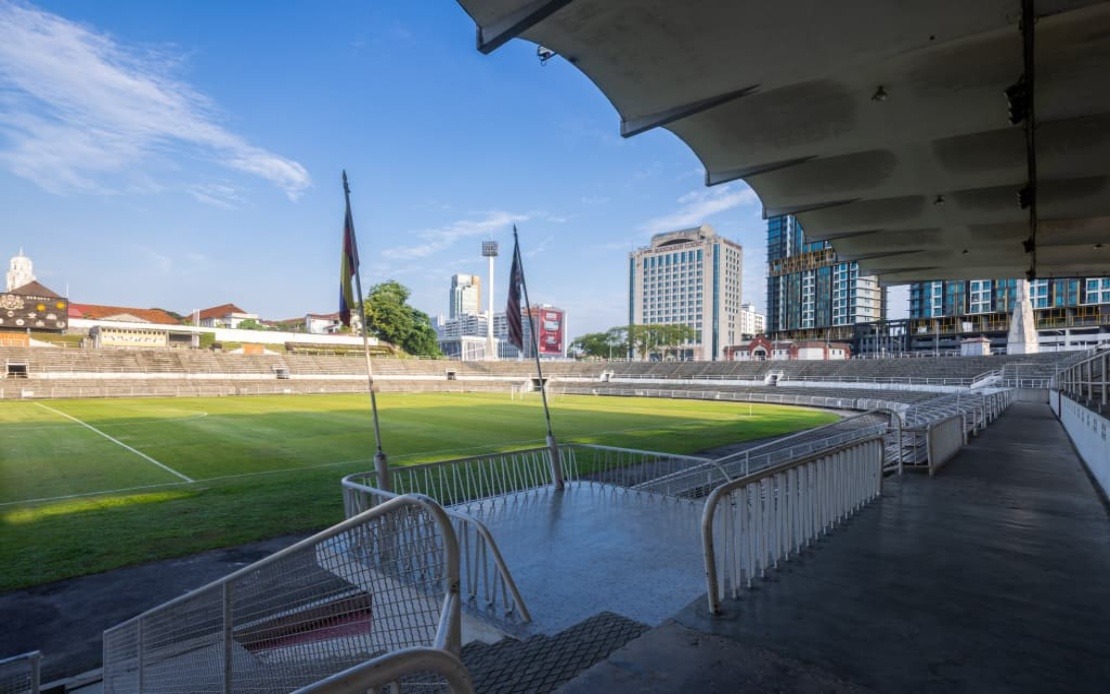
Nearly seven decades have passed since Stadium Merdeka witnessed the proclamation of Malaya's independence, yet the venue continues to stand as a profound emblem of Malaysia's nationhood and freedom. Located in the heart of Kuala Lumpur and framed against the contemporary backdrop of Merdeka 118 (Menara Merdeka Maybank), the stadium represents an extraordinary convergence of historical significance and modern urban development. Its enduring presence amid towering skyscrapers serves as a tangible reminder that even as Malaysia's skyline transforms, the foundations of the nation's identity remain anchored in this singular location where it all began.
Constructed within a single year at a cost of approximately RM2.3 million, Stadium Merdeka hosted one of Asia's most pivotal moments on August 31, 1957, when Tunku Abdul Rahman Putra Al-Haj, Malaysia's first Prime Minister, proclaimed the nation's independence. The emotional crescendo of Tunku's seven resounding cries of "Merdeka!" echoed through the stadium, marking the definitive end of British colonial governance over the Malayan territories. Beyond its architectural merit or sporting function, Stadium Merdeka became the physical manifestation of a nation's aspirations and the culmination of decades of political struggle and negotiation. This momentous occasion established the stadium not merely as infrastructure but as hallowed ground in Malaysian collective consciousness.
Prof Dr Sarjit Singh Gill, a social anthropology expert from Universiti Putra Malaysia and Chairman of the National Council of Professors' National Unity Cluster, emphasises the stadium's transcendent significance. According to Gill, the venue embodies far more than sporting or entertainment functions—it encapsulates Malaysia's identity, dignity, and cultural heritage in physical form. The independence proclamation marked the conclusive rupture with colonialism and inaugurated a transformative chapter for the Federation of Malaya. For generations of Malaysians, particularly those born after independence, Stadium Merdeka serves as an accessible connection to abstract historical concepts, grounding the nation's origin story in a tangible, visitable space.
The stadium's historical importance was reinforced just six years later when it hosted another defining national moment in 1963. The venue witnessed the proclamation of the formation of the Malaysian Federation, effectively ending British colonial administration in Sabah, Sarawak, and Singapore—though Singapore's subsequent separation redefined Malaysia's territorial composition. This dual historical significance establishes Stadium Merdeka as the epicentre of Malaysia's political transformation during a critical post-war period when formerly colonised territories navigated the complexities of nationhood and regional integration.
Despite its national importance, Stadium Merdeka faced existential threats during the late 1990s when redevelopment pressures threatened its survival. Public opposition combined with government intervention secured the stadium's future, demonstrating the depth of popular sentiment regarding its preservation. In 2000, Permodalan Nasional Berhad (PNB) assumed stewardship of the heritage site, committing to its conservation and public accessibility. This transition marked a pivotal shift from treating the stadium merely as functional infrastructure to recognising and protecting it as a national treasure requiring deliberate curatorial attention and sustainable management strategies.
Under PNB's management, Stadium Merdeka underwent meticulous restoration guided by original Public Works Department construction drawings. Conservation efforts prioritised authenticity, with later architectural additions removed to restore the stadium to its original 20,000-seat configuration. Distinctive features including the scoreboard, washroom facilities, decorative mosaic tiles, and the characteristic cantilevered roof underwent careful rehabilitation. This conservation philosophy reflects international best practices in heritage preservation, ensuring that visitors encounter Stadium Merdeka as it existed during those transformative moments of 1957 and 1963, rather than in some modernised or substantially altered form.
Datuk Dr Izwan Ibrahim, Chief Executive Officer of PNB Merdeka Ventures Sdn Bhd, articulates a conservation philosophy centred on preserving the stadium's authenticity while ensuring its historical narratives remain accessible to Malaysian audiences. Izwan emphasises that Stadium Merdeka transcends its physical structures—it represents the collective aspirations, determination, and resilience that shaped contemporary Malaysia. This approach recognises that heritage preservation serves not merely nostalgic or antiquarian purposes but functions as an active pedagogical tool and community resource. The stadium has evolved from its original function as a venue for National Day celebrations into a multifaceted cultural landmark hosting diverse activities, including the Bazram Merdeka bazaar, a Ramadan marketplace that attracted over 250,000 visitors during a recent year, demonstrating its continued relevance to Malaysian social and cultural life.
A particular priority for PNB's stewardship involves engaging younger Malaysian generations who may possess only abstract knowledge of 1957 and independence narratives. While curricula across Malaysia's education system cover the independence period and Tunku Abdul Rahman's pivotal role, Izwan advocates for experiential learning that transcends textbooks and classroom instruction. He recognises the transformative potential of physical presence at Stadium Merdeka, where younger Malaysians can physically inhabit the space where independence was proclaimed, creating visceral connections to national identity. The refurbished athletic track now serves community running and sports programmes, while coordinated school visits enable students to experience the stadium as lived space rather than historical abstraction. This intergenerational engagement strategy acknowledges that historical consciousness deepens through embodied experience—standing on the same ground where Tunku proclaimed independence creates psychological and emotional dimensions that reading historical accounts cannot replicate.
The stadium's heritage significance received international validation when it received a UNESCO Asia-Pacific Heritage Award in 2008, recognition that Stadium Merdeka's preservation meets global conservation standards and holds value extending beyond national boundaries. Subsequently, the site was gazetted as a National Heritage site in 2009, establishing formal legal protections and ensuring systematic approaches to future preservation efforts. These dual designations underscore that Stadium Merdeka's importance transcends Malaysian borders—it represents a significant chapter in Asia's decolonisation narrative and demonstrates the region's broader struggle for sovereignty and self-determination during the post-World War II period.
For Alias Daud, a long-serving staff member who spent the final decade of his 35-year PNB career tending to the stadium, the venue holds profound personal significance beyond administrative functions. Alias describes experiencing waves of pride, gratitude, and nostalgia whenever entering Stadium Merdeka, having witnessed countless visitors from diverse backgrounds traverse its grounds, each carrying personal narratives and memories connected to Malaysian nationhood. For Alias, the venue functions not as workplace but as home—a sacred space where he participated in preserving a national treasure. His reflections illuminate how heritage preservation engages not only institutional frameworks and conservation protocols but fundamentally shapes the lived experiences and emotional connections of those stewarding these sites. During Malaysia's national month, government agencies, educational institutions, and universities intensify their Stadium Merdeka visits, transforming the venue into an active site of national reflection, commemoration, and historical documentation.
Visitors frequently express astonishment upon learning that Stadium Merdeka hosted independence's proclamation, with many experiencing renewed appreciation upon physically occupying the space where that historical rupture occurred. Younger visitors particularly demonstrate heightened engagement, photographing key locations and reading inscriptions with evident fascination. This genuine curiosity among contemporary Malaysians suggests that effective heritage presentation can bridge generational divides and foster organic interest in national history among those for whom independence represents abstract historical content rather than lived experience. The stadium's power derives partly from its ordinariness—it functions not as isolated museum but as accessible public space that continues hosting events, accommodating visitors, and maintaining active cultural relevance alongside its commemorative functions.
As Kuala Lumpur's urban landscape continues its dramatic transformation, with gleaming skyscrapers ascending around Stadium Merdeka's relatively modest structure, the stadium's juxtaposition with modernity reinforces rather than diminishes its symbolic power. The contrast visually represents Malaysia's journey from colonial dependency to modern sovereign nation, with Stadium Merdeka anchoring contemporary development within historical continuity. Standing amid architectural markers of economic progress and technological advancement, the stadium embodies the principle that material development and national memory-keeping need not conflict—rather, they can coexist and mutually reinforce collective identity. As Malaysia contemplates its future trajectory and subsequent generations inherit the legacies of independence, Stadium Merdeka will persist as the physical and spiritual centre where Malaysia's journey as a free and sovereign nation commenced, preserving the spirit of Merdeka for generations yet to come.

