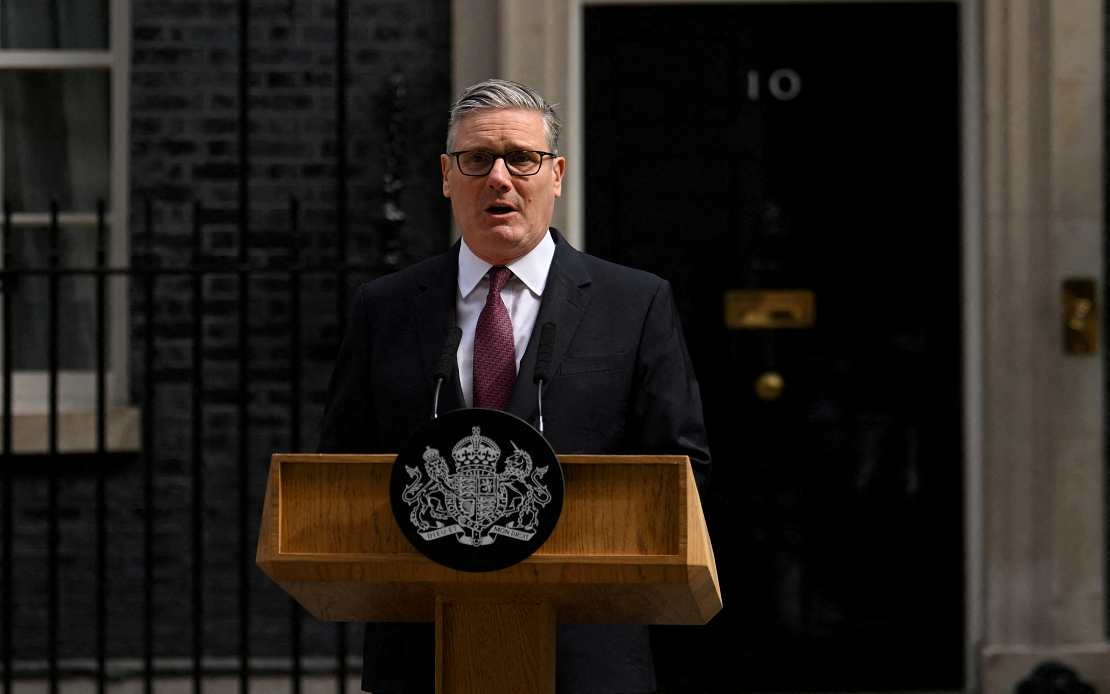
Keir Starmer has formally stepped down as British Prime Minister, delivering his final address from Downing Street on Monday before proceeding to Buckingham Palace to formally tender his resignation to King Charles. The outgoing leader, accompanied by his wife Victoria Starmer alongside senior Labour figures and personal associates, marked the conclusion of his tenure with a speech emphasizing accomplishment and national progress. Starmer asserted that his mission had been fulfilled and that he departed the role with satisfaction, preparing to hand over authority to his successor Andy Burnham.
The timing and circumstances of Starmer's departure represent a significant moment in contemporary British politics, carrying implications for the broader European political landscape and Southeast Asian observers monitoring shifts in Commonwealth governance. His exit after roughly two years as Prime Minister concludes a remarkable trajectory that saw him resurrect a Labour Party in profound disarray following its catastrophic 2019 election loss, when the party suffered its worst performance since 1935 under Jeremy Corbyn's leadership. The magnitude of that initial defeat had left the organization fractured and electorally radioactive, yet Starmer's structural reforms and ideological repositioning enabled a dramatic reversal in electoral fortunes.
Starmer's reflection on his premiership centred on the transformation of Britain's economic and social standing during his tenure. He contended that the nation had emerged as demonstrably stronger and more equitable than when Labour assumed office, referencing the period since his government took power approximately two years prior. This assertion frames his administration as having implemented substantive reforms that addressed longstanding inequities and bolstered national economic resilience, though the specific details of these achievements were not elaborated in his departing statement. The framing allows supporters to point to measurable improvements while providing cover for areas where progress remained contested or incomplete.
The five-and-a-half-year journey from Labour's 2019 collapse to Starmer's landslide victory in the 2024 general election represents one of modern British politics' most dramatic comebacks. During this extended period, Starmer methodically rebuilt party structures, disciplined internal factions, cultivated a moderate image, and positioned Labour as a competent alternative government. The 2024 election delivered a commanding mandate that exceeded even optimistic expectations, providing Starmer with substantial parliamentary majorities and a genuine mandate for governance. Yet his relatively brief tenure as Prime Minister—scarcely exceeding two years—suggests either internal complications, shifting political circumstances, or strategic calculations about optimal timing for transition that remain incompletely understood from publicly available information.
The succession of Andy Burnham to the premiership marks another significant transition within the Labour hierarchy. Burnham, who has previously held substantial governmental and administrative posts, represents continuity of Labour governance whilst potentially signalling shifts in policy direction or leadership style. His assumption of power during what appears to be a robust period of Labour dominance indicates the party's consolidation of electoral strength following years of Conservative governance. The transition occurs within a stable parliamentary environment where Labour maintains clear legislative majorities, reducing the immediate pressure for emergency governance measures or national crisis management.
For Malaysian and Southeast Asian observers, the British leadership transition underscores broader patterns in democratic governance across Commonwealth nations. Leadership transitions in established Westminster democracies like Britain provide instructive examples regarding institutional stability, succession planning, and the mechanisms through which democratic systems manage power transfers. Malaysia, as a Commonwealth member with its own parliamentary traditions and multiparty system, maintains particular interest in how Westminster precedents evolve and how democratic institutions navigate leadership changes without destabilizing governance frameworks or threatening institutional legitimacy.
Starmer's emphasis on having restored national fairness alongside economic strength reflects Labour's fundamental campaign messaging and ideological positioning. The framing suggests his administration prioritized both economic performance and distributional equity, attempting to transcend traditional left-right dichotomies by presenting these objectives as complementary rather than contradictory. Whether international observers and domestic constituencies perceived meaningful progress on these dual objectives remained contested territory in British political discourse, yet Starmer's departing statement confidently asserted their achievement.
The ceremonial dimensions of Starmer's resignation—the formal address, the journey to Buckingham Palace, the passage of authority through established constitutional procedures—demonstrate the continuity of Westminster institutional practices across leadership transitions. These rituals reinforce the legitimacy of democratic processes and the subordination of executive power to constitutional frameworks and monarchical authority. The visibility of constitutional compliance and procedural regularity contributes to broader public confidence in institutional stability during moments of political transition.
Burnham's imminent assumption of the premiership occurred within a context of apparent Labour governmental stability and continued economic management of the post-pandemic recovery. The transition suggests no immediate external pressures or emergency circumstances compelling accelerated change, distinguishing it from crisis-driven leadership transitions that sometimes characterize British politics. This relative stability and ordered succession contrasts with episodes of forced resignation or emergency replacement, positioning Burnham's ascension as a deliberate strategic transition rather than reactive damage control.
The broader significance of this British political moment extends beyond Westminster itself to encompass questions about Labour's future direction, the sustainability of the party's electoral coalition, and the management of governance in an increasingly complex domestic and international environment. Burnham's inherited government faces substantial inherited challenges ranging from economic management to social provision to international relations, yet commences with substantial parliamentary capacity to implement its agenda. The transition consolidates Labour's post-2024 dominance whilst introducing new leadership perspectives potentially responsive to evolving constituent demands and emerging policy challenges.

