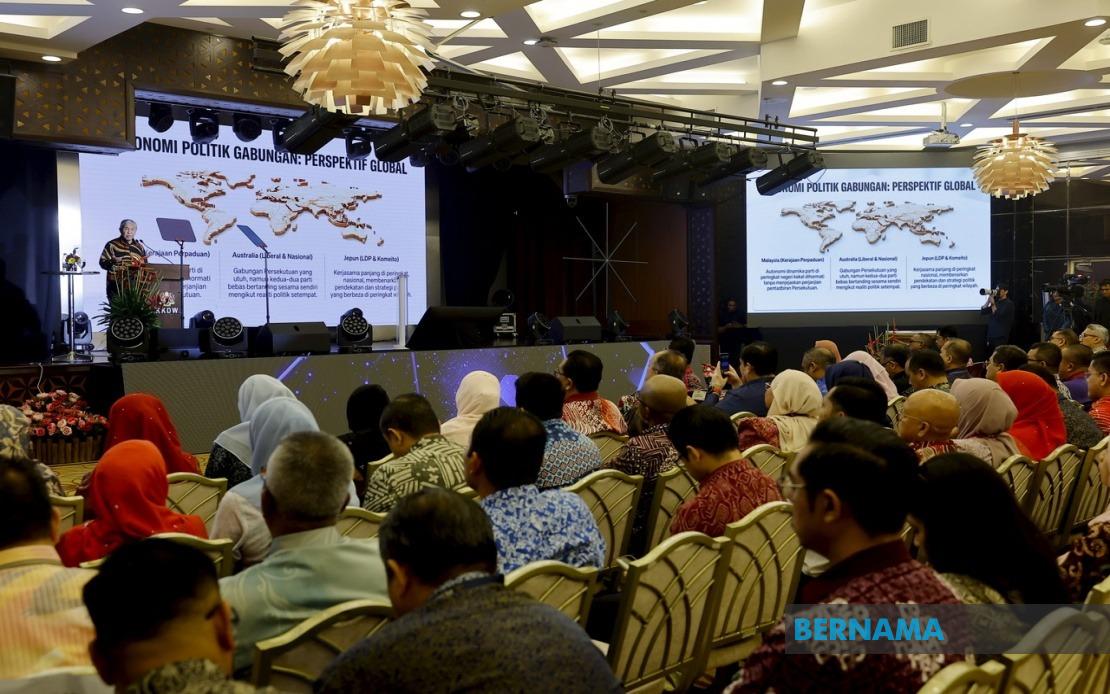
Malaysia's Deputy Prime Minister and Barisan Nasional chairman Datuk Seri Dr Ahmad Zahid Hamidi moved to calm concerns about the impact of state-level political jostling on federal governance, declaring at a ministry gathering in Putrajaya that rivalries confined to state elections would pose no danger to the unity administration's continuity or effectiveness.
Speaking at the Rural and Regional Development Ministry's monthly assembly, Ahmad Zahid emphasised that the federal government's stability rested not on the absence of political competition but on the binding agreement that underpins the Unity Government's formation and continues to govern coalition dynamics until Parliament is dissolved. The declaration comes against the backdrop of recent state electoral contests, notably in Johor and Negeri Sembilan, which have intensified political maneuvering among coalition partners and rival blocs.
The Deputy Prime Minister's comments address a persistent tension within Malaysia's governing architecture: the ability of political parties to pursue their individual interests and electoral strategies while simultaneously maintaining the cohesion necessary for a multiparty coalition government to function effectively. Ahmad Zahid framed this apparent paradox through the lens of "political autonomy within a coalition government," a concept that acknowledges each party's right to chart its own political course provided such moves do not breach the foundational compact upon which the government rests.
This framework carries particular relevance for Malaysian readers navigating the complexities of the Unity Government, which brought together historically opposing political forces following the 2022 general election. The coalition encompasses Barisan Nasional, Pakatan Harapan, and various other partners, an arrangement that was unprecedented in its breadth and has periodically faced strains as constituent parties contest elections at state and local levels. Ahmad Zahid's reassurance appears calibrated to address investor concerns, civil service uncertainty, and public anxiety about whether state-level political turbulence might cascade upward to destabilise federal decision-making.
Regarding the implementation of government programmes and policies, Ahmad Zahid stated that recent political developments would neither alter the MADANI administration's overall direction nor impede the execution of planned initiatives. This assurance matters substantially for major infrastructure projects, economic policies, and development programmes that typically require multiyear implementation cycles and depend on governmental continuity. A government in terminal political decline tends to lose bureaucratic momentum, hesitate on major commitments, and see key personnel departing for more stable shores.
The Deputy Prime Minister further underscored that as long as Parliament remains in session, the federal government would continue discharging its duties and fulfilling the mandate conferred by voters. This declaration reflects the constitutional reality of Malaysia's Westminster-influenced system: a government that has not lost a parliamentary vote and retains the confidence of the legislature possesses legitimate authority to govern regardless of peripheral political turbulence. Ahmad Zahid's emphasis on continuity of function and responsibility suggests confidence that the coalition commands sufficient parliamentary numbers to weather localised political contests.
For Southeast Asian observers and the international business community, Ahmad Zahid's reassurances carry weight in signalling that Malaysia intends to maintain policy consistency and administrative coherence despite the pressures exerted by electoral competition at subnational levels. Regional economies and trading partners often value predictability and clear governance frameworks; perceptions of governmental instability can trigger capital flight, currency weakness, and reduced foreign investment. The Deputy Prime Minister's comments thus serve a dual purpose: reassuring domestic stakeholders whilst signalling to external audiences that Malaysia's government remains functionally intact.
The concept of political autonomy within coalition structures acknowledges an uncomfortable reality that Malaysian political actors have long understood: parties do not sacrifice their institutional identities, electoral prospects, or ideological commitments merely by joining a governing coalition. Rather, they negotiate the terms of coexistence, agreeing to refrain from actions that would bring down the government whilst reserving the right to compete for voter support and pursue divergent strategies on matters not central to the coalition's survival. This equilibrium is inherently fragile and demands constant diplomatic attention from senior leadership.
Ahmad Zahid's intervention suggests that coalition architects believe this balance remains workable and that state-level contests, whilst potentially altering the political landscape in individual states, need not reverberate through federal structures. Whether this assessment reflects strategic confidence or merely rhetorical positioning remains an open question; the months and years ahead will test whether the Unity Government can truly compartmentalise political competition or whether fractures appearing at state level eventually propagate to the centre.
For Malaysian governance, the Deputy Prime Minister's remarks highlight a crucial question about the sustainability of diverse coalition governments in a system where electoral competition is simultaneously vigorous and constitutionally constrained. The test of Ahmad Zahid's claims will come when state-level results force substantive questions about power-sharing, ministerial appointments, or policy direction—moments when the distinction between autonomous political action and coalition loyalty becomes genuinely contested.
Looking forward, the stability Ahmad Zahid described depends on the continued willingness of coalition partners to distinguish between legitimate partisan rivalry and threats to governmental continuity. This requires restraint, pragmatism, and a recognition that the costs of governmental collapse might exceed the benefits of marginal electoral gains. Whether these conditions persist as Malaysia moves toward the next general election cycle remains an essential factor determining the trajectory of the Unity Government and the nation's broader political evolution.

