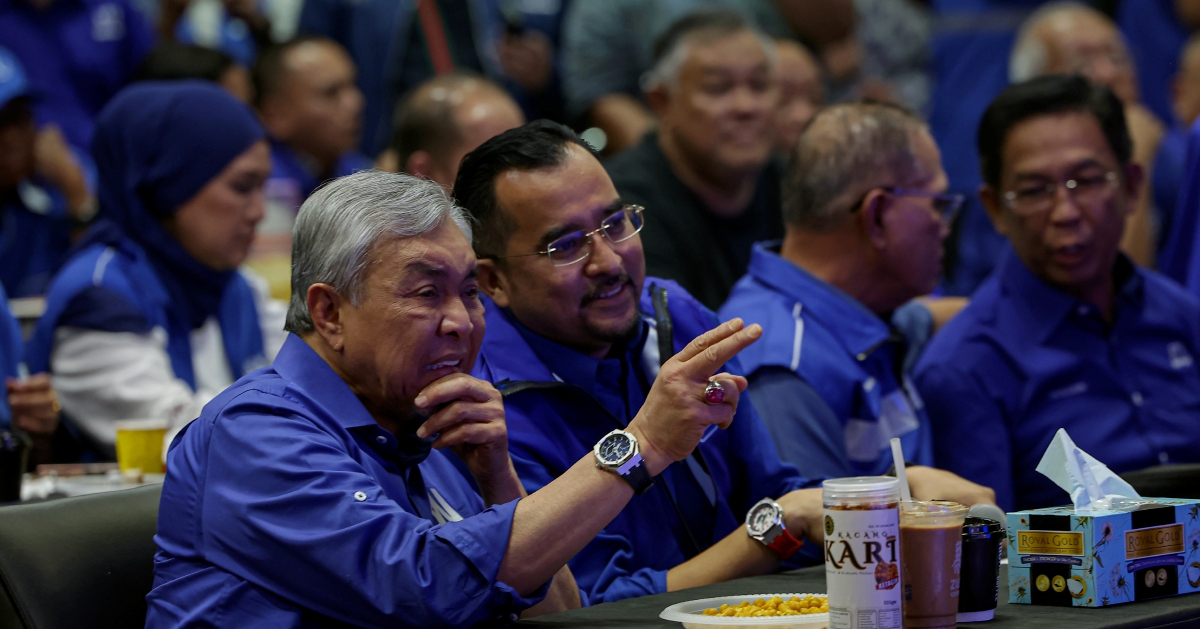
Umno's secretary-general Datuk Dr Asyraf Wajdi Dusuki has issued a sobering reminder to the party faithful in the aftermath of Barisan Nasional's victory in the Negri Sembilan state election, urging organisational discipline and measured restraint as the coalition consolidates its position. Speaking to supporters and party members, Dusuki emphasised that electoral success, while validating the people's endorsement of BN's agenda, should serve as a catalyst for renewed commitment rather than complacency or triumphalism.
The warning carries particular resonance within Malaysian political circles, where Umno's historical trajectory has been punctuated by cycles of dominance followed by organisational introspection. Dusuki's intervention reflects a conscious effort to anchor the party's leadership messaging around institutional learning rather than mere electoral arithmetic, signalling an awareness that voter confidence is inherently contingent and subject to rapid erosion when governing parties lose sight of their foundational principles. The secretary-general's framing positions humility not as weakness but as strategic necessity, a calculated recalibration designed to prevent the kind of institutional drift that has previously undermined Umno's electoral fortunes.
Negri Sembilan's political landscape has long served as a barometer for BN's broader viability, making the coalition's performance there particularly significant for Umno's positioning ahead of potential federal-level contests. The state has experienced considerable political volatility in recent years, oscillating between different power structures and presenting complex dynamics that reward disciplined campaigning and responsive governance. That Barisan Nasional secured electoral validation in this environment reinforces perceptions of organisational resilience and renewed relevance at the grassroots level, though such victories are often accompanied by internal pressure to capitalise swiftly on momentum.
Dusuki's emphasis on avoiding past missteps addresses a recurring vulnerability within Umno's political culture. Previous periods of electoral dominance have sometimes coincided with increased reports of patronage problems, intra-party tensions, and governance lapses that collectively eroded public confidence in the organisation's capacity for self-correction. By invoking these historical echoes, the secretary-general appears to be attempting to institutionalise a culture of continuous scrutiny and accountability within party structures, positioning discipline as a prerequisite for sustained electoral performance rather than an optional feature of party operations.
The timing of Dusuki's statement also reflects calculations regarding Umno's broader political positioning within Malaysia's evolving coalition dynamics. Barisan Nasional's resurrection as an electoral force has paradoxically increased internal pressures within the alliance, as component parties navigate questions about resource distribution, campaign autonomy, and credit allocation. Dusuki's intervention can be interpreted partly as an internal message to Umno rank-and-file that consolidation and unity remain paramount, potentially signalling the leadership's commitment to preventing the kind of factional fragmentation that has destabilised the party during previous political transitions.
For Malaysian voters and observers beyond Umno's organisational hierarchy, Dusuki's cautionary tone also carries implications regarding governance expectations. Electoral victories ostensibly should translate into improved service delivery, responsive administration, and tangible policy outcomes at the state level. The secretary-general's emphasis on avoiding arrogance implies a recognition that voter mandates are conditional commitments rather than blank cheques, and that governing parties must continuously justify public trust through performance and demonstrated attentiveness to constituent concerns. This framing may also influence how Barisan Nasional approaches policy implementation in Negri Sembilan, potentially encouraging greater stakeholder engagement and public accountability mechanisms.
The broader Southeast Asian context provides additional texture to Dusuki's positioning. Across the region, ruling parties and coalitions have confronted significant electoral volatility in recent years, with voter behaviour increasingly characterised by tactical voting, reduced partisan loyalty, and heightened responsiveness to governance performance. Malaysia's political electorate has demonstrated particular sensitivity to perceptions of institutional failing or leadership hubris, frequently punishing parties perceived as taking electoral support for granted. Dusuki's intervention thus aligns with adaptive strategies evident among successful political organisations across Southeast Asia, which increasingly emphasise institutional humility and continuous voter engagement as prerequisites for sustained electoral viability.
Umno's internal dynamics will likely prove crucial in determining whether Dusuki's message translates into substantive organisational change or represents merely rhetorical positioning. The party's experience with reform initiatives and institutional learning has been mixed historically, suggesting that converting leadership rhetoric into embedded organisational practice presents genuine challenges. The credibility of Dusuki's warning will ultimately be tested through observable changes in party conduct, campaign practices, and governance approaches during Negri Sembilan's development initiatives over the coming years. How successfully Umno internalises these principles will significantly influence both the party's medium-term electoral trajectory and broader assessments of Barisan Nasional's capacity for institutional governance.

