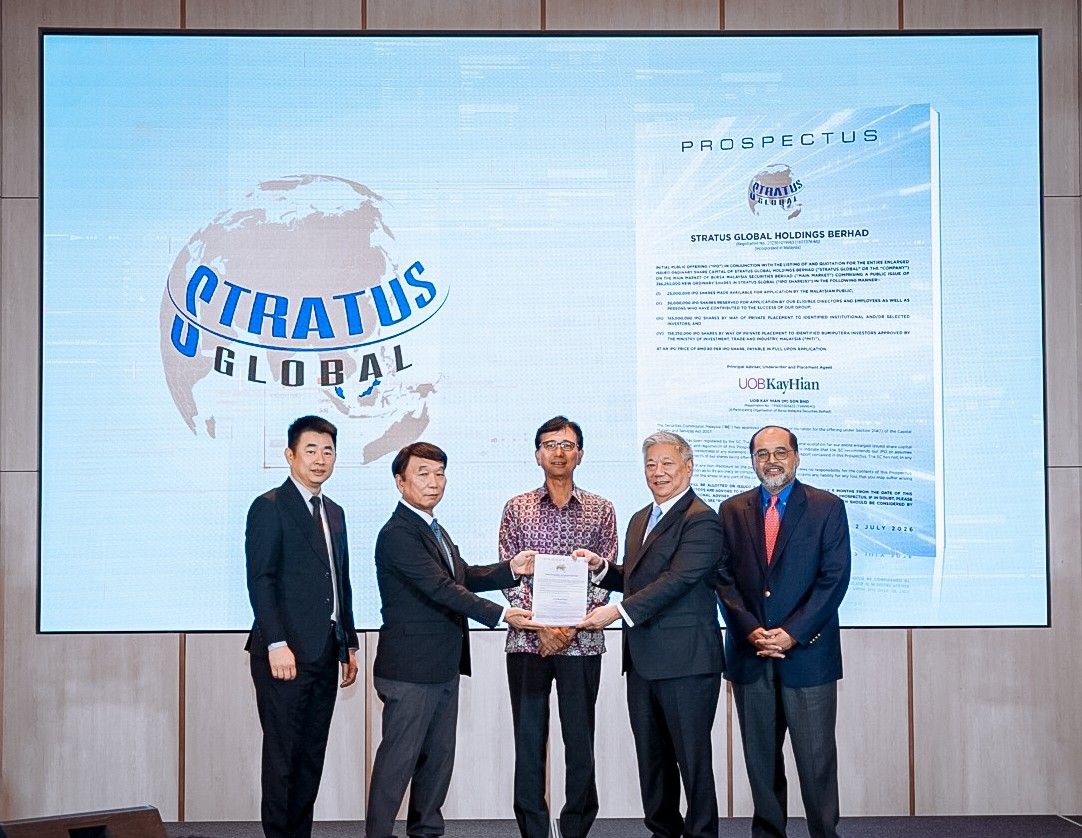
Stratus Global Holdings Bhd, a provider of automated material handling systems for semiconductor manufacturers, has entered the public markets with an ambitious RM285mil capital raise on Bursa Malaysia's Main Market. The listing marks a significant inflection point for the 26-year-old company, which has established itself as a critical infrastructure provider to the region's semiconductor ecosystem. The IPO involves the issue of 356.25 million new shares priced at 80 sen each, yielding a post-listing market capitalisation of RM1bil based on an enlarged capital base of 1.25 billion shares. Subscription opened immediately, with the bidding period concluding on July 10 and debut trading scheduled for July 21.
The fundraising structure reflects Stratus Global's confidence in its market position and growth trajectory. Notably, the IPO consists entirely of fresh capital issuance, with no secondary offering from existing shareholders taking a partial exit. This approach signals that founding investors and management retain full conviction in the company's direction and value creation potential. Such structures are often favoured when insiders believe the business is still in its high-growth phase and want to maintain operational continuity without dilution of control through premature stake sales.
The capital allocation blueprint reveals a company simultaneously building physical infrastructure while pursuing geographic and technological expansion. The RM122.6mil earmarked for constructing a new manufacturing plant in Penang represents the single largest deployment of IPO proceeds. This expansion is strategically timed to capitalise on Malaysia's position as a global semiconductor manufacturing hub and reflects industry tailwinds. Penang's established semiconductor ecosystem, skilled workforce, and government incentives make it an obvious choice for industrial capacity expansion. The remaining funds are distributed across international market penetration (RM20mil), research and development innovation (RM45mil), operational liquidity (RM82.4mil), and flotation costs (RM15mil).
Stratus Global's business model centres on providing integrated automated material handling systems to semiconductor fabrication facilities. Since its 1998 founding, the company has developed proprietary expertise in designing, fabricating, installing, and commissioning complex AMHS solutions tailored to semiconductor manufacturing environments. These systems are mission-critical infrastructure within semiconductor fabs, automating the movement, storage, and retrieval of wafers and other manufacturing inputs with precision and reliability. The company's customer roster spans multinational semiconductor corporations operating manufacturing and assembly operations across Malaysia, Asia, Europe, and North America. This geographic and customer diversification has insulated the business from regional cyclicality while positioning it for recurring revenue streams as customers upgrade and expand capacity.
The semiconductor industry's structural demand drivers underpin Stratus Global's growth prospects. Global chip production continues reshoring from concentrated geographical locations toward diversified manufacturing ecosystems across Southeast Asia, driven by geopolitical tensions and supply chain resilience imperatives. Malaysia has benefited substantially from this shift, attracting incremental semiconductor manufacturing and assembly investments. For Stratus Global, this translates into visible pipeline growth, with both existing customers expanding capacity and new entrants to the Malaysian ecosystem requiring integrated AMHS solutions. The R&D allocation of RM45mil suggests management is investing in next-generation capabilities, potentially including automation optimisation, digital integration, and sustainability features that increasingly matter to semiconductor manufacturers.
Executive director and chief executive officer Ryo Narisawa has framed the listing as enabling the company's transition into an enhanced growth phase. The IPO capital provides the financial firepower to execute multi-year capacity expansion, geographic reach extension, and technological innovation simultaneously. For a specialised industrial equipment supplier, this combination is essential: capital-intensive manufacturing requires upfront investment in facilities and capabilities, international expansion demands working capital for sales and distribution infrastructure, and maintaining technological leadership in automation requires sustained R&D spending. The public market listing also enhances Stratus Global's credibility with multinational semiconductor companies evaluating equipment suppliers, as public company status typically signals financial stability and governance rigour.
UOB Kay Hian (M) Sdn Bhd serves as principal adviser, underwriter, and placement agent for the offering. The bank's involvement adds institutional credibility to the IPO and ensures professional distribution to institutional and retail investors. The two-week subscription window represents a compressed timeline, though this is increasingly common for competitively positioned offerings in Malaysia's equity market. Investor appetite will likely reflect confidence in semiconductor sector fundamentals and Stratus Global's competitive positioning within the AMHS solutions space.
The July 21 listing date carries symbolic importance for Malaysia's semiconductor ecosystem. Public market recognition of a homegrown systems supplier reinforces the industry's maturation beyond commoditised assembly and packaging toward higher-value automation and integration solutions. This mirrors regional trends in Vietnam, Thailand, and Singapore, where local companies have graduated from contract manufacturing toward intellectual property-driven automation and precision engineering. Stratus Global's IPO demonstrates that Malaysian entrepreneurs can build globally competitive specialised industrial companies, attracting institutional capital and scaling operations to serve multinational customers.
For Malaysian investors, the IPO presents exposure to a defensive industrial infrastructure play embedded within cyclical semiconductor sector growth. The company's recurring customer relationships with multinational semiconductor manufacturers provide revenue stability, while capacity expansion and international geographic diversification offer upside optionality. Working capital efficiency and capital deployment discipline will determine whether Stratus Global can convert IPO capital into shareholder value creation. The market's reception to the offering will signal broader investor appetite for Malaysian mid-cap industrial companies with global customer exposure and technology-driven business models.

