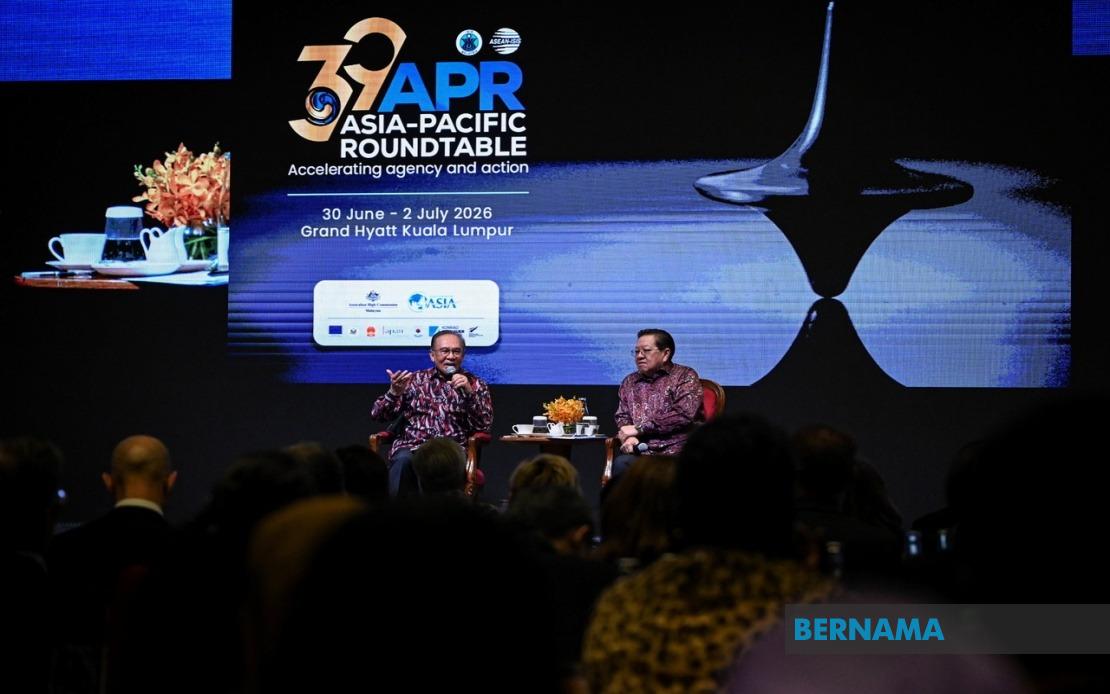
Prime Minister Datuk Seri Anwar Ibrahim has placed domestic governance reform at the centre of Malaysia's policy agenda, arguing that the nation cannot effectively contribute to global affairs without first addressing its own institutional challenges. Speaking at the 39th Asia-Pacific Roundtable in Kuala Lumpur on July 2, Anwar framed the government's immediate priorities around establishing stronger administrative foundations, combating systemic corruption, narrowing socioeconomic gaps, and guaranteeing that all Malaysians can access quality education and healthcare services. His remarks underscored a deliberate shift in emphasis away from grand international positioning towards granular domestic improvements, a posture that reflects both pragmatism and an acknowledgment of structural weaknesses requiring urgent attention.
The Prime Minister's intervention at the roundtable discussion came during a question-and-answer format, allowing him to elaborate on his administration's governing philosophy. He articulated a vision centred on empowering ordinary citizens through better public services and equitable access to fundamental goods. This framing positions governance reform not as a technical administrative exercise but as a moral and social imperative directly affecting the lived experience of Malaysians across income levels and demographic groups. By anchoring his remarks in citizen welfare rather than geopolitical ambition, Anwar signalled a recalibration of national priorities during a period when Malaysia faces competing demands for limited resources and political capital.
While acknowledging that Malaysia would maintain its established stance on principled international issues, Anwar emphasised that the government's energies must remain concentrated on nation-building. This distinction is significant: Malaysia would not retreat from its traditional diplomatic roles or positions on global matters, but it would not allow international engagement to distract from essential domestic work. For a country navigating complex regional dynamics and facing mounting developmental challenges, this prioritisation reflects a strategic choice to build credibility and capacity at home before expanding external commitments. The approach suggests confidence that a stronger Malaysia—one with improved governance, reduced corruption, and more equitable outcomes—will naturally wield greater influence in regional and global forums.
A central theme in Anwar's address was the demonstration that a Muslim-majority democracy can simultaneously uphold Islamic values, democratic principles, moderation, and social inclusivity. This positioning carries particular weight in a global context where Muslim-majority nations are sometimes stereotyped as resistant to democratic norms or pluralism. By explicitly committing Malaysia to these dual commitments, Anwar presented the country as a counterexample to such assumptions, positioning Malaysia's governance model as potentially instructive for other predominantly Muslim societies grappling with similar questions about development, faith, and democracy. Such messaging also resonates domestically with Malaysians concerned about the compatibility of religious identity with secular democratic governance.
Anwar cautioned against interpreting international tensions through the lens of a "clash of civilisations," a concept popularised by political scientist Samuel Huntington that posits fundamental, irreconcilable differences between major cultural and religious blocs. Instead, the Prime Minister suggested that most global conflicts originate from misunderstanding, prejudice, and ignorance rather than from deep civilisational incompatibility. By invoking the late Palestinian-American scholar Edward Said, whose work critiqued orientalism and cultural essentialism, Anwar reframed international discord as a "clash of ignorance." This framing carries significant implications for Malaysia's own approach to interethnic and interreligious relations, positioning understanding and knowledge as antidotes to conflict rather than viewing difference as inherently divisive.
The government's MADANI framework featured prominently in Anwar's discussion, described as an approach balancing technological advancement with human and moral development. Rather than pursuing progress through technological innovation alone, MADANI emphasises the cultivation of deeper appreciation across racial, religious, and cultural boundaries. This holistic conception of development acknowledges that material progress divorced from social cohesion and mutual respect risks generating new forms of inequality and resentment. For Malaysian policymakers, the framework offers a template for sustainable advancement that does not sacrifice social solidarity in pursuit of economic metrics.
Anwar drew on the Quranic concept of "li ta'arafu," often translated as "to know one another," to articulate a vision of social coexistence that transcends mere tolerance. Rather than simply accepting difference as an inevitable feature of multiethnic society, the concept calls for active engagement aimed at genuine understanding and appreciation. This distinction is crucial: tolerance can be passive and conditional, whereas the spirit of li ta'arafu demands intentional cultivation of relationships and knowledge across communal lines. In Malaysia's context—a nation of significant ethnic and religious diversity—this principle offers both a philosophical grounding and a practical roadmap for managing pluralism.
The emphasis on understanding over tolerance takes on particular urgency given Malaysia's historical experience with communal tensions and more recent concerns about polarisation. Political discourse in Malaysia has at times been marked by zero-sum framing of interethnic interests and competitive claims about religious authority and privilege. Anwar's invocation of li ta'arafu represents an attempt to redirect public conversation toward shared projects of mutual comprehension, implicitly arguing that such understanding creates space for cooperation and collective problem-solving. For a multiracial and multireligious nation, this reorientation carries immediate domestic relevance alongside its apparent international messaging.
The Prime Minister's emphasis on education and healthcare as fundamental rights warrants particular attention given Malaysia's ongoing developmental challenges. While the country has achieved relatively high literacy rates and life expectancy compared to regional peers, access to quality services remains unequally distributed, with rural and lower-income communities often underserved. By positioning these sectors as central to governance reform, Anwar signalled that his administration views human capital development and health security as prerequisites for both social stability and economic competitiveness. This framing aligns with empirical research suggesting that nations investing heavily in universal education and healthcare experience stronger long-term growth and reduced inequality.
The speech encapsulates a broader strategic posture whereby Malaysia aims to strengthen internal institutional capacity and social cohesion as the foundation for meaningful international engagement. In Southeast Asia, where several nations contend with governance deficits, corruption, and communal tensions, Malaysia's articulation of this priority potentially carries demonstration value. A successful execution of Anwar's reform agenda would suggest that Muslim-majority democracies can effectively combat institutional weaknesses while maintaining cultural and religious identity, a lesson with resonance across the region.
Looking forward, the critical test will be the translation of these articulated priorities into measurable reforms. Public sector governance, corruption reduction, and equitable access to social services require sustained institutional effort, political will, and resource allocation across multiple budget cycles. The roundtable remarks establish the intellectual and moral framework; implementation will determine whether the government's governance agenda achieves the transformative impact Anwar envisions. For Malaysian citizens and observers across Southeast Asia, the coming years will reveal whether this expressed commitment to domestic reform translates into substantive improvements in the quality of state institutions and the lived experience of ordinary Malaysians.

