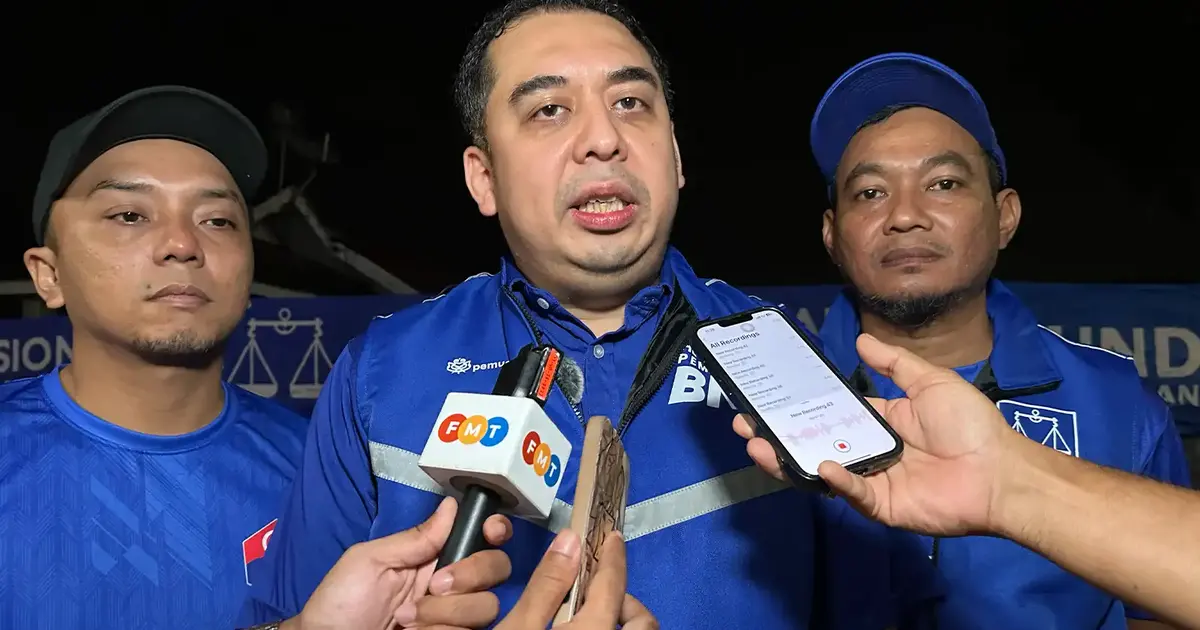
Nazifuddin Razak has suggested that a commanding Barisan Nasional performance in upcoming Johor elections would constitute a clear expression of public sentiment favouring a royal pardon for his father, former prime minister Najib Razak. The younger Razak has positioned electoral success in the state as a barometer of grassroots opinion on the politically sensitive matter of clemency for the ousted leader, who remains embroiled in multiple legal proceedings connected to the 1Malaysia Development Berhad scandal.
The framing of electoral outcomes as a mandate for particular policy outcomes has become an increasingly common rhetorical device in Malaysian politics, particularly among members of the ruling coalition seeking to validate their policy positions. In this instance, Nazifuddin appears to be constructing a narrative whereby strong voter support for his party would translate into broader societal acceptance of measures that might benefit his father. This interpretation of electoral mathematics, however, remains contestable, as voters typically cast ballots based on a multifaceted calculus involving local governance, economic management, and party performance rather than single predetermined outcomes.
Najib Razak's legal situation continues to dominate discourse surrounding his political rehabilitation. His conviction on corruption charges has resulted in a significant prison sentence, though this remains subject to ongoing legal appeals and constitutional processes. The question of whether a future royal pardon might be extended has become a focal point for both supporters and opponents of the former premier, with each camp reading electoral results through the lens of their preferred outcome.
Nazifuddin's statement reflects the broader positioning of the Razak family within contemporary Malaysian political dynamics. As the son of a polarising figure, Nazifuddin has gradually become a public representative of his father's interests, articulating arguments that frame Najib not merely as a legal defendant but as a political figure whose rehabilitation commands popular legitimacy. This strategy requires demonstrating that substantial segments of the electorate view Najib favourably despite the corruption allegations that precipitated his downfall in 2018.
Crucially, Nazifuddin acknowledged that any royal pardon represents an exclusively monarchical prerogative, a statement that carries particular significance within Malaysia's constitutional framework. The Yang di-Pertuan Agong, as head of state, possesses the authority to exercise clemency within defined constitutional parameters, a power that operates independently of electoral outcomes or political pressure. This caveat in Nazifuddin's remarks thus simultaneously asserts electoral sentiment as morally persuasive while conceding ultimate decision-making authority to the throne.
The timing of such statements carries strategic importance for Barisan Nasional's political positioning in Johor, where the coalition has historically maintained substantial support but has faced periodic challenges to its dominance. A resounding victory would provide the party with renewed legitimacy and reinvigorate its narrative of electoral strength, which Nazifuddin and other Razak family associates can then weaponise in discussions about broader policy directions, including those touching on his father's legal predicament.
For Malaysia's broader political landscape, the intersection of electoral outcomes and potential clemency for high-profile figures raises questions about the appropriate relationship between popular voting patterns and judicial or executive remedies. While electoral mandates can certainly influence policy priorities and political direction, the extension of clemency for corruption convictions involves principled considerations extending beyond simple majority preference. Constitutional governance typically maintains a distinction between what voters prefer politically and what justice systems determine independently of electoral cycles.
The Razak family's political rehabilitation efforts have evolved considerably since Najib's 2018 electoral defeat. What was once an apparently terminal political situation has gradually transformed, with Najib recalibrating his public presence and his family members undertaking increasingly visible advocacy on his behalf. Johor represents particularly fertile ground for such efforts, given the state's historical connections to the Razak family and its substantial Barisan Nasional constituency.
Regional observers note that this dynamic reflects broader patterns evident across Southeast Asia, where former leaders facing legal challenges attempt to position themselves as victims of political persecution rather than perpetrators of alleged crimes. The Malaysian case study becomes instructive for understanding how judicial processes and political legitimacy interact, particularly when high-profile figures command substantial family networks and residual political infrastructure.
Looking forward, the relationship between electoral performance and clemency decisions will likely remain contested terrain in Malaysian politics. Whether the electorate in Johor delivers the overwhelming support that Nazifuddin anticipates remains uncertain, but his willingness to explicitly link such outcomes to pardon prospects indicates the extent to which his father's case has become enmeshed with contemporary partisan politics, notwithstanding the constitutional realities that ultimately govern such decisions.

