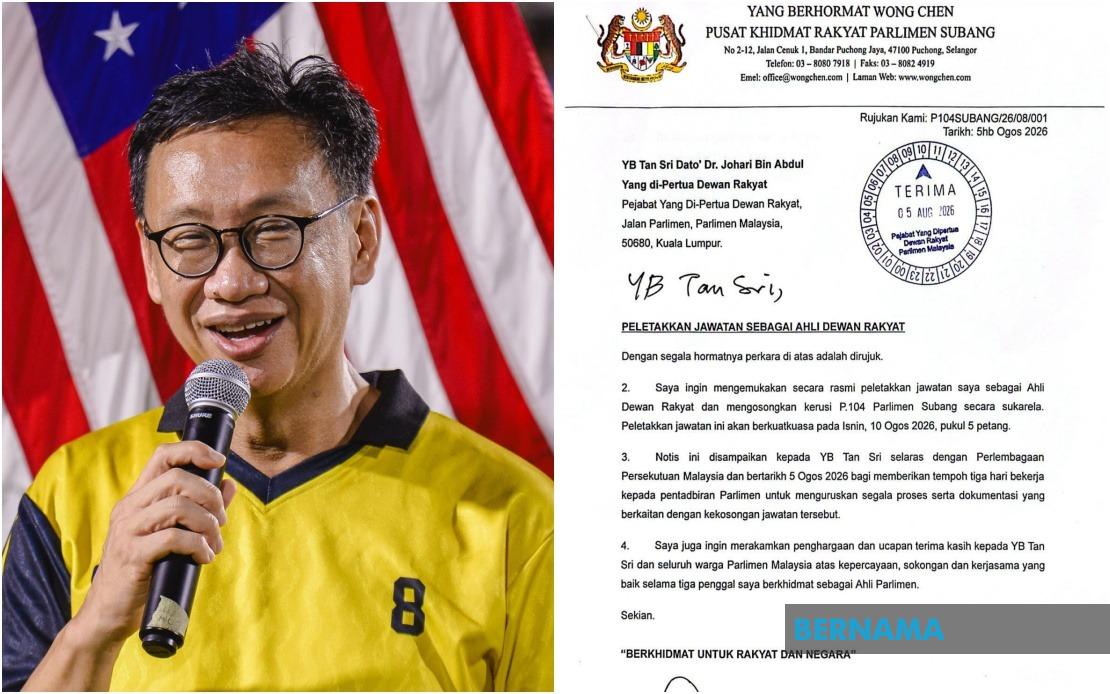
Wong Chen, the long-serving Subang Member of Parliament, has officially stepped down from his position in the Dewan Rakyat as of 5:00 pm today, bringing an end to his three consecutive terms representing the constituency. His departure marks a significant transition for the Klang Valley district, which has been a closely watched political battleground in recent electoral cycles.
The 18-year parliamentary veteran submitted his formal resignation letter to Dewan Rakyat Speaker Tan Sri Johari Abdul on August 5, 2026, providing advance notice to allow Parliament's administrative machinery adequate time to process the vacancy and prepare for the subsequent by-election procedures. This measured approach reflects conventional parliamentary practice, giving government departments the breathing room necessary to organise the constitutional machinery required for filling the seat.
In a detailed Facebook announcement, Wong Chen expressed his appreciation for the institutional support he received throughout his parliamentary tenure. His message specifically acknowledged Speaker Tan Sri Johari Abdul's leadership and commended the entire Parliament administration for maintaining collaborative working relationships across his time in the chamber. The tone of his statement suggested a departure undertaken on cordial terms with legislative authorities.
Wong Chen's resignation comes voluntarily under the provisions of the Federal Constitution, indicating his decision was made independently rather than through parliamentary expulsion or forced circumstances. This distinction matters in Malaysian political discourse, as voluntary resignations typically carry different implications than those resulting from party disciplinary action or constitutional breach. The formal documentation dated August 5 clearly establishes the constitutional foundation for his exit.
The Subang constituency has represented one of Malaysia's more competitive parliamentary seats over recent election cycles, with Wong Chen successfully defending his position across three general elections. His departure opens questions about the demographic and political composition of the district, which encompasses suburban and urban residential areas in the Klang Valley region. The upcoming by-election will likely attract significant national attention given the seat's electoral volatility.
Wong Chen has scheduled a comprehensive press conference for 11:00 am tomorrow, where he intends to elaborate on the circumstances surrounding his resignation and potentially discuss his future political direction. This formal media engagement suggests his departure involves substantive explanations beyond the constitutional technicalities, indicating broader considerations may have influenced his decision-making.
As part of his formal transition from parliamentary office, Wong Chen announced that all references to the Yang Berhormat honorific title—a designation accorded to Members of Parliament—will be systematically removed from billboards, signboards, and official correspondence beginning next month. This methodical removal of official markers represents the practical administrative side of leaving parliamentary service, requiring coordination across various communication platforms and office infrastructure throughout the constituency.
The resignation creates immediate procedural implications for Parliament's administrative systems, requiring the Speaker's office to initiate processes for declaring the seat vacant and establishing timelines for the by-election. The Election Commission will need to coordinate with the Selangor state government, as Subang falls within Selangor's jurisdiction, to schedule the polling date in accordance with constitutional requirements permitting by-elections within prescribed timeframes.
For Malaysian readers, Wong Chen's departure represents a notable generational shift in one of the country's key urban constituencies. His three-term track record provides a baseline for evaluating successor candidates, whether they emerge from his former political party or opposition formations. The Subang seat's particular demographic profile—relatively educated, ethnically mixed, and economically diverse—makes it particularly influential in national political calculations and coalition-building strategies.
The timing of this resignation may carry significance for broader coalition dynamics at the federal level. Three-term MPs typically possess substantial institutional knowledge and network capital within Parliament, and their departures can affect legislative committee compositions and party representation across parliamentary committees. The parliamentary leadership's relationship with Wong Chen, evidenced by the courteous tone of his acknowledgement of Speaker Tan Sri Johari Abdul, suggests his exit was managed through established institutional channels.
Wong Chen's departure also raises questions about the broader career trajectories of established parliamentarians in Malaysian politics. Whether his resignation signals intention to pursue other political or professional directions will likely become clearer following tomorrow's press conference. His decision to provide advance notice and maintain cordial institutional relationships suggests planning for a measured transition rather than an abrupt exit prompted by immediate circumstances.

