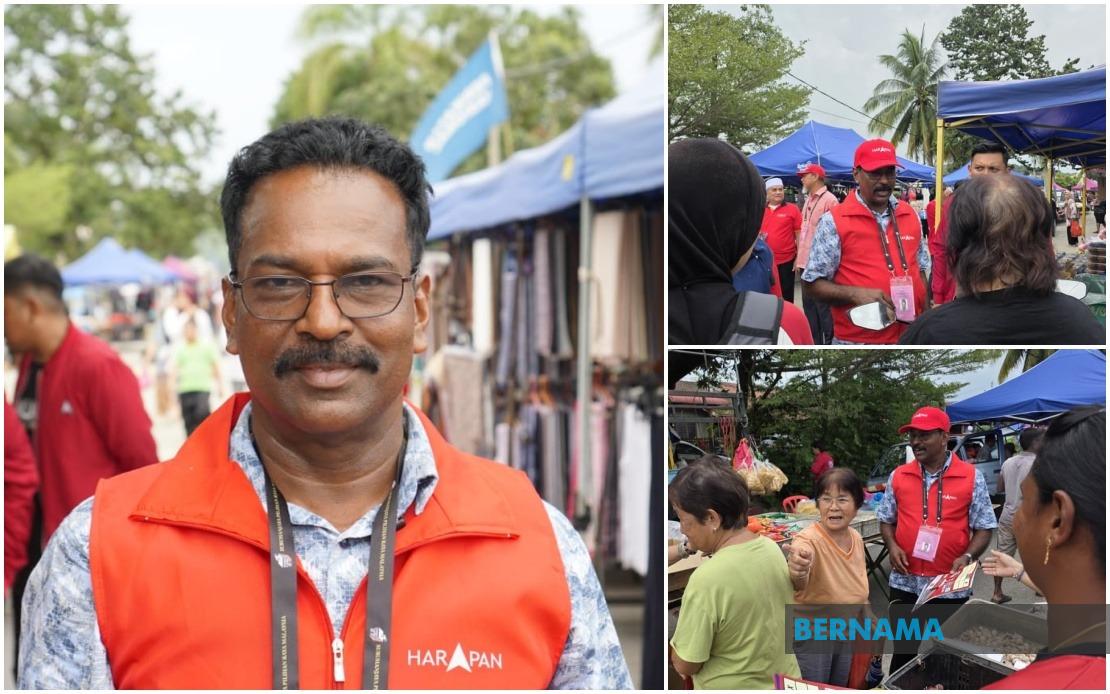
C. Subramani, the Pakatan Harapan candidate contesting Bukit Kepong in the 16th Johor state election, is banking on a groundswell of voter frustration to upset the traditional power dynamics in a constituency currently represented by a Perikatan Nasional incumbent. Speaking during campaign stops across the Pagoh district, Subramani expressed confidence that his engagement with residents—particularly marginalised communities—has positioned him to deliver a result that few political observers anticipated when nominations closed. The three-way contest between PH, Barisan Nasional, and Perikatan Nasional candidates reflects the fractured state of Malaysian electoral politics, yet Subramani's optimism suggests momentum is building behind his candidacy as voters increasingly signal appetite for substantive change.
The Pagoh native's campaign strategy reflects a deliberate focus on constituency-level granularity, moving beyond national talking points to address micro-level infrastructure deficits that daily affect ordinary residents. Through systematic visits to Orang Asli settlements within the constituency, Subramani has constructed a detailed inventory of unmet needs—from inadequate drainage systems to poorly maintained street lighting and structural problems with bridges that constrain rural mobility. This methodical approach to constituency development differs markedly from previous election cycles when many candidates operated from urban-centric platforms disconnected from rural realities. By translating these observations into concrete policy commitments, Subramani has created a framework for governance that resonates with communities accustomed to federal and state governments operating in silos, with accountability diffused across multiple administrative layers.
A central pillar of Subramani's platform involves breaking down bureaucratic barriers between state and federal administrations to accelerate resolution of constituency problems. He argues that education matters requiring attention from the federal Ministry of Education, irrigation challenges needing intervention from relevant federal agencies, and drainage issues affecting livelihoods should be escalated efficiently through direct channels to ministers or the Prime Minister when state and federal governments operate in policy alignment. This approach acknowledges a persistent structural problem in Malaysian governance: when competing political coalitions control different tiers of administration, residents become casualties of institutional rivalry. For a largely rural constituency like Bukit Kepong, such coordination breakdowns have historically meant that federal infrastructure funding fails to translate into tangible improvement because state governments withhold cooperation, and vice versa. Subramani's pledge to functionally integrate governance structures addresses this fundamental failure of Malaysian federalism.
Economic revitalisation forms another dimension of his vision, particularly through reimagining the Bukit Kepong Gallery as a historical tourism destination capable of generating local employment and tax revenue. Rural constituencies throughout Johor possess significant cultural and historical assets that remain largely underdeveloped because electoral politics has traditionally prioritised cash handouts over infrastructure investment. By transforming a cultural institution into an economic engine, Subramani proposes a model where heritage preservation and economic development reinforce rather than contradict each other. Tourism revenue could fund additional social services while reducing dependence on government transfers, creating a sustainable economic foundation for the community rather than pursuing short-term political gains through temporary financial assistance.
Affordability and economic inclusion remain pressing concerns in Bukit Kepong, particularly for the B40 community comprising the bottom 40 percent of income earners. Subramani has prioritised construction of affordable housing targeted at this demographic, recognising that property ownership represents perhaps the most significant wealth-accumulation mechanism available to lower-income Malaysians. Current housing markets in many Johor constituencies have become increasingly unaffordable even for skilled workers, effectively excluding the B40 population from property ownership and intergenerational wealth transfer. By committing to deliberate construction programmes for this segment, Subramani addresses structural inequality rather than treating poverty as an electoral issue requiring only temporary welfare measures.
Subramani's political biography also shapes voter perceptions of his candidacy. Previously contesting the Buloh Kasap seat during the 2022 Johor state election, he brings accumulated experience in electoral competition and constituency management. His tenure as Pagoh PKR chief demonstrates sustained organisational involvement rather than parachute candidacy, suggesting deeper integration within community structures and party mechanisms. This progression from lower-profile positions toward higher-stakes contests aligns with typical patterns in Malaysian politics where candidates build support gradually through demonstrated competence at local level. For voters wary of politicians who materialise during election season and vanish thereafter, Subramani's sustained presence and institutional responsibilities provide reassurance of genuine commitment to the constituency.
The political context of Bukit Kepong reflects broader shifts occurring across Malaysia's electoral landscape. The 16th Johor state election involves 172 candidates competing for 56 state assembly seats, with approximately 2.7 million registered voters eligible to participate. These figures indicate a considerably fragmented political environment where traditional two-coalition contests have fragmented into genuine three-way competitions. For a constituency previously held by Datuk Dr Sahruddin Jamal of Perikatan Nasional—who retained the seat in 2022 with a majority of just 710 votes—the thinness of the incumbent's electoral mandate suggests substantial fluidity. A difference of 710 ballots across thousands of voters indicates a constituency almost evenly divided, where motivated grassroots organising could realistically produce a change in representation. Subramani's acknowledgment of the three-way nature of the contest suggests strategic awareness of this electoral mathematics and confidence that his support base, properly mobilised, can overcome the incumbent's residual organisational advantages.
Voter sentiment in rural Johor constituencies has shifted noticeably toward demanding tangible development outcomes rather than accepting patronage politics as inevitable. This maturation of electoral expectations creates opportunity for candidates willing to move beyond rhetoric toward substantive policy proposals addressing specific community challenges. Subramani's enumeration of particular infrastructure deficits and concrete economic development initiatives reflects responsiveness to this expectation. Rather than generic promises of prosperity under different political management, he articulates precisely which institutions require reform, why current arrangements underperform, and how alternative administrative approaches would improve outcomes. This specificity strengthens his credibility with voters who have witnessed countless election campaigns promising wholesale transformation without delivering measurable improvement.
The Bukit Kepong contest carries significance extending beyond the constituency itself, as it represents one instance of broader PH efforts to regain electoral ground in Johor after poor performance in 2022. The coalition's revival in various peninsular states during recent by-elections and local contests has created momentum, yet translating such trends into substantial gains in a full state election remains challenging. Subramani's potential victory, if achieved, would constitute an important data point regarding whether PH resurgence reflects genuine ideological repositioning and competence improvement, or merely temporary protest voting against incumbent coalition performance. The constituency-focused grassroots organising approach he has adopted offers a model potentially replicable across other marginal seats where traditional calculations no longer predetermine outcomes.

