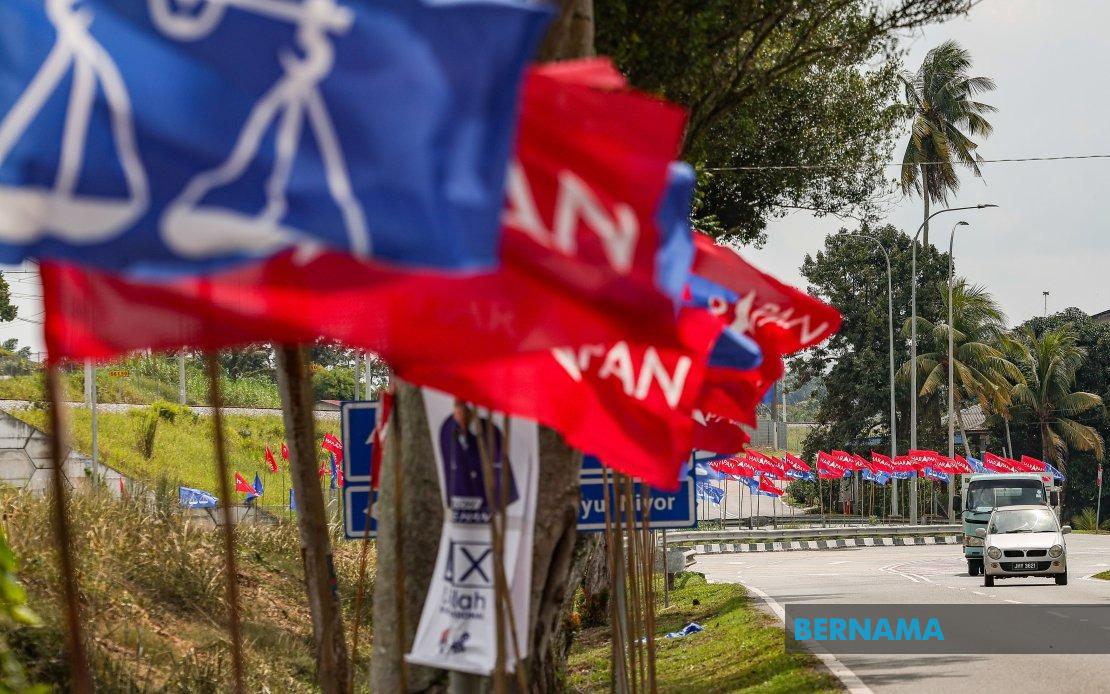
Pakatan Harapan's bid to regain the Larkin state seat in Johor hinges on a crucial variable: voter turnout. The coalition's candidate Suhaizan Kaiat has expressed confidence that his party can wrest the constituency from the incumbent Barisan Nasional if more people cast their ballots in the 16th Johor state election scheduled for July 11. His optimism draws on historical evidence rather than mere campaigning rhetoric, pointing to voting patterns that suggest the electorate's mood can shift dramatically depending on participation levels.
Suhaizan, who also serves as Member of Parliament for Pulai, grounds his assessment in the results of the 14th General Election, a watershed moment when Larkin voters demonstrated their willingness to reject the long-established BN machinery. That election victory under the Pakatan Harapan banner, with Datuk Mohd Izhar Ahmad winning the seat, showed the constituency could be moved away from traditional voting patterns. However, the subsequent 2022 Johor state election told a starkly different story, with BN's Mohd Hairi Mad Shah claiming the seat with a majority of 6,178 votes. That reversal came in an election where turnout languished at only 51 per cent, a figure Suhaizan argues was artificially depressed by pandemic-related constraints rather than representative of genuine voter preference.
The distinction between a general election and a state election matters significantly in Malaysian electoral politics. General elections typically command greater public attention, generating higher engagement and turnout across the electorate. State elections, by contrast, often struggle to mobilise voters with the same intensity. The 2022 Johor poll suffered from additional handicaps, with COVID-19 pandemic precautions limiting campaign activities and suppressing participation. Suhaizan's strategy therefore rests on the assumption that if the upcoming election attracts turnout comparable to general election levels, the constituency's underlying political alignment favours PH. This represents a calculated bet that 2022 was an anomaly driven by low engagement rather than a true reflection of voter sentiment.
Additionally, Suhaizan identifies a potentially significant source of support from Bersatu voters who may migrate towards PH. The political landscape has shifted since the previous election, with tensions emerging between Bersatu and its traditional ally PAS. This friction creates an opening for PH to appeal to voters who previously supported Bersatu but may now be seeking alternatives. Notably, Bersatu has chosen not to field a candidate in Larkin this time, a decision that could either scatter its support or concentrate it elsewhere. Suhaizan believes that PH's previous partnership with Bersatu in electoral alliances provides sufficient common ground to attract these voters, particularly those dissatisfied with recent political developments.
The contest itself has become triangular rather than two-way, adding complexity to vote distribution. Alongside Suhaizan and incumbent Mohd Hairi, the Bersama party has nominated Norsinah Abu to contest the seat. This three-way split introduces an element of unpredictability, as voters disenchanted with both major coalitions can now express their protest vote. Historically, such scenarios have benefited incumbents who retain core party machinery and support, though high turnout can disrupt this advantage by mobilising newly activated voters who are less bound by party loyalty. The Larkin battlefield thus becomes genuinely competitive rather than a foregone conclusion either way.
The broader context of the Johor election encompasses 172 candidates competing for 56 state seats, making this one of Malaysia's more significant sub-national electoral contests. Johor's political significance stems from its status as the largest state in Peninsular Malaysia by land area and its economy's contribution to the nation. The outcome will shape state governance for the next five years and carry implications for federal politics, particularly regarding the balance of power within Peninsular Malaysia's ruling configurations. A strong PH performance could bolster the coalition's narrative of comeback potential, while continued BN dominance would reinforce arguments about the party's resilience despite recent national setbacks.
For Southeast Asian observers monitoring Malaysia's democratic dynamics, the Johor election serves as a bellwether for voter behaviour patterns in the region. The emphasis on turnout as a decisive factor reflects broader trends across Southeast Asia, where participation levels often swing elections more dramatically than shifting policy preferences. PH's strategy of counting on mobilisation rather than conversion suggests the coalition views its core supporters as energisable through effective campaigning and by highlighting the stakes of the election. This approach has proven effective in some contexts, such as the 2018 general election, but carries risks if the party overestimates its ability to drive turnout.
Early voting is scheduled for July 7, providing an alternative to July 11's main polling day. Early voting mechanisms have grown in importance across Malaysian elections, as they allow those unable to vote on the main day to participate nonetheless. How candidates perform in early voting can offer preliminary signals of actual support levels, though such indicators require careful interpretation given that early voters often exhibit different demographic profiles than main-day voters. Both PH and BN will scrutinise early voting results closely to adjust final campaign messaging in the brief window before the main election.
Suhaizan's framing of the contest—transforming the 2022 defeat into an argument about procedural factors rather than fundamental voter preference—represents classic opposition rhetoric designed to maintain morale and motivate supporters. Whether this narrative proves persuasive will depend partly on external factors like economic conditions and political news in the week before polling, partly on ground-level campaign effectiveness, and partly on the unpredictable element of whether voters actually do turn out at higher rates. The candidate's confidence should be understood as both an expression of genuine assessment and a performative statement intended to energise the PH machinery.
The path to victory for PH in Larkin thus remains narrow but visible. It requires not merely competitive campaigning but an actual shift in participation dynamics compared to 2022. Whether Malaysian voters in Johor will provide that higher turnout, and whether they will distribute their votes according to PH's hopes should they do so, will become clear on July 11. The election offers voters themselves a choice not only about which party governs Larkin, but implicitly about what kind of political engagement they wish to demonstrate.

