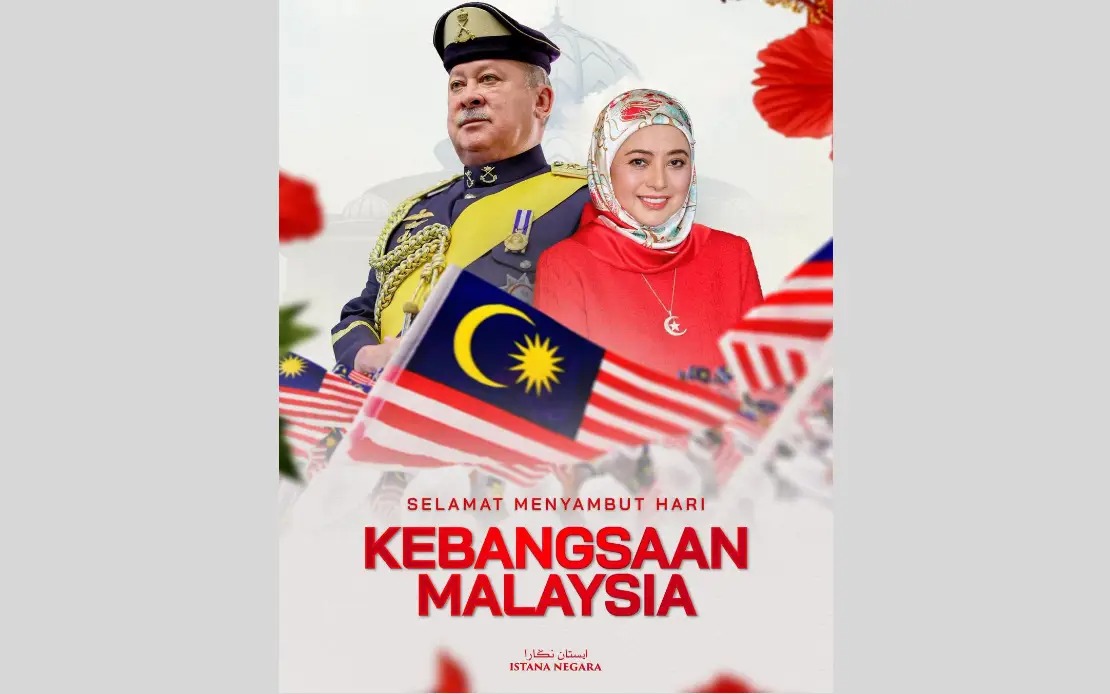
Malaysia's reigning monarchs, Sultan Ibrahim Sultan Iskandar and Raja Zarith Sofiah, led the country's 69th National Day commemoration in Putrajaya on August 31, delivering greetings to citizens through an official royal announcement. The occasion marked another milestone in the nation's democratic journey, with the celebration drawing together government officials, armed forces personnel, and representatives from across Malaysia's diverse communities to mark the country's independence achieved in 1957.
The festivities in Putrajaya welcomed Prime Minister Datuk Seri Anwar Ibrahim and his spouse Datuk Seri Dr. Wan Azizah Wan Ismail, who greeted the royal couple upon their arrival at 8 am. Also in attendance was Communications Minister Datuk Seri Fahmi Fadzil, who chairs the National Day and Malaysia Day (HKHM) 2026 Main Committee. The gathering demonstrated the ceremonial unity that characterizes Malaysia's highest state occasions, bringing together the executive and constitutional heads of state in shared patriotic observance.
This year's celebration centred on the theme "Malaysia MADANI: Kesejahteraan Dinikmati," which translates to an emphasis on the wellbeing enjoyed by the population. The MADANI framework, introduced as a guiding philosophy for national governance, seeks to reshape policy priorities around equitable development and social cohesion. By anchoring National Day around this concept, organizers aimed to communicate that independence and sovereignty ultimately derive meaning from their tangible benefits to ordinary Malaysians rather than abstract nationalist symbolism alone.
The proceedings opened with a formal military ceremony that underscored the armed forces' constitutional role in safeguarding national unity and territorial integrity. This traditional element has remained central to National Day observances across decades, reinforcing continuity with Malaysia's post-independence defence establishment. Following the military formalities, the program transitioned to cultural and entertainment segments featuring stage performances that entertained the assembled crowd and broadcast audience.
A procession that followed showcased Malaysia's demographic complexity through carefully choreographed presentations. The parade drew participation from 10,819 individuals organized across 76 separate contingents, including representatives from government agencies, educational institutions, community organizations, and civil society groups. The spectacle incorporated 22 brass bands providing musical accompaniment, 11 specially decorated vehicles, and 328 combined assets from the army, navy, and air force, demonstrating the military's organizational capacity and technological capabilities.
Animal handlers brought 112 service animals into the parade, including horses, dogs, and other creatures traditionally associated with ceremonial displays across Malaysian culture. This inclusion reflected efforts to incorporate diverse symbolic elements that resonate across the country's plural society. Complementing these physical displays, organizers deployed 22 electric vehicles throughout the procession, signalling commitment to environmental sustainability and modernization even within traditional state ceremonies—a deliberate message about reconciling progress with responsibility.
A particularly innovative element involved a human graphic display positioned on the terraces surrounding the main venue. This arrangement featured 26 distinct formations created by assembled participants, collectively producing visual patterns that communicated Malaysia's multicultural character. Such displays require extensive coordination and rehearsal, transforming thousands of individuals into a living canvas expressing national identity. The complexity of orchestrating such performances underscores the resource commitment and planning infrastructure required for major state ceremonies in Malaysia.
For Malaysian audiences, National Day celebrations carry significance beyond ceremonial ritual, functioning as annual moments for political elites to articulate their vision for national direction and for citizens to reflect on collective progress. The visible presence of the reigning monarchs provides constitutional legitimacy to proceedings, anchoring them within Malaysia's constitutional monarchy framework where the Yang di-Pertuan Agong serves as ceremonial head of state while prime ministers exercise executive authority. This institutional separation between ceremonial and executive branches distinguishes Malaysia's system from purely republican arrangements.
The emphasis on Malaysia MADANI throughout this year's celebration signals government intentions to position the upcoming 2026 National Day planning around themes of inclusive development and citizen welfare. As the nation approaches midway through its third consecutive decade of democracy following the 1998 Asian financial crisis, such thematic choices reflect ongoing attempts to build national consensus around developmental priorities. The scale of participation—nearly 11,000 individuals plus spectators numbering in the tens of thousands—demonstrates the logistical capacity Malaysian institutions have developed for coordinating large-scale public events.
Regional observers view Malaysia's National Day observances as windows into the nation's political stability and institutional health. The smooth coordination of such large-scale events, backed by security arrangements protecting attendees, signals effective governance capacity even amid ongoing political discussions about constitutional reform and federal-state relations. For Southeast Asia more broadly, Malaysia's multi-ethnic, multi-religious approach to national identity as expressed through such celebrations provides a model, however imperfect, for managing diversity within democratic frameworks that competing regional nations also navigate.

