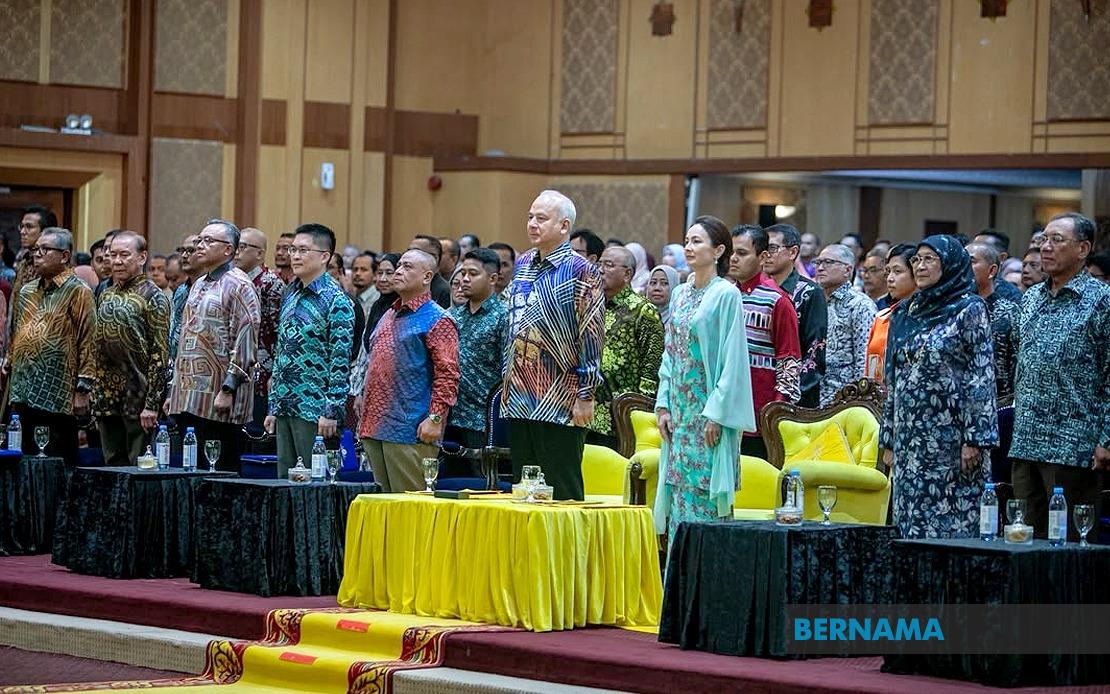
Sultan Nazrin Shah, the Sultan of Perak, attended a signature Merdeka Month celebration in Ipoh on Thursday evening, underscoring the royal institution's commitment to fostering patriotism and national pride among the younger generation. The event, held at Bangunan Perak Darul Ridzuan, formed part of the state-level observance of the 2026 Merdeka Month and drew participation from across Perak's educational landscape. Alongside Sultan Nazrin was Tuanku Zara Salim, the Raja Permaisuri of Perak, accompanied by Menteri Besar Datuk Seri Saarani Mohamad and Deputy Education Minister Wong Kah Woh, illustrating the high-level political and institutional backing for the initiative.
The programme demonstrated remarkable reach across Perak's school system, with 214,095 entries documented across both primary and secondary institutions, representing 83.6 per cent of the state's student population. This figure reflects not merely administrative success but a genuine groundswell of interest in what the state education system frames as a formative cultural experience. Perak Education Department director Zulkafli Mohamed Mokhtar noted in his address that the participation rate had climbed 15 per cent year-on-year, indicating that the programme has transcended ceremonial status to become a meaningful engagement platform for young Malaysians navigating their formative years during a period when national identity and civic values require intentional cultivation.
The underlying philosophy driving the initiative aligns closely with Malaysia's broader educational vision. Officials framed the Merdeka Month activities not as static commemoration but as a dynamic mechanism for talent discovery, confidence-building, and capability development across diverse fields. The event incorporated competitions spanning Malaysian language and English public speaking, choral performances, essay writing, poetry composition, and visual arts categories for both primary and secondary levels. This diversity of formats reflects recognition that students possess varied aptitudes and that patriotic education must meet learners where their interests and strengths naturally lie rather than imposing uniform approaches.
The Malaysia Education Plan 2026-2035 provides the strategic scaffolding for this initiative, establishing a framework that extends beyond traditional academic metrics. Rather than confining educational outcomes to examination results, the plan emphasises moral development, critical thinking, historical appreciation, and the cultivation of future leadership capacity. By situating the Merdeka Month programme within this broader educational architecture, state authorities signal that competitions and cultural activities constitute legitimate pedagogical tools for developing well-rounded citizens capable of addressing complex national challenges. For Malaysian educators, this represents an attempt to bridge persistent gaps between classroom instruction and real-world civic engagement.
Sultan Nazrin's participation carried particular symbolic weight, as royal patronage lends institutional legitimacy to the enterprise while reinforcing connections between constitutional monarchy and national identity formation. The Sultan presented a special achievement award to the Kinta Utara District Education Office, which received RM20,000 in cash recognition. This financial incentive structure demonstrates how the state government attempts to operationalise support for educational initiatives by rewarding institutional excellence at the district level, creating cascading incentives that encourage broader participation and commitment throughout the system.
The competitive elements acknowledged standout individual performances, with Ifwat Arrafi Mohd Amin of Sekolah Menengah Kebangsaan Tun Abd Razak in Bagan Datuk earning honours in the upper secondary Malay language public speaking category. Similarly, E Johnnes Abysia from Sekolah Menengah Kebangsaan Sungai Pari in Kinta Utara captured the English public speaking championship. These individual recognitions matter beyond ceremonial purposes; they create role models and tangible aspirational pathways for peers who witness their peers' success. The diversity of awardees across district locations suggests relatively equitable distribution of talent and opportunity across Perak's geographically dispersed communities.
Tuanku Zara Salim's active participation in presenting awards for essay writing, poetry composition, and poster design competitions underscored the royal family's invested engagement rather than ceremonial attendance. This gendered distribution of recognition responsibilities, with both Sultan and Permaisuri presenting across different competition categories, conveyed a message of shared institutional commitment that transcends traditional hierarchies. Such visible partnership in state celebrations carries weight in societies where royal symbolism remains potent and where younger audiences absorb lessons about gender roles and institutional responsibility through observational learning.
For Southeast Asian education specialists and policy observers, Perak's approach merits attention as a case study in how state governments navigate the tension between standardised national curricula and locally responsive educational experiences. The significant participation rates suggest that when schools and students perceive educational competitions as meaningful rather than purely bureaucratic, engagement follows. This carries implications for other Malaysian states contemplating similar initiatives and for regional governments seeking to strengthen civic education without resorting to coercive mandates or formulaic approaches.
The programme's expansion trajectory also reflects shifting demographics and technological accessibility within Malaysia's school system. Higher participation rates may partly reflect improved communication infrastructure and school administrative capacity to register students in centralised competitions. Nevertheless, the educational establishment's ability to channel that participation into constructive patriotic expression, rather than allowing it to dissipate through poorly organised activities, demonstrates institutional sophistication. For Malaysian policymakers, this success offers a template for replicating similar initiatives in other domains requiring mass youth engagement, from environmental conservation to digital literacy.
Looking forward, sustaining such participation levels presents a distinct challenge separate from initial mobilisation. The education sector must ensure that subsequent iterations of the Merdeka Month programme maintain quality, fairness, and genuine engagement rather than devolving into formulaic repetition. The presence of high-level political and royal support suggests institutional will to maintain investment, though budget constraints and shifting ministerial priorities remain persistent risks in Malaysia's education policy landscape. Schools in less resourced districts will require sustained support to maintain competitive participation, particularly in categories requiring specialised coaching or materials.
The event ultimately reflected a deliberate state strategy to instrumentalise cultural celebration toward specific educational and social objectives. By framing Merdeka Month not as historical retrospection but as a platform for contemporary youth development, Perak's approach integrates national commemoration with pragmatic talent identification and values formation. This represents a maturing understanding that patriotic education works most effectively when it operates through channels that students voluntarily choose and in which they perceive intrinsic value beyond examination outcomes. For Malaysian education observers and regional policymakers, the Perak programme demonstrates that traditional state rituals retain currency when reimagined as vehicles for genuine student development rather than mere administrative obligations.

