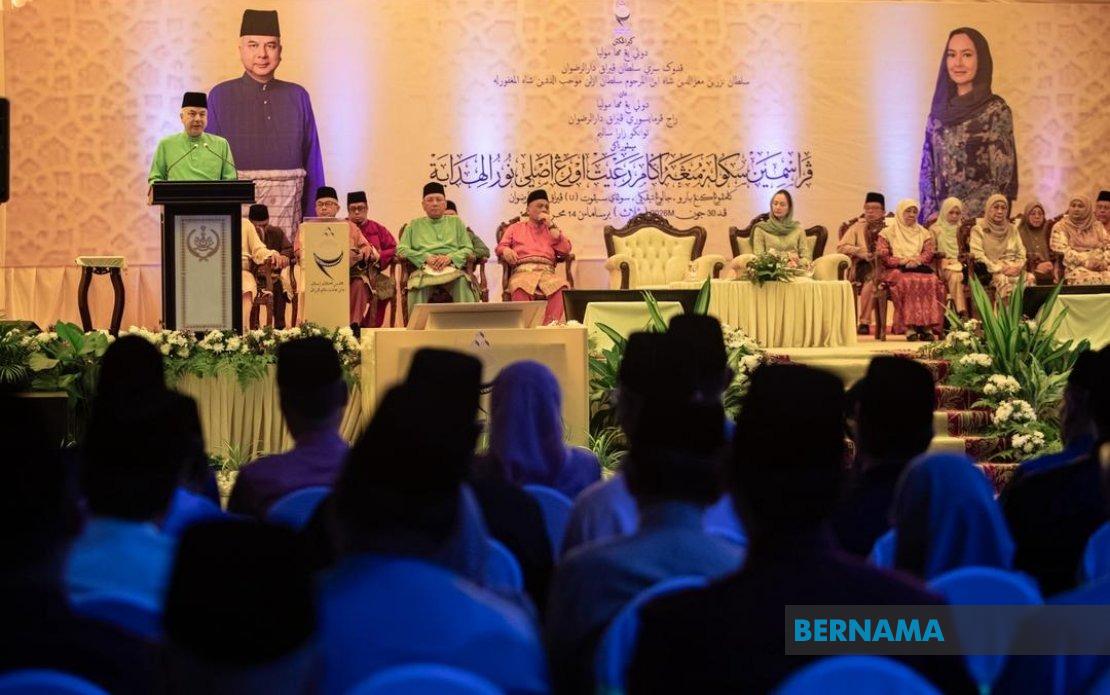
The Orang Asli community in Perak reached a significant educational milestone on June 30 when Sultan Nazrin Shah, the reigning Sultan of Perak, officially opened Sekolah Menengah Agama Rakyat (SMAR) Orang Asli Nurul Hidayah in Kampung Kenang, Sungai Siput Utara. This inaugural event marks a watershed moment in Malaysia's efforts to integrate indigenous populations into the formal education system whilst preserving their cultural and spiritual identity. The establishment of this institution represents more than a simple ribbon-cutting ceremony; it symbolizes a deliberate policy shift toward addressing historical educational disparities that have long constrained opportunity and advancement for Orang Asli youth across the peninsula.
Alongsidde Sultan Nazrin, the ceremony welcomed other senior royalty including Raja Jaafar Raja Muda Musa and Raja Iskandar Dzurkarnain Sultan Idris Shah, alongside government officials such as Menteri Besar Datuk Seri Saarani Mohamad. The presence of high-ranking representatives from the Perak Islamic Religious and Malay Customs Council (MAIPk) and the Perak Islamic Religious Department (JAIPk), led by president Tan Sri Mohd Annuar Zaini and director Datuk Harith Fadzilah Abdul Halim respectively, underscored the institutional buy-in from both state and religious authorities. This collaborative approach reflects a broader recognition that addressing educational gaps within indigenous communities demands coordinated efforts across governmental, religious, and community structures.
In characterizing the school's significance, Sultan Nazrin described SMAR Nurul Hidayah as a transformative catalyst for the Kampung Kenang settlement and surrounding Orang Asli populations. The institution emerged organically from modest beginnings as a dakwah and fardu ain learning centre before evolving into a comprehensive educational establishment offering an integrated curriculum that fuses conventional academic subjects with formal Islamic religious instruction. This hybrid approach acknowledges a fundamental reality in Malaysian nation-building: that educational advancement need not require the abandonment of religious identity or cultural continuity. Rather, the school demonstrates how modern pedagogical frameworks can accommodate and amplify indigenous communities' spiritual and cultural commitments.
The trajectory spanning more than three decades has yielded demonstrable outcomes that extend beyond standardized examination results. Sultan Nazrin highlighted that the school has successfully nurtured individuals who subsequently returned to their communities as educators, community advocates, and awareness-raisers. This phenomenon of educational reciprocity—where graduates funnel their acquired knowledge back into their own communities—represents a sustainable model for poverty alleviation and social mobility that sidesteps the historical pattern whereby education serves as a one-way exit from indigenous settlements. By creating institutional structures that encourage alumni to reinvest their capabilities locally, SMAR Nurul Hidayah addresses a critical challenge in development work: ensuring that human capital accumulation benefits the broader community rather than merely extracting talented individuals from their origins.
The Sultan articulated a vision of education extending far beyond the acquisition of technical competencies or examination credentials. His remarks emphasized that schooling constitutes a holistic developmental endeavour encompassing intellectual expansion, spiritual deepening, emotional maturation, and physical wellness. This multidimensional conception of educational purpose reflects traditional Islamic pedagogical philosophy whilst remaining relevant to contemporary understandings of human flourishing. The framing proves particularly significant for Orang Asli populations, whose historical marginalization has often reduced educational discourse to economic instrumentalism—preparing workers for labour markets rather than cultivating integrated personhood. By anchoring the school's mission in character development, moral fortitude, and leadership capacity, Sultan Nazrin repositioned education as a fundamentally humanistic endeavour.
The establishment of SMAR Nurul Hidayah directly challenges persistent infrastructural inequalities that have historically constrained Orang Asli access to secondary schooling. Geographic isolation, poverty, and inadequate transportation networks have historically rendered formal education inaccessible for many indigenous youth. By locating a purpose-built religious secondary institution within an Orang Asli settlement, Malaysian authorities have taken concrete steps to eliminate geographical barriers to educational entry. The investment in dedicated infrastructure signals government commitment to reducing the opportunity gap between urban-based privileged populations and rural indigenous communities. This physical presence serves both practical and symbolic functions: it removes immediate logistical impediments to enrollment whilst demonstrating to Orang Asli families that their children's educational aspirations merit serious institutional investment.
Sultan Nazrin's emphasis on the school's role in preserving Islamic values, syariah principles, and moral character addresses a tension sometimes perceived between modernization and religious tradition. The school model demonstrates that Orang Asli communities need not choose between contemporary educational advancement and religious fidelity. Instead, SMAR Nurul Hidayah creates institutional space where both dimensions flourish simultaneously. This reconciliation holds particular significance given Malaysia's identity as an Islamic nation where religious education occupies a constitutionally protected and culturally significant position. By ensuring that Orang Asli students access this religious educational dimension, the nation moves toward fuller inclusion of indigenous populations within the Islamic institutional framework that characterizes Malaysian society.
The Sultan's characterization of the new facilities as a major investment in the future reflects recognition that educational infrastructure requires sustained capital commitment. The new buildings, teaching resources, and learning environments constitute tangible government expenditure directed toward a historically underprioritized population. This budgetary allocation carries political significance in a federal context where competition for development resources remains intense. By channeling funds toward Orang Asli education, Perak authorities have signaled that indigenous advancement constitutes a legitimate policy priority deserving resource allocation comparable to larger population groups. This shifts the baseline expectations regarding equitable distribution of public investment, establishing precedent for future allocations.
The achievement of SMAR Nurul Hidayah's students warrants particular attention as an empirical validation of indigenous educational capacity. Sultan Nazrin's reference to encouraging results challenges persistent stereotypes and deficit-based narratives that have historically portrayed Orang Asli populations through lenses of inadequacy or incapacity. Student performance metrics serve as concrete refutation of prejudicial assumptions, demonstrating instead that with appropriate institutional support, culturally responsive pedagogy, and adequate resource allocation, indigenous learners achieve excellence across academic and religious domains. These outcomes contribute to broader decolonization efforts within Malaysian education by centering indigenous student agency and capability rather than framing indigenous communities primarily through narratives of victimization or need.
Moving forward, the model established by SMAR Nurul Hidayah potentially extends beyond Perak's borders. The school's designation as the nation's first Orang Asli Islamic secondary institution positions it as a proof-of-concept that could inform educational policy development in other states with substantial indigenous populations. Whether other state governments and religious authorities will replicate this model remains contingent upon political will and budgetary priorities. However, the existence of a functioning, successful institution demonstrating the viability of purpose-built Orang Asli education creates both practical precedent and moral pressure for broader policy adoption. States such as Pahang, Johor, and Kelantan, home to significant Orang Asli communities, may face increasing demands from indigenous advocacy groups to establish comparable facilities.
The long-term implications for Malaysian multicultural nation-building merit consideration. Historically, indigenous populations have experienced education as a mechanism of assimilation wherein schooling functioned to erode distinct cultural and linguistic identities. SMAR Nurul Hidayah's model suggests an alternative trajectory wherein formal education accommodates cultural particularity whilst enabling meaningful participation in national institutions and economic structures. This approach aligns with contemporary international best practices regarding indigenous education, which increasingly emphasize culturally embedded pedagogy and community-centered schooling rather than standardized, culturally homogenizing models. Malaysia's adoption of this framework in Perak potentially positions the nation as a regional exemplar of inclusive educational practice.
The inauguration ultimately represents neither endpoint nor complete solution to educational disparities affecting Malaysia's indigenous populations. Rather, it constitutes one institutional intervention within a larger ecosystem requiring sustained attention to curriculum relevance, teacher training, student support services, and family engagement. Yet by establishing a functioning secondary institution specifically designed to serve Orang Asli learners whilst integrating Islamic religious education, Perak has created concrete infrastructure through which educational equity can advance. The measure of success will ultimately depend upon whether this pioneering institution catalyzes broader systemic changes toward genuine inclusion, or whether it remains an isolated exemplar unsupported by complementary policy reforms and resource commitments across Malaysia's fragmented educational administration.

