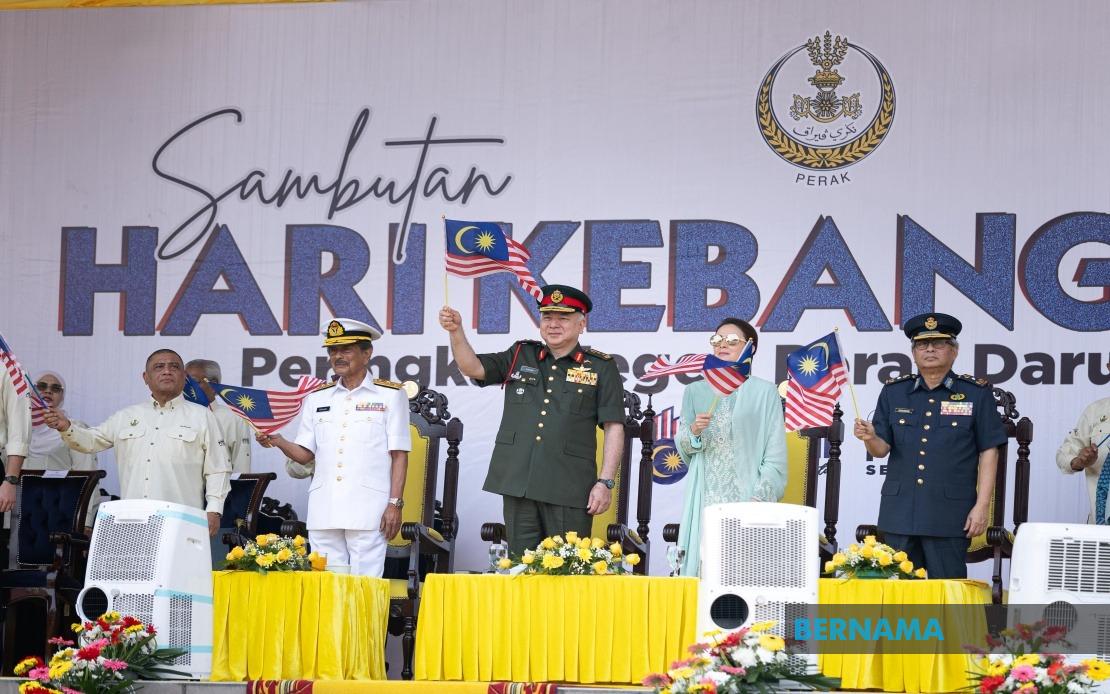
Sultan of Perak Sultan Nazrin Shah and Raja Permaisuri Tuanku Zara Salim presided over the Perak-level National Day 2026 Awards Presentation Ceremony at Dewan Bandaran Ipoh on August 31, marking a significant occasion to recognise individuals who have sacrificed for the nation's defence. The event drew prominent state officials including Perak Menteri Besar Datuk Seri Saarani Mohamad, State Secretary Datuk Ahmad Suaidi Abdul Rahim, and members of the State Executive Council, alongside Raja Muda of Perak Raja Jaafar Raja Muda Musa and Raja DiHilir of Perak Raja Iskandar Dzurkarnain Sultan Idris Shah.
During the ceremony, Sultan Nazrin conferred recognition upon 11 individuals drawn from Malaysia's security establishment, each representing different branches of the armed forces and civil police. The recipients comprised six personnel from the Malaysian Armed Forces, two from the Royal Malaysia Police, and three from the Royal Malaysian Navy. Each honoured individual received a monetary gift of RM1,000 alongside a certificate of appreciation, a tangible acknowledgement of their service to the nation during critical periods.
Among the most notable recipients was Warrant Officer 2 Mohamad Razali Din, whose service exemplified the physical toll demanded by national security operations. Din sustained severe injuries during Operation Naga in Banding when he stepped on a landmine, resulting in the amputation of his left leg below the knee. His continued willingness to be recognised despite such sacrifice underscores the commitment expected from Malaysia's defence personnel in protecting territorial integrity and combating security threats.
Another distinguished honouree was Warrant Officer 2 Megat Abdullah Megat Othman, whose operational record reflected combat effectiveness during internal security operations. Othman successfully eliminated three communist terrorists during Operation Batu Kawah in Sri Aman, demonstrating the frontline role played by armed forces personnel in addressing armed insurrection. His presentation with a commando knife alongside the standard recognition reflected the distinctive commendation for direct combat achievement.
The broader cohort of Malaysian Armed Forces recipients included Staff Sergeant Idris Ismail, Corporal Mokhtar Sulaiman, Lance Corporal Khairul Anuar Abdul Hamid, and Lance Corporal Alias Abd Wahab, representing the enlisted ranks' substantial contribution to national defence operations across various theatres and timeframes. The recognition of enlisted personnel alongside senior warrant officers reflects institutional acknowledgement that security and sovereignty depend upon capabilities distributed throughout the service hierarchy.
The police contingent among the honourees comprised retired Sub-Inspector Omar Jayus and retired Sergeant Major Abdul Malek Nordin, both representing the civilian law enforcement dimension of national security architecture. Their inclusion alongside military personnel underscores the integrated approach Malaysia maintains toward internal security, where police and armed forces operate complementary roles in maintaining order and protecting citizens.
Naval representation came from three retired officers: First Admiral Mohamad Imran Abd Hamid, Commander Mohd Akhbar Mohd Yusof, and Warrant Officer 2 Ahmad Safwi Shaari. The inclusion of naval personnel reflected Malaysia's maritime security priorities, particularly relevant given the nation's extensive coastlines and significant Exclusive Economic Zone. These officers' recognition acknowledged the Royal Malaysian Navy's role in protecting territorial waters and maintaining freedom of navigation.
Beyond the awards ceremony, Sultan Nazrin also presented prizes for excellence in National Day 2026 competitions, including the National Month parade and beautification initiatives across Perak. This broader programme of recognition extended beyond security sector achievements to encompass community participation in national observances, demonstrating how official recognition frameworks encompass multiple dimensions of national celebration and civic engagement.
Menunggu Besar Saarani Mohamad's address during the ceremony articulated a sophisticated political message regarding national cohesion and social stability. Saarani emphasised that Malaysia's foundational strength derived not from homogeneity but from deliberate coexistence among diverse populations, a nuanced framing particularly relevant in contemporary Malaysia where communal tensions occasionally surface. He reminded attendees that unified nationhood required constant cultivation, not passive maintenance, and that the symbols binding Malaysians—the Jalur Gemilang flag, the Federal Constitution, the Malay language as official medium, and the institution of Rulers—functioned as frameworks within which diversity could coexist peacefully.
Saarani's cautionary remarks about erosion of communal solidarity addressed a substantive concern within Malaysian discourse. He warned that social distance emerged when individuals perceived others primarily through demographic categories—race, religion, or group affiliation—rather than as individual persons. This concern reflected recognition that inter-communal friction historically escalated through precisely such processes of categorical thinking displacing individual recognition. His articulation suggested that maintaining Malaysia's fragile social compact required conscious effort to see beyond identity markers toward shared humanity.
The Menteri Besar's framing of national unity as an achievement requiring perpetual reinforcement carried implications beyond ceremonial rhetoric. In Southeast Asian context, where multiple nations grapple with managing internal diversity, Malaysia's experience offered both cautionary and instructive lessons. The emphasis on institutional frameworks—constitutional order, shared language, unified symbols, and the stabilising role of traditional monarchy—represented an argument that successful pluralism required robust institutional architecture rather than relying upon demographic goodwill alone.
For Malaysian audiences and regional observers, the Perak ceremony served multiple purposes simultaneously: honouring individuals whose sacrifices sustained state capacity, reaffirming institutional commitments to recognising service, and articulating political messaging about national cohesion adapted to contemporary social dynamics. The event illustrated how ceremonial occasions functioned as platforms for reinforcing state ideology while simultaneously providing meaningful recognition to security personnel whose contributions remained often invisible to general populations. The combination of awards to those bearing permanent war injuries alongside combat achievements and administrative service underscored that defence of national sovereignty encompassed multiple pathways and demanding personal costs.

