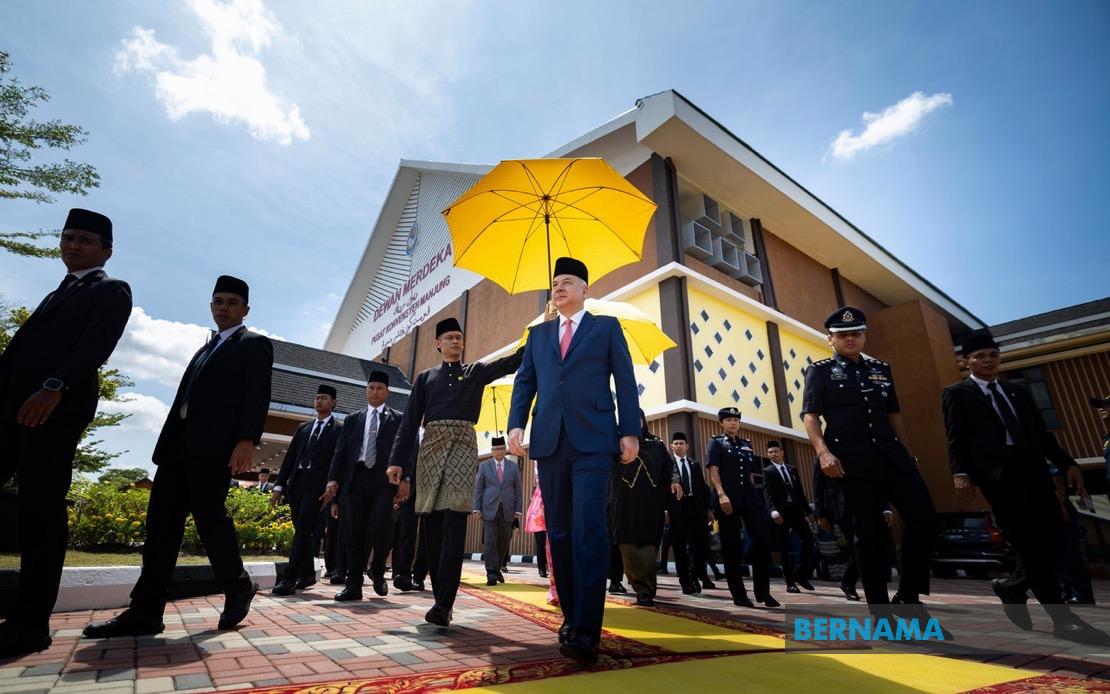
Sultan Nazrin Shah, the Sultan of Perak, formally opened the Merdeka Hall of Manjung Municipal Council in Lumut on August 4, marking a significant milestone for the coastal district in Perak. The ceremony drew together key figures from the state and federal governments, including Tuanku Zara Salim, the Raja Permaisuri of Perak, and Raja Iskandar Dzurkarnain Sultan Idris Shah, the Raja Di Hilir. The event underscored the collaborative approach between Perak's state administration and the federal government in advancing infrastructure development across the state.
The venue itself represents a substantial investment in Manjung's future. Constructed at a cost of RM12.7 million, the Merdeka Hall boasts a capacity of 2,500 people, positioning it as a major gathering space for the municipality. Its architectural and functional scope extends well beyond ceremonial purposes, as the facility has been designed to accommodate official functions, large-scale conferences, and community activities. For a district seeking to elevate its profile on the national and regional stage, such infrastructure carries symbolic weight as much as practical utility.
Manjung Municipal Council's Menteri Besar, Datuk Seri Saarani Mohamad, articulated three interconnected milestones converging at this opening. The first reflects the fulfilment of a vision initiated in 2016, demonstrating the multi-year commitment required for significant capital projects in Malaysia. Simultaneously, the council celebrates its silver jubilee, having been established as a district council on January 1, 1980, before being elevated to municipal status on August 1, 2001. This quarter-century trajectory illustrates how local government structures evolve to meet growing administrative and developmental demands. The third milestone addresses ambition: Manjung is positioning itself to achieve Tourism and Maritime City status by 2030, a designation that would reshape the district's economic trajectory and regional significance.
The project's origins carry implications for understanding governance continuity in Perak. Initial planning commenced in 2016 under a previous Menteri Besar who championed the reconstruction effort. The subsequent journey through Federal Government channels for budget allocation, eventual approval, and completion demonstrates both the institutional persistence required and the coordination mechanisms between state and federal tiers. For observers tracking Malaysia's federal-state dynamics, this project exemplifies constructive partnership, particularly relevant given periodic tensions in centre-state relations elsewhere in the country.
Manjung's strategic vision warrants closer examination for Malaysian readers. The district encompasses Lumut, home to crucial naval installations and port infrastructure, alongside growing tourism potential anchored in coastal attractions and maritime heritage. The aspiration to become a Tourism and Maritime City reflects pragmatic economic diversification, particularly as traditional industries face global pressures. Establishing world-class venues like Merdeka Hall positions Manjung to attract international conferences, trade exhibitions, and cultural events that generate revenue and employment while elevating the district's profile beyond Perak's boundaries.
Saarani's remarks during the ceremony emphasised the symbolic dimension of the Merdeka name itself. He characterised independence as a perpetual trust requiring vigilant stewardship and values that sustain societal dignity. This framing, common in Malaysian official discourse, connects infrastructure investment to deeper questions of national resilience and social cohesion. The Merdeka Hall thus becomes more than functional space; it represents tangible commitment to spaces where diverse voices can gather, knowledge circulates, and consensus-building occurs. Such messaging resonates particularly in Malaysian context, where unity narratives remain central to national identity discourse.
The timing compounds the event's significance. Launching a major municipal facility during Manjung's 25th anniversary celebrations amplifies media attention and public engagement. For local stakeholders—traders, tourism operators, community organisers—the hall's inauguration signals governmental confidence in the district's trajectory. This confidence may trigger private sector interest, from hospitality investment to supporting service industries. Regional competitions for hosting major events intensify across Southeast Asia, and facilities like Merdeka Hall serve as essential infrastructure for capturing such opportunities.
From a Malaysian political perspective, this inauguration illustrates how state governments leverage development projects to demonstrate competence and deliver on promises. Saarani's emphasis on governance continuity and Federal-state cooperation addresses potential criticism that delays or cost overruns undermine credibility. Completing projects on schedule and within budget strengthens political capital, particularly important for state administrations seeking re-election or enhanced standing within national party structures.
The project also reflects broader patterns in Malaysian urban development. As major cities become increasingly congested and expensive, secondary cities like Manjung seek to differentiate themselves through strategic infrastructure. The RM12.7 million investment, while substantial, remains modest compared to mega-projects in the Klang Valley or Penang, yet represents significant commitment for a district municipality. This tier of investment increasingly characterizes Malaysia's approach to balanced development, recognising that growth beyond premier urban centres requires targeted capital injection into enabling infrastructure.
Looking forward, the hall's success hinges on utilisation and maintenance. Malaysian history includes examples of grand facilities underutilised due to poor planning, insufficient local demand, or management challenges. For Manjung, the marketing effort matters equally to construction quality. Attracting regional conferences, international symposia, and major events requires proactive engagement with event organisers, consistent service delivery, and competitive pricing relative to other Malaysian venues. The district's maritime and naval connections offer distinctive positioning possibilities that can be leveraged.
The presence of Datuk Seri Dr Zambry Abd Kadir, the Higher Education Minister, hints at potential complementarities. Educational institutions increasingly partner with municipalities for conferences, research dissemination, and academic gatherings. Manjung's proximity to universities and research facilities in Perak and neighbouring states could be systematically cultivated to ensure regular Merdeka Hall usage. This sector-specific thinking transforms a general-purpose facility into a strategic node within broader ecosystem development.
Ultimately, the Merdeka Hall opening demonstrates how Malaysian governance increasingly recognises that post-pandemic recovery and economic competitiveness require investment in gathering spaces and community infrastructure. While digital connectivity expands, face-to-face interaction remains irreplaceable for conferences, business matchmaking, and cultural exchange. Manjung's investment positions the district to capture opportunities arising from Malaysia's strategic location and growing profile in regional tourism and maritime sectors. The hall's success will substantially depend on management quality and continuous engagement with potential users, but the initial commitment reflects calculated ambition appropriate for a municipality aspiring to genuinely regional significance.

