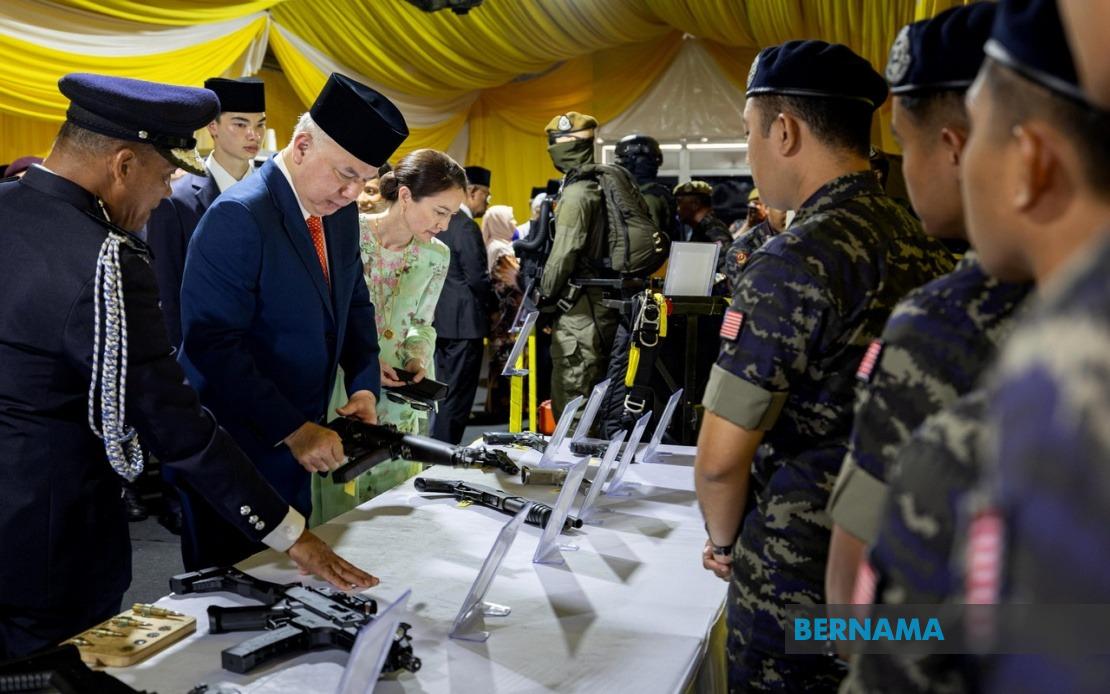
The Sultan of Perak, Sultan Nazrin Shah, formally inaugurated the Sultan Nazrin Shah 69 Commando Camp in Ulu Kinta on July 7, marking a significant milestone for one of Malaysia's most storied security units. The ceremony brought together members of the royal household, including the Raja Permaisuri of Perak, Tuanku Zara Salim, alongside senior government officials and law enforcement leaders, underscoring the national importance attached to the facility.
The presence of Home Minister Datuk Seri Saifuddin Nasution Ismail and Inspector-General of Police Tan Sri Mohd Khalid Ismail, together with Perak Menteri Besar Datuk Seri Saarani Mohamad, demonstrated the cross-institutional support backing this major infrastructure investment. The gathering reflected the government's recognition that modern, well-equipped facilities are essential for maintaining Malaysia's security posture in an increasingly complex regional environment.
The new camp represents a substantial financial commitment, with construction costs exceeding RM206 million spread across a sprawling 338-hectare site in Ulu Kinta. This scale of investment signals the government's determination to provide the 69 Commando with world-class infrastructure that matches the demands of contemporary security operations. The facility was deliberately designed to accommodate the unit's operational, training, and administrative functions under a unified command structure, replacing the previous arrangements across multiple locations.
In his remarks at the opening ceremony, Saifuddin Nasution articulated the MADANI Government's overarching security philosophy, emphasising that the camp exemplifies the administration's commitment to fortifying Malaysia's security apparatus against emerging and sophisticated threats. He stressed that provision of adequate facilities and conducive training environments forms a cornerstone of national defence strategy. This positioning reflects growing awareness among Malaysian policymakers that excellence in security operations depends critically on infrastructure that enables personnel to maintain peak readiness and proficiency.
Malaysia's standing in the Global Peace Index provides quantitative validation for these efforts. The country's 12th-place ranking among 163 nations represents a notable achievement that Home Minister Saifuddin Nasution highlighted as a source of national pride. This metrics-based acknowledgment underscores that Malaysia's security framework, despite regional challenges, continues to deliver measurable stability that benefits both domestic populations and international confidence in the nation's governance.
The 69 Commando unit, established in 1969, carries a distinguished operational heritage spanning more than five decades. The unit's involvement in combating communist insurgency during earlier periods, followed by its response to the Al-Maunah incident in 2000, demonstrates the breadth of challenges it has confronted. More recent high-profile operations underscore the unit's continuing relevance: participation in Ops Daulat in Lahad Datu, Sabah in 2013 during the armed incursion, and deployment in connection with the MH17 tragedy in 2014, all illustrate the 69 Commando's role as Malaysia's go-to rapid response force for complex security contingencies.
Beyond conventional counter-insurgency and crisis response, the unit has developed specialised capabilities in counter-terrorism operations and hostage rescue missions, skill sets increasingly essential in Southeast Asia's security landscape. These capabilities position Malaysia to respond effectively to the types of asymmetric threats that challenge governments across the region. The new camp's design deliberately accommodates advanced training scenarios that will enable the 69 Commando to maintain and enhance these critical proficiencies.
The transfer of the facility to Royal Malaysia Police custody in 2024 consolidates command and control arrangements, bringing the 69 Commando under a unified police leadership structure. This organisational alignment reflects broader security sector reforms aimed at enhancing operational coherence among Malaysia's law enforcement and paramilitary agencies. The arrangement also enables more efficient resource allocation and inter-agency coordination for complex operations requiring multiple security institutions.
Saifuddin Nasution's characterisation of the camp as more than mere physical infrastructure carries deeper significance. He framed it as a symbolic affirmation of national gratitude toward the generations of 69 Commando personnel who have risked their lives safeguarding Malaysian sovereignty and territorial integrity. This recognition of sacrifice serves to reinforce institutional morale and esprit de corps among security personnel, qualities essential for maintaining operational effectiveness during prolonged or high-stress deployments.
The facility's role in nurturing the next generation of 69 Commando officers and personnel addresses succession planning and institutional continuity challenges facing all elite military and paramilitary units. Modern training infrastructure allows more sophisticated simulation of operational scenarios, accelerating the learning curve for incoming personnel and enabling them to internalise complex tactical and strategic lessons that would take far longer to acquire through traditional methods.
For Malaysia and Southeast Asian observers, the opening of Sultan Nazrin Shah Camp represents a broader investment in regional security capacity. As transnational security threats—ranging from maritime piracy to organised crime networks to terrorism—persist across the region, well-resourced and professionally trained rapid response units become increasingly valuable to both individual nations and regional stability architecture. Malaysia's commitment to equipping the 69 Commando with modern facilities suggests confidence in the unit's continued relevance and effectiveness.
The naming of the facility in honour of Sultan Nazrin Shah carries both symbolic and practical significance. The Sultan's involvement in the opening ceremony places the royal seal of approval on national security investments, reinforcing the constitutional roles of Malaysia's monarchies in overseeing matters of internal and external security. This royal endorsement strengthens public confidence in security institutions and connects defence operations to the broader framework of constitutional governance.
Looking forward, the Sultan Nazrin Shah Camp will likely serve as a testing ground for new operational doctrines and training methodologies that could be adapted across Malaysia's broader security apparatus. The facility's comprehensive design accommodates not only tactical training but also strategic-level exercises and inter-agency coordination drills. Over the coming years, the camp's effectiveness in maintaining 69 Commando readiness will provide valuable lessons for security planning across Southeast Asia.

