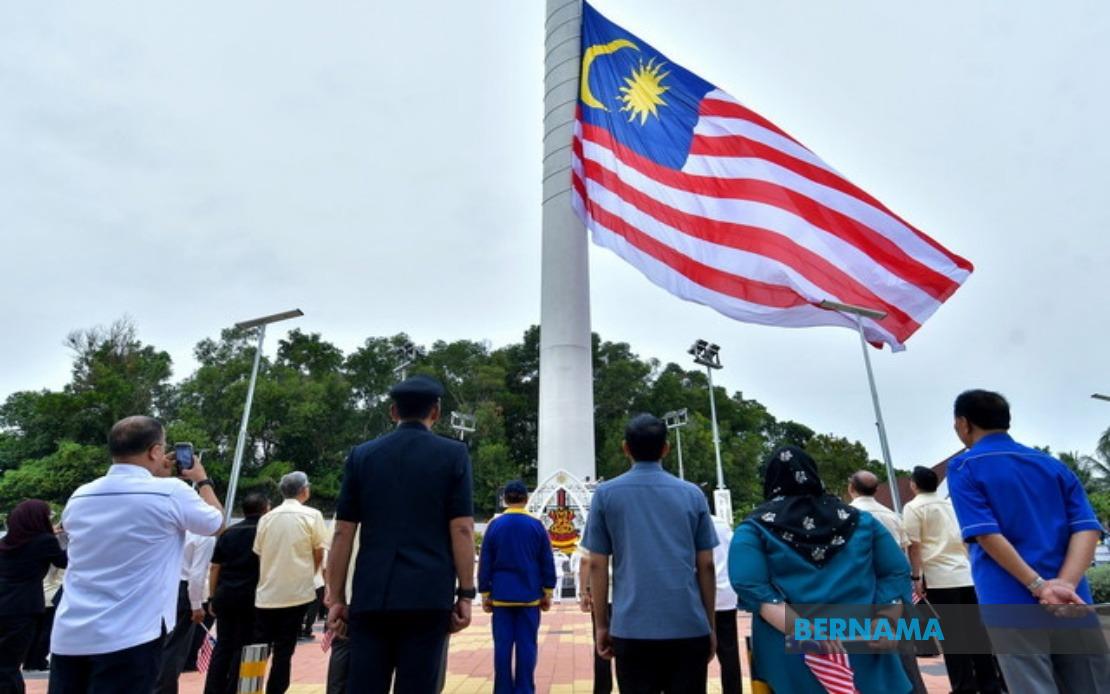
In a powerful statement delivered during the flag-hoisting ceremony at Dataran Selangor, Sultan Sharafuddin Idris Shah has pressed Malaysians to recognise the Jalur Gemilang not as a seasonal emblem brought out during festive periods, but as a enduring representation of shared national identity that transcends the divisive boundaries often emphasised in public discourse. Speaking on August 26, the Selangor ruler stressed that despite the evident diversity spanning ethnicity, faith, political orientation, and social background that characterises Malaysian society, the flag stands as a tangible reminder of the fundamental reality that all residents remain citizens of a single nation bound by common cause and mutual obligation.
The Sultan's intervention carries particular significance given the contemporary Malaysian context, where concerns about communal cohesion frequently dominate public conversation. By framing the Jalur Gemilang as a unifying emblem that transcends factional boundaries, Sultan Sharafuddin addressed what appears to be a deliberate rhetorical strategy—one that emphasises shared citizenship over sectarian identity. His insistence that "this flag belongs to all of us" represents more than ceremonial rhetoric; it constitutes an institutional voice reminding Malaysians that national symbols remain the collective property of the entire populace, regardless of individual circumstances or allegiances.
The broader context of this statement involves the month-long celebration extending from August 26 through September 17, commemorating both the August 31 National Day and the September 16 Malaysia Day. Sultan Sharafuddin had previously authorised the sustained display of the Jalur Gemilang throughout this extended observance period, transforming Dataran Selangor into a symbolic anchor point for patriotic expression. This decision reflects a deliberate effort to maintain the visibility of national symbolism during the crucial weeks bridging these two independence-related commemorations, each carrying distinct historical significance for different segments of the Malaysian federation.
Crucially, the Sultan positioned his remarks within a broader framework concerning the responsibilities of both ordinary citizens and national leadership. While acknowledging the straightforward mechanics of flag deployment—thousands of Jalur Gemilang unfurling across towns and cities—he redirected attention toward the substantially more demanding challenge of constructing a genuine national community where individuals of all backgrounds authentically experience acceptance, dignity, and belonging. This distinction between symbolic gesture and substantive inclusion exposes a central tension within contemporary Malaysian nation-building: the relative ease of patriotic performance versus the laborious work of building intercommunal trust.
The Sultan's commentary on generational responsibility deserves particular attention within the Southeast Asian context. By specifically calling for educational initiatives emphasising respect across religious, cultural, and ethnic boundaries, he implicitly diagnosed a knowledge gap within younger cohorts who may lack sufficient exposure to Malaysia's diversity or adequate frameworks for engaging across difference. This pedagogical concern reflects anxieties about social fragmentation that extend across multiple Southeast Asian societies navigating rapid demographic change and competing ideological narratives.
Equally pointed were his observations regarding political and institutional leadership. Sultan Sharafuddin explicitly cautioned against instrumentalising communal distinctions for factional advantage, noting that leaders and politicians bear specific responsibility to demonstrate moderation, forbearance, and empathy while refusing to weaponise identity categories. This constitutes a direct rebuke of political strategies that leverage ethnic or religious sentiment, however obliquely expressed. Coming from Malaysia's hereditary institution, such criticism carries institutional weight and represents a rare public intervention into political norms by the established monarchy.
The Sultan's enumeration of Malaysia's ethnic and religious composition—Malays, Chinese, Indians, Kadazan-Dusuns, Ibans alongside Muslims, Buddhists, Christians, and Hindus—served a deliberate cataloguing function. By explicitly naming these communities within the context of a shared flag, he reinforced the principle that national symbolism encompasses and affirms all constituent groups rather than serving as property of particular majorities. This rhetorical strategy counters zero-sum framings that treat intercommunal accommodation as loss rather than mutual enrichment.
For Malaysian readers and policymakers, Sultan Sharafuddin's remarks offer an instructive template for reconceptualising national unity. Rather than portraying unity as requiring erasure of individual identity or subordination to dominant groups, he articulated a vision where distinct backgrounds coexist within frameworks of mutual recognition and respect. This framing proves particularly relevant for Malaysia's position within Southeast Asia, where similar tensions between plural populations and nation-state consolidation generate ongoing political contestation.
The Sultan's distinction between independence as ceremonial celebration and independence as substantive commitment to peaceful coexistence crystallises a fundamental challenge facing Malaysian governance. The ease with which officials can orchestrate flag ceremonies masks the persistent difficulty of constructing institutional arrangements and social practices that genuinely facilitate intercommunal flourishing. His implicit suggestion that true independence remains incompletely realised—that the work of building genuine unity continues—provides a sobering counterpoint to triumphalist commemoration.
Ultimately, Sultan Sharafuddin's position reflects institutional concerns about Malaysia's social cohesion at a moment when polarisation threatens the foundational accommodation underlying the federal system. By positioning the Jalur Gemilang as belonging equally to all Malaysians and invoking monarchical authority to reinforce this principle, he attempted to establish normative guardrails against particularistic appropriation of national symbolism. Whether such interventions prove sufficient to counteract centrifugal forces within Malaysian society remains an open question—one with profound implications for regional stability given Malaysia's multicommunal character and strategic position within Southeast Asia.

