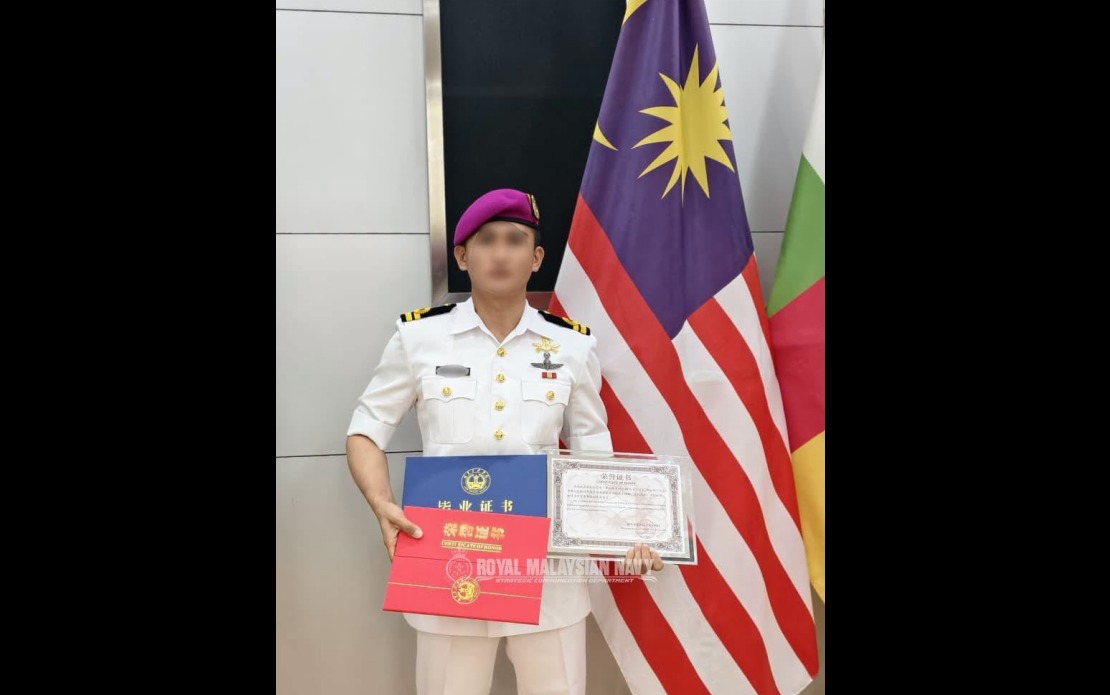
Sultan Sharafuddin Idris Shah, who serves as Captain-in-Chief of the Royal Malaysian Navy, has formally commended a member of the RMN's elite Special Naval Forces (PASKAL) for his exemplary performance in a rigorous four-month sniper programme conducted at the PLA Infantry Academy in Shijiazhuang, Hebei Province. The officer's attainment of the Excellent Student Award represents a significant milestone for Malaysia's naval special operations community and underscores the growing defence cooperation between Kuala Lumpur and Beijing in professional military training.
The sniper course, which ran from March 1 to July 31, drew 131 participants representing more than two dozen nations, creating an intensely competitive environment where advanced marksmanship skills, tactical awareness, and operational discipline were rigorously tested. The Malaysian trainee's emergence as the overall top performer amid this multinational cohort signals the calibre of personnel being developed within PASKAL ranks and reflects the meticulous selection and preparation processes that precede such international postings. His success also highlights Malaysia's commitment to maintaining cutting-edge proficiency among its naval commando forces, a capability essential for maritime security operations across the Strait of Malacca and the broader South China Sea region.
Beyond the primary Excellent Student Award, the officer received additional recognition in the form of a Certificate of Honors—Excellent Cadre designation and Silver Badge Medals, accolades that further validate his technical mastery and exemplary conduct throughout the demanding programme. The stack of honours reflects not merely shooting accuracy but comprehensive competency spanning fieldcraft, movement discipline, target identification under operational stress, and integration within multinational military contexts. Such credentials will substantially enhance his utility within PASKAL, where sniper capabilities form a critical component of maritime special operations, counterterrorism, and force protection missions.
The Sultan's formal commendation carries particular weight in the Malaysian military hierarchy and civil-state framework. As both the reigning monarch of Selangor state and the constitutional head of the RMN, Sultan Sharafuddin's public recognition serves multiple purposes: it elevates individual achievement into a matter of national pride, reinforces the prestige of naval service among the officer corps, and demonstrates royal patronage of professional excellence. His statement emphasising that the officer's accomplishment "will serve as an example to other PASKAL officers and personnel to work harder to bring honour to the force and country" frames the achievement not as an isolated victory but as a benchmark for institutional aspiration and collective advancement.
The context of this training exchange deserves examination within broader regional dynamics. China's PLA Infantry Academy has increasingly hosted international military delegations and students, positioning itself as a centre for advanced infantry and special operations instruction. Malaysia's participation in such programmes reflects the pragmatic defence engagement that characterises Sino-Malaysian relations, wherein capability development takes precedence over geopolitical friction. For Malaysian defence planners, access to PLA training infrastructure provides cost-effective exposure to advanced techniques and standardised practices that enhance interoperability with neighbouring defence forces and strengthen the technical foundation of elite units.
PASKAL itself occupies a distinctive position within Southeast Asian special operations communities. Established during Malaysia's confrontation with Indonesia in the 1960s, the force has evolved into a highly trained maritime commando unit equipped for amphibious assaults, hostage rescue, underwater demolition, and intelligence gathering operations. The organisation maintains strict recruitment standards and employs rigorous selection processes that produce operators capable of sustained performance in challenging maritime and jungle environments. The officer's sniper qualification represents a specialisation that directly enhances PASKAL's lethality and precision-strike capabilities during counter-piracy, counter-terrorism, and force protection missions.
RMN Chief Admiral Tan Sri Dr Zulhelmy Ithnain was equally commended by the Sultan for overseeing an institution producing personnel of international competitive standing. This recognition underscores the navy's strategic investment in human capital development and the operational imperative of maintaining world-class professional standards. The Admiral's stewardship of the RMN during a period of modernisation, including the acquisition of new frigates and submarines, depends fundamentally on personnel training programmes that transform equipment investments into operational capability. International training exchanges like this sniper course contribute directly to that transformation by exposing personnel to global best practices and foreign operational methodologies.
The achievement also carries implications for Malaysia's broader defence posture within Southeast Asia. As maritime security challenges intensify—from transnational piracy and human trafficking to territorial claims and resource competition—nations require elite forces equipped with specialised capabilities. The PASKAL officer's top ranking demonstrates Malaysia's capacity to field personnel competitive with international standards, which indirectly contributes to regional stability by assuring both allies and potential adversaries of Malaysia's serious commitment to maritime security governance. In an era when non-traditional security threats pervade Southeast Asian waters, the combination of institutional competence and individual excellence proves increasingly valuable.
The Sultan's commendation also reflects Malaysia's cultural emphasis on recognising and celebrating achievement within hierarchical institutional structures. The formal state-level acknowledgement of a junior officer's professional accomplishment reinforces meritocratic values within the military establishment, signalling that exceptional performance receives reward and visibility regardless of rank. This approach contrasts with purely administrative assessment procedures and helps sustain organisational morale and competitive spirit among personnel striving for advancement and recognition.
Looking forward, the officer's enhanced credentials position him as a potential mentorship resource within PASKAL, where his direct experience of international training standards and foreign instructional methodologies can be disseminated across the unit. The knowledge transfer from individual achievement to collective institutional capacity represents the ultimate value proposition of international military education. Future PASKAL sniper courses conducted domestically may incorporate techniques and approaches acquired through participation in the Shijiazhuang programme, thereby multiplying the impact of the original training investment. The Royal Malaysian Navy and PASKAL have signalled their commitment to sustained professional excellence at the highest levels, a capability essential for meeting twenty-first century maritime security imperatives across Southeast Asia's increasingly complex operational environment.

