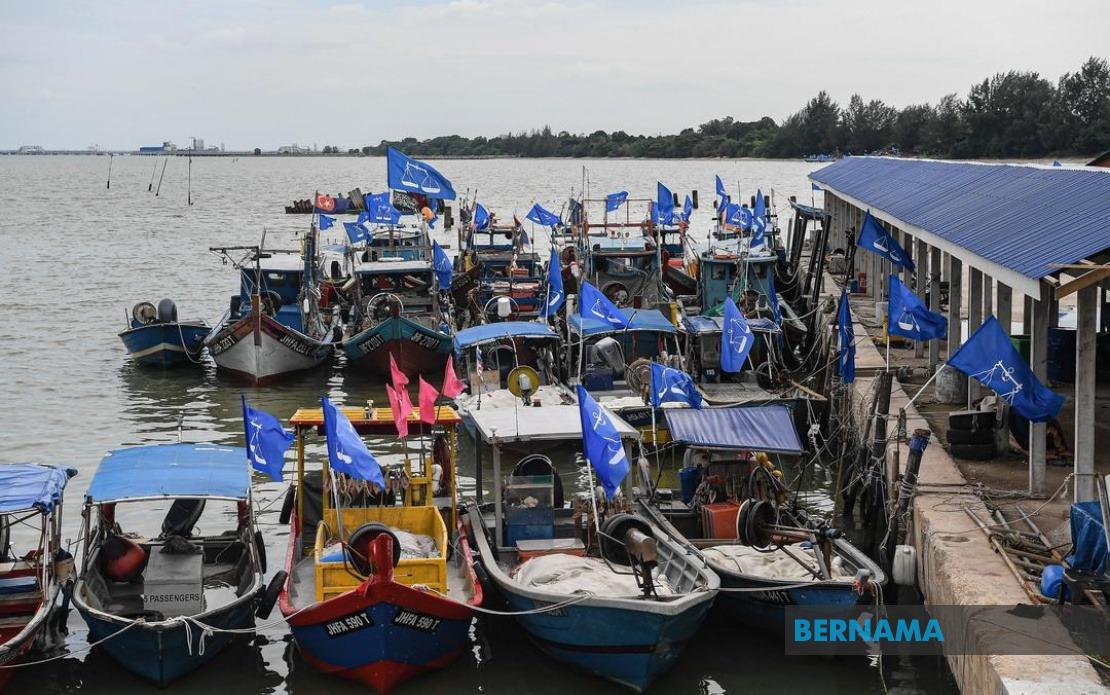
The Sungai Rengit business community faces mounting pressure as traders and fishermen in this Johor coastal town look to the winner of the Tanjung Surat state seat to finally resolve infrastructure shortcomings that have hampered their livelihoods for close to a decade. Located in Kota Tinggi and strategically positioned to serve the Pengerang Integrated Petroleum Complex (PIPC) and its workforce, Sungai Rengit has become a focal point for economic activity in the region. Yet the reality on the ground tells a different story: traders operating at the temporary Medan Selera Sungai Rengit food court are conducting business from makeshift structures, while the fishing community grapples with rising operational costs despite subsidies. Both constituencies hope that the outcome of the July 11 Johor state election will bring substantive change.
The plight of food traders at Medan Selera Sungai Rengit exemplifies the challenges facing small business operators in rural and semi-industrial areas. Nearly a decade ago, traders were relocated from their original site to accommodate a development project, a displacement that was supposed to be temporary. They were assured of relocation to a new facility within approximately eighteen months, but that timeline has stretched indefinitely. The promised new site exists but remains unsuitable for business operations. Beverage seller Lai Swee Hong, who has run her stall for three decades, points out that the alternative location suffers from inadequate parking and sits on a one-way road, both significant obstacles that deter customers and reduce foot traffic. Given these practical constraints, she and her peers have urged that the existing temporary site be properly upgraded rather than abandoned, since it remains the more accessible and familiar option for the community it serves.
The physical conditions at the temporary food court compound underscore the urgency of intervention. Traders operate from structures equipped only with canopy roofs and plywood walls—a setup that provides minimal protection against the elements and leaves stalls vulnerable to weather damage. More troublingly, the open design offers virtually no security against theft. Stalls lack proper doors and locking mechanisms, exposing traders' equipment and inventory to pilferage. Food trader Wini Fasiha Zawawi describes a pattern of petty theft incidents that have persisted since last year, with kitchen appliances disappearing despite police patrols and complaints filed with local authorities. While individual losses may not reach thousands of ringgit, the cumulative effect erodes already thin profit margins for small operators who can least afford such losses. The local authorities have acknowledged reports but have taken no concrete action to address security concerns, creating a sense of abandonment among a community that depends on predictable, safe working conditions.
This infrastructure neglect comes at a particularly acute moment given Malaysia's wider cost-of-living pressures. Traders already struggling with inconsistent customer traffic and weather-damaged stalls now must contend with rising operational expenses. The community's frustration is compounded by the fact that they have no mechanism to escalate their concerns beyond local authorities, and the political transition offers a reset opportunity. Both major candidates competing for the Tanjung Surat seat—Pakatan Harapan's Faizul Abdul Ghani and incumbent Barisan Nasional representative Aznan Tamin—will face immediate pressure to deliver tangible improvements. The traders are explicitly hoping that the elected assemblyman will prioritize facility upgrades and security enhancements as early actions in his term.
The fishing community in Sungai Rengit and its adjacent kampung faces a distinct but equally pressing set of challenges. Operating costs at sea have risen substantially, driven by fuel expenses, equipment maintenance, and the broader inflationary environment. The government's fuel subsidy scheme provides critical relief, but fishermen argue that current subsidy levels are insufficient to offset the full extent of cost increases. Sin Hock Hwee, a veteran fisherman with fifty years of experience in the profession, emphasizes that the subsidy has been instrumental in allowing fishermen to maintain viable livelihoods, yet he calls for the scheme to be enhanced further. For younger fishermen like Hidayat Isa, who is thirty-five, the concerns extend beyond immediate operating costs. He points to neglected jetty facilities that require modernization and improved infrastructure to support more efficient fishing operations.
Younger fishermen also voice concerns about representation and agency in policy discussions affecting their sector. Hidayat Isa specifically calls for the elected assemblyman to demonstrate proactivity in upgrading jetty infrastructure and, crucially, to remain responsive to the voices of the fishing community's younger members. This intergenerational dimension reflects a broader anxiety among younger residents that development priorities may overlook their needs and aspirations. The symbolic proposal to designate Kampung Sungai Rengit as an adopted village for the incoming assemblyman suggests a desire for sustained political attention and personal accountability. Such designations, while ceremonial, create an implicit commitment to continued engagement and visible development efforts.
The Tanjung Surat state constituency has become a focal point of electoral competition in the 16th Johor state election. The contest between Pakatan Harapan's Faizul Abdul Ghani and Barisan Nasional's Aznan Tamin will likely hinge partly on which candidate can convincingly commit to addressing the infrastructure and security deficiencies that have plagued the community. Both parties recognize that peripheral constituencies like Tanjung Surat, despite their smaller populations, represent swing votes that can influence overall electoral outcomes. The traders and fishermen of Sungai Rengit occupy a strategic position in this contest; their collective grievances, if mobilized effectively, could determine voter turnout and preference in a closely watched race.
From a regional perspective, the Sungai Rengit case illustrates a pattern common across Southeast Asian states: the challenge of ensuring equitable development in areas that are economically important yet geographically peripheral. The Pengerang Integrated Petroleum Complex is a major industrial asset for Johor and contributes substantially to the state and national economy. Yet the workers and service providers dependent on this complex—the traders at Medan Selera and the fishermen operating from nearby jetties—have been left with substandard facilities and deteriorating conditions. This disconnect between the economic importance of an area and the quality of public infrastructure available to local communities reflects governance failures that extend beyond any single election cycle.
The timing of the election creates an opportunity to reset expectations and establish a new baseline of accountability. Both candidates will be judged not merely on campaign promises but on the speed and quality of implementation once in office. For traders, this means measurable improvements in stall conditions, enhanced security measures, and a clear timeline for either upgrading the temporary site or facilitating a genuine transition to the planned new facility. For fishermen, it translates into demonstration of commitment to fuel subsidy continuity or expansion, jetty modernization, and regular consultation with fishing associations. The newly elected representative will face immediate pressure to produce visible results within the first six months of taking office.
The broader implications for Johor and Malaysia are significant. Sungai Rengit's experience suggests that many constituencies may harbor similar grievances—infrastructure neglect, security concerns, inadequate support for traditional livelihoods—that have been overlooked or postponed through successive electoral cycles. If the incoming Tanjung Surat assemblyman addresses these issues comprehensively and visibly, the approach could become a model for how state governments engage with economically vital but administratively overlooked communities. Conversely, if the new representative adopts a reactive posture or allows complaints to accumulate without action, the precedent will discourage similar communities from investing political capital in the electoral process.
The July 11 polling day will determine not only which candidate wins the Tanjung Surat seat but, implicitly, which vision for community-responsive governance prevails in this pocket of Johor. The traders and fishermen of Sungai Rengit have articulated their priorities with clarity and specificity. They are not requesting dramatic transformation but rather basic competence in infrastructure maintenance and security provision. Whether the elected representative delivers on these fundamental expectations will define the quality of governance in the years ahead and shape political trust in the broader region.

