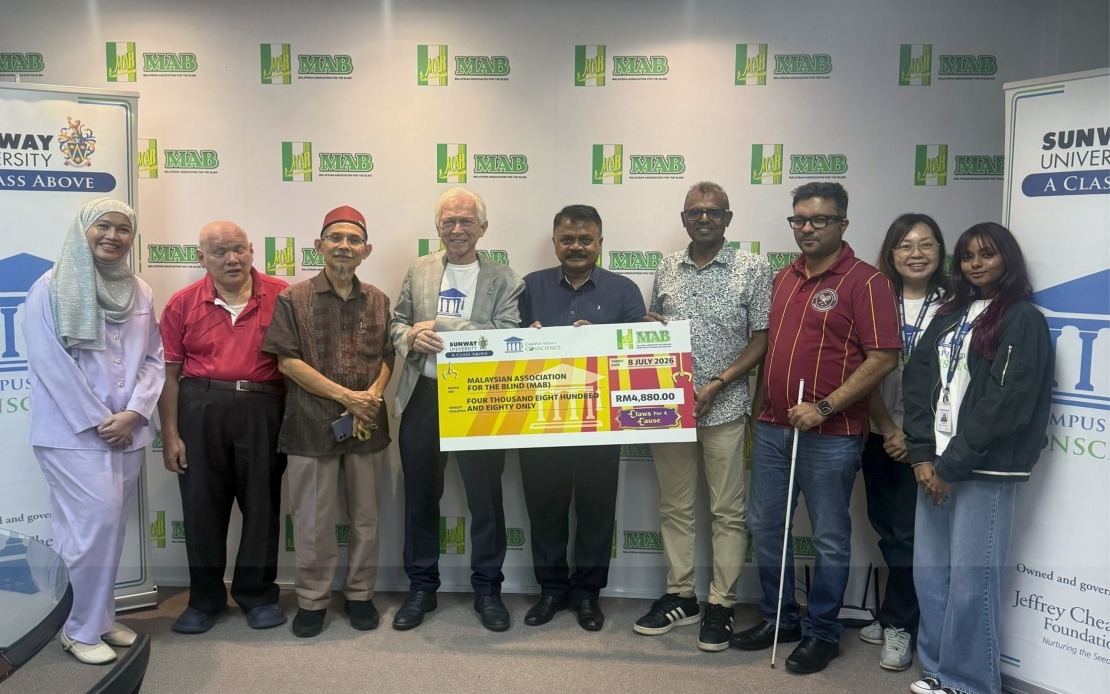
Sunway University has successfully mobilised its student and staff community to generate RM4,880 in donations for the Malaysian Association for the Blind, demonstrating how educational institutions can leverage interactive activities to support vulnerable populations. The fundraising drive, branded "Claws For A Cause," unfolded over a week-long period on campus and represented a collaboration between the university and entertainment company Space Panda, transforming a familiar arcade game into an instrument for charitable impact.
The campaign operated under Sunway University's broader Campus With A Conscience programme, a framework designed to embed social responsibility into daily university life rather than relegating it to standalone charitable events. By integrating fundraising into regular campus activities through the claw machine installation, organisers maximised participation rates among the student population and created an entertainment-driven approach that lowered barriers to involvement. This methodology reflects a broader shift in corporate and institutional philanthropy, where charitable giving is embedded within enjoyable, low-pressure experiences rather than presented as formal donation drives.
Professor Sibrandes Poppema, President and Vice-Chancellor of Sunway University, articulated the institution's philosophical positioning in relation to the initiative, emphasising that social engagement constitutes an essential component of the university's mission rather than a peripheral activity. His statement underscored that Sunway operates as a "mission-driven, fifth-generation university," terminology suggesting an institution with decades of community-centred practice and evolved approaches to stakeholder relations. This framing situates the fundraising campaign within a larger ecosystem of institutional values encompassing education, research, innovation, and community partnership, signalling that charitable work directly reflects the university's core identity.
The selection of the Malaysian Association for the Blind as the beneficiary organisation carries particular significance for Malaysia's third sector landscape. Vision impairment affects a substantial population segment, yet resources dedicated to support services, rehabilitation, and accessibility infrastructure often lag behind other health priorities in public funding allocation. By directing community fundraising toward MAB, Sunway University elevated awareness of visual impairment challenges while generating practical financial support for an organisation working to enhance employment prospects, educational access, and social inclusion for blind and partially sighted Malaysians.
Space Panda's participation exemplifies the growing corporate recognition that brand enhancement and social responsibility can align through partnership with educational institutions. Marcus, the company's director, framed the collaboration as an opportunity to demonstrate that "small acts of kindness could make a meaningful difference," language that simultaneously acknowledges the modest scale of individual contributions while emphasising their cumulative power. This rhetorical approach resonates with the psychology of prosocial behaviour, as research suggests people are more likely to participate in fundraising when contribution amounts feel modest and when collective impact is explicitly highlighted.
The practical mechanics of the "Claws For A Cause" initiative merit analysis as a case study in experiential fundraising design. By converting a gaming experience into a charitable mechanism, organisers reduced the cognitive friction typically associated with donation requests. Participants could engage with the activity for intrinsic motivations—entertainment and skill demonstration—while simultaneously generating charitable outcomes. This model potentially offers scalability for other institutions and organisations seeking to mobilise younger demographics toward philanthropic participation, particularly in Southeast Asia where game-based engagement shows high cultural resonance.
From a sectoral perspective, the campaign illustrates the evolving relationship between higher education institutions and community support organisations in Malaysia. Universities increasingly function as civic anchors within their localities, leveraging their concentrated populations and institutional infrastructure to amplify the reach of charitable initiatives. When educational institutions partner with established non-profits like MAB, they extend the beneficiary organisations' fundraising capacity beyond traditional donor bases while simultaneously providing their students with tangible exposure to social issues affecting Malaysian communities.
The partnership model between Sunway University and Space Panda also highlights the emerging ecosystem of corporate-educational collaboration in Malaysia's social enterprise landscape. Rather than operating in isolation, both organisations recognised mutual benefit in joint programming—the entertainment company gained positive brand association with educational and charitable values, while the university deepened its community engagement footprint. This win-win structure encourages replication among other businesses and institutions seeking authentic pathways to corporate social responsibility that transcend superficial gestures.
Looking forward, the RM4,880 raised represents not merely a financial contribution but a demonstration of institutional capacity mobilisation. If Sunway University's student population and staff engagement rate in this single campaign can be extrapolated to other causes, the potential for coordinated multi-initiative fundraising becomes apparent. The success of "Claws For A Cause" may prompt the university to develop additional Campus With A Conscience activities, potentially creating a systematic pipeline of support for Malaysian charities addressing education, health, disability rights, and poverty alleviation.
The campaign also carries implications for how Malaysian society conceptualises disability support and inclusion. By positioning fundraising for visual impairment services alongside student entertainment, Sunway University and Space Panda subtly normalised engagement with disability issues as a mainstream activity rather than a niche concern. This normalisation, repeated across institutional settings and corporate partnerships, gradually shifts social attitudes and increases the visibility of organisations like MAB within public consciousness, potentially expanding their donor base beyond traditional charitable circles.

