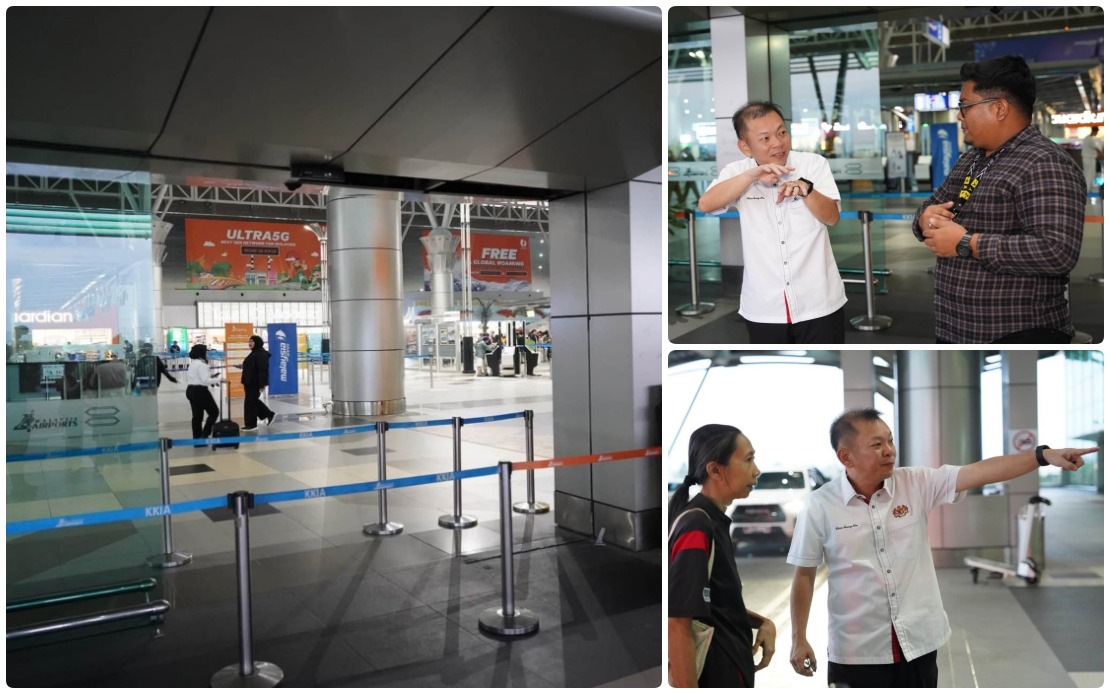
An afternoon collision at Kota Kinabalu International Airport saw a female driver suffer minor injuries when her sports utility vehicle careered into the main glass entrance of the Level 3 departure hall, leaving significant structural damage but prompting a swift institutional response that kept the airport's operations functioning smoothly.
The incident unfolded shortly after 4:20 pm on Wednesday at KKIA's Terminal 1 kerbside, where the woman's SUV inexplicably lost control before striking the entrance glass doors with considerable force. The impact was violent enough to shatter the door structures entirely and render the vehicle's front end severely damaged, though the collision fortunately did not extend to harming any of the scores of passengers or airport personnel present in that vicinity at the time.
Kota Kinabalu District Police Chief ACP Shahrudin Mat Husain confirmed the collision and indicated that authorities have launched an investigation to establish the precise circumstances that led to the vehicle's loss of control. The police statement suggested that determining the root cause remains an ongoing process, though preliminary indications point to mechanical failure or driver error as possible contributing factors.
Ambulance personnel responded swiftly to transport the injured driver to a nearby medical facility for treatment of her minor injuries. Hospital officials confirmed she was admitted for observation and care but that her condition remained stable given the relatively limited severity of her injuries sustained in the crash. Her treatment proceeded without complication, allowing her recovery to proceed as expected for such incidents.
Malaysia Airports, the entity responsible for operating KKIA, moved quickly to minimise disruption to the airport's scheduled operations. Within minutes of the collision, Aviation Security and Customer Service personnel established a perimeter around the affected entrance and coordinated the emergency response. By six o'clock in the evening—approximately ninety minutes after impact—the damaged vehicle and associated debris had been completely removed from the departure hall area, and preliminary clearing operations were well underway.
The airport operator's statement emphasised that the incident had been compartmentalised to a single entrance point on Level 3, and that the airport's remaining automatic door systems at the departure level remained fully operational throughout the afternoon and evening. Passenger flow through alternative entrances continued unimpeded, demonstrating the redundancy built into major airport infrastructure. Repair works to restore the damaged entrance doors to full functionality commenced immediately, with Malaysia Airports coordinating contractors to effect the necessary replacements and structural repairs.
Deputy Minister of Agriculture and Food Security Datuk Chan Foong Hin, who had coincidentally just arrived at the airport when the incident occurred, publicly commended the airport's management and personnel for their efficiency in handling what might have otherwise escalated into a more serious operational disruption. His statement on social media platforms highlighted the professionalism displayed by KKIA staff in clearing the area and maintaining normal passenger operations despite the dramatic nature of the collision. He explicitly thanked the management team for ensuring that the airport's reputation and service standards were not compromised by the incident.
The quick restoration of normal airport operations at KKIA underscores how modern airport infrastructure is designed with redundancy and rapid-response protocols that prevent singular incidents from cascading into widespread chaos. The presence of multiple automatic entrance points at the departure level meant that the single damaged entrance represented only a marginal loss of capacity, with passenger throughput easily accommodated by alternative routes. This systemic resilience is particularly important for a gateway airport serving Sabah's tourism and business traffic.
Royal Malaysia Police have assumed investigation authority over the matter, with Malaysia Airports providing comprehensive cooperation and documentation. The investigation will likely focus on establishing whether the collision resulted from vehicle malfunction, driver medical episode, or some combination thereof. The police will coordinate with the hospital regarding any medical findings that might shed light on the driver's condition at the moment of the incident.
For Malaysian airport operators and policymakers, the KKIA incident illustrates both the vulnerability of modern airport infrastructure to vehicle-related incidents and the importance of rapid institutional response capabilities. The controlled way in which the situation was managed prevented what could have been a serious security concern from becoming an operational crisis. Airport management's decision to implement immediate clearing protocols and activate alternative flow routes demonstrated the value of well-rehearsed emergency procedures that balance immediate safety concerns with the imperative to maintain service continuity.
The broader implications for airport safety across Southeast Asia suggest the need for continued investment in both preventive measures—such as bollard systems and physical barriers designed to prevent vehicle incursion into passenger areas—and responsive infrastructure that ensures single-point failures do not cascade into system-wide disruptions. KKIA's performance in this instance provides a positive benchmark for regional airports managing the inevitable intersection between road traffic and airport operations.

