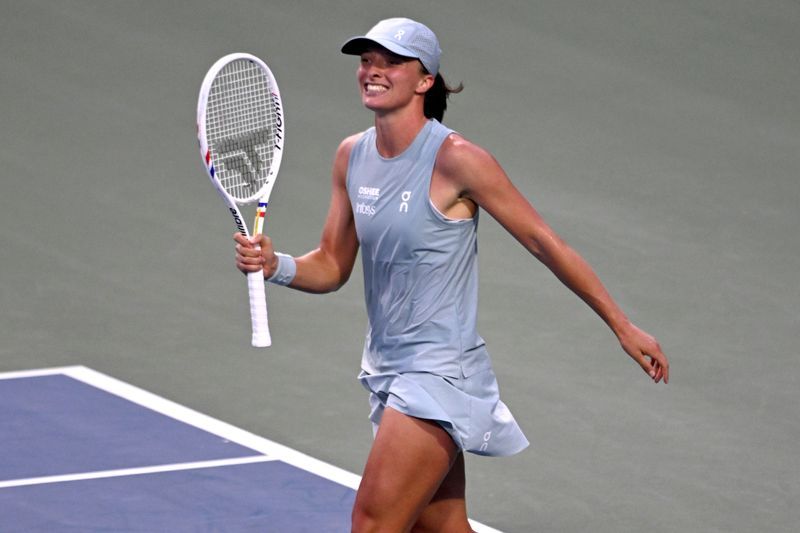
Iga Swiatek's resounding victory over Diana Shnaider at the Canadian Open in Toronto on Monday—a decisive 6-2 6-1 triumph completed in just 68 minutes—represents a crucial turning point for the Polish champion as she prepares for the year's final Grand Slam tournament at Flushing Meadows. The match showcased Swiatek at her most authoritative, combining aggressive baseline play with precise court positioning to systematically dismantle her Russian opponent and advance to the semi-final round of what ranks as one of tennis's most prestigious WTA 1000 events.
The dominance Swiatek exhibited against Shnaider extended across both sets, with the Pole breaking her opponent's serve twice in the opening frame while capitalising on a string of unforced errors that accumulated to 12 in that set alone. Swiatek's positioning proved suffocating; she dictated the rallies from the baseline with crisp ball striking while simultaneously limiting the opportunities available to Shnaider to mount any sustained attacking sequence. By the time Swiatek reached a 5-2 advantage, the outcome had already become inevitable, with Shnaider's forehand finding the net to hand Swiatek the opening set with clinical efficiency.
The second set offered no relief for the Russian competitor, as Swiatek maintained her stranglehold over proceedings without ever facing genuine pressure on her own serve. Shnaider failed to create a single break point opportunity, a statistic that underscores how thoroughly Swiatek controlled the tempo and intensity of the encounter. The Pole sealed the match when she produced a sharply angled crosscourt winner that clipped the line for a decisive 5-1 lead, before Shnaider's forehand sailed long on match point to conclude the one-sided affair.
This semi-final berth marks Swiatek's first appearance at the WTA 1000 level this season, an achievement that holds particular significance given the inconsistency that has characterised her campaign so far. The former world number one failed to advance beyond the quarter-final stage at any Grand Slam tournament prior to this week and suffered an embarrassing second-round elimination at Miami at the hands of fellow Polish player Magda Linette. Such early exits raised concerns about both her form and mental resilience during high-pressure competitions.
The Miami defeat proved sufficiently troubling to prompt Swiatek to make a significant coaching change, moving away from the partnership with Wim Fissette and bringing in Francisco Roig to guide her through the remainder of the season. This managerial shift represented not merely a tactical adjustment but a recognition that the psychological component of professional tennis requires fresh perspective and renewed structures when results deteriorate.
Swiatek's struggles extended to the most prestigious clay-court championship, where she proved unable to defend her Wimbledon title, falling in the third round to Alexandra Eala in straight sets. These setbacks had accumulated into a narrative of underperformance for a player who, just months earlier, held genuine aspirations of contending for multiple major titles throughout the season.
However, the performance against Shnaider suggests that the tactical and mental reset initiated by the coaching change may already be yielding tangible results. The clinical execution displayed against a competitive opponent provides Swiatek with momentum heading into the semi-final stage and, more critically, toward the US Open at Flushing Meadows, where she captured one of her six Grand Slam titles in 2022. That venue holds positive historical associations for the Pole, potentially providing psychological advantage as she seeks to rebuild her Grand Slam credentials during the season's final stretch.
Swiatek's path in Toronto now intersects with either Russian Ekaterina Alexandrova or ninth-seeded Ukrainian competitor Elina Svitolina, who were scheduled to contest their quarter-final match on the same Monday. Both opponents present distinct stylistic challenges that will test whether Swiatek's dominant display against Shnaider represents sustainable form or a momentary resurgence against an opponent who simply failed to bring her best tennis.
For Malaysian and Southeast Asian tennis enthusiasts, Swiatek's journey at this stage of the season carries broader implications for the competitive landscape heading toward the US Open. Her resurgence would alter the narrative around favourite status at Flushing Meadows and potentially reshape expectations for several other contenders who might have viewed her recent form as creating opportunity. The Polish player's technical excellence and previous Grand Slam pedigree ensure that should she maintain this trajectory, she will demand serious consideration among the tournament's potential champions.
The implications of Swiatek's advancement extend beyond individual achievement. Her return to form at the WTA 1000 level demonstrates the volatility inherent in elite professional tennis, where coaching adjustments, mental recalibration, and focused tournament preparation can rapidly alter competitive trajectories. For aspiring players throughout the region observing elite-level competition, Swiatek's capacity to respond to adversity through structural change offers instructive lessons about managing extended periods of underperformance.
As Swiatek prepares for her semi-final encounter against either Alexandrova or Svitolina, the narrative has shifted meaningfully from questions about her season's viability to assessment of whether she can sustain this resurgence through multiple rounds. The commanding performance against Shnaider has purchased credibility, though the true test will arrive in matches against opponents who present greater tactical variety and competitive mettle. The Polish champion's trajectory at this juncture will significantly influence both Canadian Open outcomes and broader US Open positioning.

