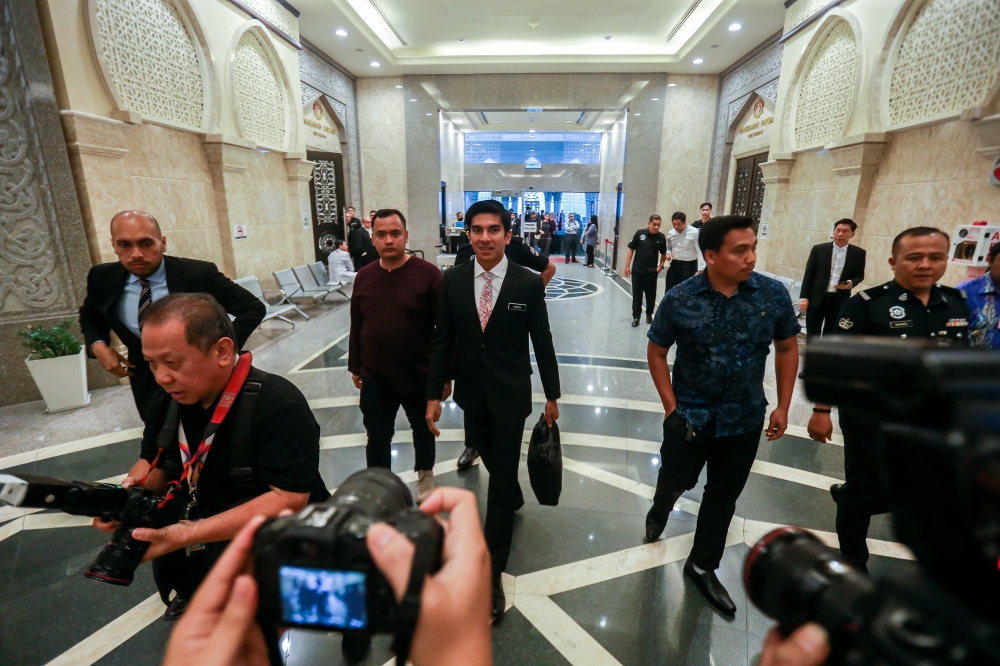
The Palace of Justice in Putrajaya became a focal point of political interest on July 13 as Muar Member of Parliament Syed Saddiq Syed Abdul Rahman arrived for what could prove a defining moment in his political career. The young politician, accompanied by his family and fiancée, faced a Federal Court ruling that held significant implications not only for his personal future but also for broader questions about accountability and due process within Malaysia's political establishment. The gathering of supporters underscored the public attention surrounding the case, reflecting the intense scrutiny that attaches to high-profile prosecutions involving politicians.
Syed Saddiq's legal battle centres on money-laundering accusations that have shadowed his political trajectory for some time. The case represents a notably complex intersection of political fortunes and criminal accountability, raising questions about the mechanisms through which Malaysia's courts navigate allegations against sitting lawmakers. The Federal Court hearing represented the culmination of a lengthy legal process, during which various contested interpretations of evidence and procedure had been aired before lower courts. For observers tracking Malaysia's evolving relationship with political integrity and judicial independence, the proceedings warranted close examination.
The early arrival of crowds at the judicial venue reflected the broader significance many Malaysians attached to the outcome. Political observers have long noted that cases involving prominent parliamentarians tend to generate substantial public curiosity, partly because they offer insight into how Malaysia's institutions handle questions of accountability at the highest levels. The presence of family members and his fiancée signalled the personal dimensions that accompany such legal proceedings, humanising what might otherwise appear as an abstract legal matter.
For the DAP-aligned Muar constituency, Syed Saddiq's situation presented ongoing concerns about representation and continuity in parliamentary affairs. The MP has maintained a visible public profile despite the legal cloud, participating in parliamentary debates and constituency duties. His legal travails have not deterred his engagement with legislative processes, though inevitably the case consumes significant energy and resources. The outcome of the Federal Court decision would determine whether the conviction would stand or whether grounds for appeal or remission might emerge.
The money-laundering conviction itself requires contextual understanding within Malaysia's regulatory framework. The Financial Intelligence and Enforcement Department and relevant law enforcement agencies had investigated the matter over an extended period, accumulating evidence that prosecutors characterised as demonstrating improper financial conduct. The threshold for money-laundering convictions in Malaysia involves proving not merely questionable financial transactions but a deliberate pattern of concealment or obfuscation of funds' origins.
For Malaysian politics broadly, Syed Saddiq's case exemplifies the increasing willingness of prosecution authorities to pursue sitting parliamentarians on criminal charges. Unlike earlier eras when such prosecutions remained comparatively rare, the past decade has witnessed greater frequency of legal action against elected officials. This trend reflects either enhanced enforcement capacity, shifting political circumstances that enable prosecution, or genuine increased adherence to accountability standards—assessments that informed observers hotly contest.
The Federal Court's role in this matter placed it at the intersection of judicial review and substantive legal determination. As Malaysia's apex court, the Federal Court commands significant authority in interpreting statutes and assessing whether lower courts properly applied legal principles. The hearing therefore represented an opportunity for judicial clarification regarding money-laundering jurisprudence and the evidentiary standards applying to such charges.
For younger Malaysian politicians, Syed Saddiq's ordeal carries cautionary implications about navigating the complex intersection of political fundraising, party financing, and regulatory compliance. The case emerged partly from scrutiny of party finance mechanisms and the mechanisms through which politicians raise and utilise resources. Enhanced regulatory attention to political funding has created environments where technical violations might more readily attract prosecution, reshaping the operational landscape for parliamentarians across the political spectrum.
The international dimensions of Malaysia's money-laundering framework also merit consideration. As a Financial Action Task Force member, Malaysia operates within a broader compliance architecture that establishes standards for detecting and prosecuting financial crimes. The prosecutorial approach in Syed Saddiq's case reflected Malaysia's commitment to meeting international benchmarks for financial crime enforcement, though critics sometimes question whether such frameworks apply uniformly across different demographic categories of alleged offenders.
Looking toward the eventual Federal Court decision, multiple constituencies awaited the outcome with varying expectations. Political rivals anticipated potential implications for parliamentary dynamics, legal scholars examined the judgment's contribution to jurisprudential development, and ordinary Malaysians contemplated broader questions about whether their political system functions with appropriate checks on executive authority and prosecutorial discretion. The ruling, once delivered, would inevitably generate substantial commentary about judicial independence, political accountability, and the trajectory of Malaysia's institutions.
The personal dimensions represented by his family's presence at the Palace of Justice reflected the reality that criminal proceedings carry profound human consequences extending beyond the accused individual. The fiancée's attendance particularly signalled the ripple effects of legal proceedings on intimate relationships and family planning within political families. Such considerations, while sometimes overlooked in analysis focused purely on legal and political mechanics, constitute essential dimensions of understanding prosecutions' full impact.
As Malaysian courts continue grappling with cases involving prominent politicians, the precedents established through proceedings like Syed Saddiq's will likely shape future prosecutorial strategies and judicial interpretations. The Federal Court's articulation of applicable standards for money-laundering conviction could establish frameworks influencing how authorities approach similar allegations against other parliamentarians and political figures across Malaysia's diverse political landscape.

