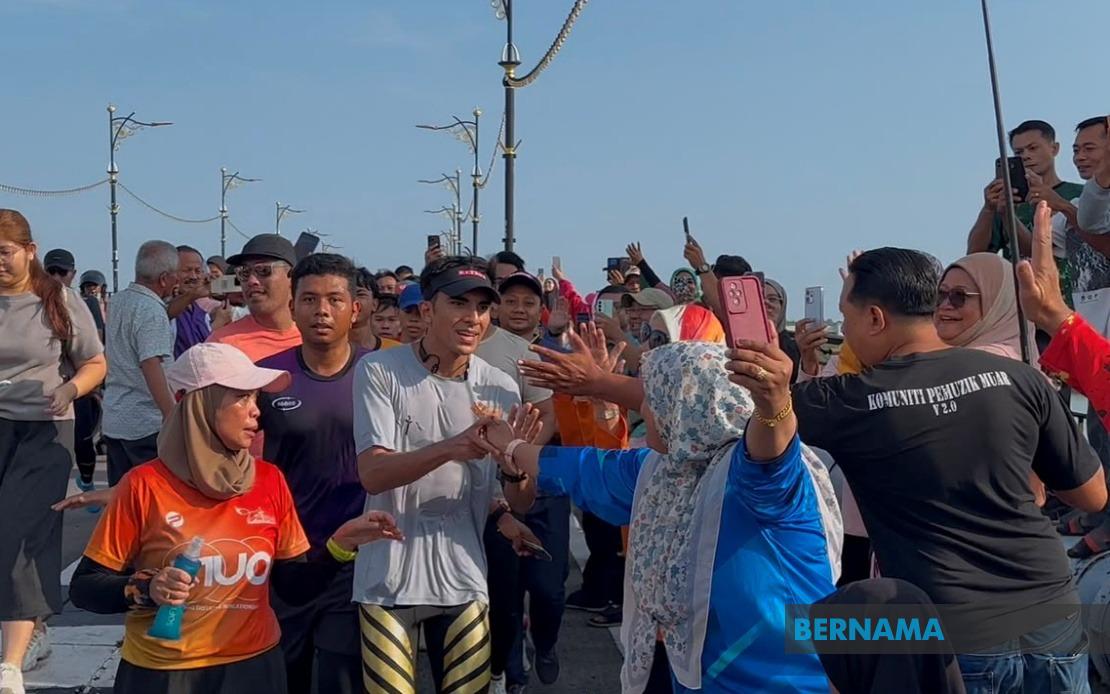
Muar Member of Parliament Syed Saddiq Syed Abd Rahman successfully completed his four-day "Larian Kesyukuran" (Gratitude Run) on July 19, crossing the finish line at Laman Maharani to the cheers of roughly 2,000 welcoming residents who had gathered since dawn. The achievement capped an ambitious 170-kilometre journey that commenced from the Palace of Justice in Putrajaya on July 16, representing one of the more physically demanding charitable initiatives undertaken by a Malaysian politician in recent memory.
The final leg of the marathon push saw Syed Saddiq begin from Simpang Sungai Rambai in Melaka early on July 19, covering the remaining 17 kilometres with accompaniment from members of the 'Muo Runner' group, who ran alongside him across the Sultan Ismail Bridge to the coastal town's main gathering point. His 9.15 am arrival marked not merely a personal milestone but a moment of celebration for the Muar community, many of whom had tracked the progression of the run through social media updates and felt motivated to turn out in person for the final stretches.
The charitable initiative demonstrated substantial financial success, ultimately raising RM650,959.2—more than triple the original RM200,000 fundraising target. This outcome underscores the capacity of grassroots-level political figures to mobilise community resources when they undertake visible, physically demanding commitments to constituent welfare. Speaking at the Muar MP's Service Centre immediately following completion, Syed Saddiq expressed deep gratitude for the public backing, emphasising that donations ranged from substantial contributions to modest sums, including a 50-sen offering from a child, each reflecting genuine goodwill rather than scale of donation.
The fundraising proceeds have been earmarked exclusively for welfare programmes benefiting Muar residents, with the allocation directed towards two primary areas: provision of food assistance packages and distribution of tablet devices to academically promising students facing financial barriers. These targeted interventions address fundamental needs identified within the constituency—nutrition security for vulnerable households and technological access for educational advancement—representing a practical approach to addressing inequalities within a relatively developed Malaysian parliamentary division.
What distinguishes this initiative from conventional fundraising drives is the personal physical commitment undertaken by the legislator. By subjecting himself to the rigours of a four-day long-distance run, Syed Saddiq effectively translated abstract political representation into tangible bodily experience, a symbolic gesture that appears to have resonated with constituents across demographic boundaries. The MP acknowledged that backing extended beyond core Muar residents, with supporters journeying from neighbouring constituencies including Batu Pahat, suggesting that the initiative's appeal transcended strict electoral boundaries.
Among those making the journey was 64-year-old Aminah Abd Rahman and her daughter Syarifah Fatimah Syed Ali, 26, who travelled from Batu Pahat specifically to offer moral support and contribute financially to the cause. Aminah articulated a perspective revealing about contemporary Malaysian political expectations, noting that relatively few elected representatives undertake such physically demanding public commitments. The fact that she and her daughter felt compelled to make the effort to participate speaks to the symbolic power of visible sacrifice as a political communication tool, particularly in an era when public confidence in institutional politics faces headwinds.
The scale of community mobilisation surrounding the run's completion—with thousands assembling at the finish point—indicates that such initiatives can generate genuine enthusiasm and engagement with political representation at the constituency level. However, the sustainability of this momentum and its translation into broader political or policy outcomes remains to be seen. Whether this fundraising success catalyses a broader conversation about constituent welfare provision in Muar, or represents a notable but ultimately singular event, will likely depend on follow-through implementation and the MP's capacity to maintain constituent engagement beyond the immediate aftermath.
For observers tracking Malaysian political activism, the Gratitude Run illustrates evolving patterns in how contemporary legislators attempt to distinguish themselves and demonstrate commitment to their constituencies. Beyond conventional constituency service or parliamentary performance, increasingly we see MPs employing personal physical challenges and visible sacrifice as mechanisms to build political capital and community goodwill. This trend reflects both shrewd political calculation and genuine commitment to constituent welfare, with both motivations likely operating simultaneously.
The initiative also sits within broader regional context. Malaysian politicians operate within competitive multiparty systems where constituent satisfaction and personal brand differentiation carry tangible electoral consequences. In this environment, demonstrating willingness to endure physical hardship on behalf of constituents' welfare can function as powerful political messaging. The success of Syed Saddiq's run in substantially exceeding fundraising targets and mobilising community participation suggests this approach resonates with voters seeking visible evidence of representative commitment.
Moving forward, questions naturally arise about resource deployment and implementation efficacy. The RM650,959 raised represents meaningful but not unlimited resources for a constituency encompassing potentially tens of thousands of households. How these funds are allocated across beneficiary populations, what oversight mechanisms ensure equitable distribution, and whether the welfare interventions produce meaningful long-term impacts will collectively determine whether the Gratitude Run achieves its intended objectives or remains primarily a successful publicity exercise. In Malaysian political contexts, such implementation details frequently separate symbolically powerful gestures from substantive policy outcomes.

