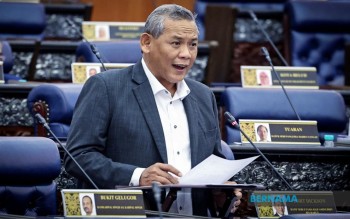
The investment challenges facing Tabung Haji require a more sophisticated understanding than simply attributing all losses to wrongdoing, according to Port Dickson Member of Parliament Datuk Seri Aminuddin Harun. Speaking during a special parliamentary session examining the Royal Commission of Inquiry report into the pilgrimage fund, the former Negeri Sembilan chief minister emphasised that the institution's financial setbacks must be evaluated with acknowledgement that legitimate market risks form part of any investment portfolio. His intervention during the Dewan Rakyat discussion marks a significant contribution to the ongoing national conversation about institutional accountability and financial stewardship, particularly as Malaysia seeks to restore public confidence in bodies managing Muslim citizens' savings.
Aminuddin's core contention addresses a fundamental distinction that often becomes blurred in public discourse surrounding Tabung Haji's performance. The investment landscape inherently exposes capital to volatility driven by factors beyond institutional control—commodity price fluctuations, currency movements, geopolitical shifts, and broader market cycles regularly produce losses even when management decisions are sound. Yet he stressed that separating naturally occurring market downturns from those triggered by institutional failure—whether through negligent judgment, self-interested decision-making, or structural governance weaknesses—remains essential for meaningful reform. This analytical clarity matters greatly for Malaysian stakeholders and the broader Southeast Asian investment community monitoring institutional accountability across the region's major financial entities.
The RCI's recommendation for forensic audits examining fourteen investments that experienced significant declines provides a mechanism for precisely this differentiation. By subjecting these specific holdings to detailed forensic review, investigators and decision-makers can establish whether performance deterioration stemmed from market conditions, flawed strategic choices, inadequate oversight, or worse. For Malaysian investors and the wider public, such granular analysis determines whether reforms should focus on improving risk management frameworks, strengthening governance structures, or addressing individual misconduct—each requiring fundamentally different corrective measures.
Aminuddin advanced a particularly significant argument regarding how Tabung Haji's leadership positions should be staffed going forward. He contended that these roles must attract individuals selected primarily for their technical qualifications—investment expertise, financial acumen, regulatory knowledge—rather than positioning them as rewards for political loyalty or vehicles for extending influence. This critique addresses a pattern deeply embedded within Malaysian institutional culture, where board appointments and senior management roles frequently reflect patronage networks rather than merit-based assessment. For a fund managing the savings of millions of Malaysians preparing for the Islamic pilgrimage, such professional standards are not merely administrative niceties but fundamental requirements.
The specific appointment criteria Aminuddin advocated encompass multiple dimensions of expertise and integrity. Board candidates should demonstrate substantive knowledge across investment strategy, Islamic finance principles, risk management methodologies, accounting practices, audit principles, corporate law, governance frameworks, and hajj operations management. Beyond technical credentials, integrity screening and transparent conflict-of-interest declarations would establish accountability mechanisms currently insufficient in Malaysian institutional practice. These requirements would substantially elevate the professional calibre of Tabung Haji's governing structure while reducing vulnerability to decisions motivated by interests other than optimal fund performance.
Among the RCI's formal recommendations was a proposal that active politicians be barred from serving as Tabung Haji's chairman or board members, whether in the principal institution or its subsidiaries. Aminuddin's support for this measure reflects growing recognition that certain positions demand independence from electoral considerations and partisan pressures. When political office-holders simultaneously control major financial institutions, inherent conflicts emerge—the temptation to influence investment decisions for electoral advantage, to prioritise politically favourable outcomes over fiduciary duty, or to leverage institutional resources for political ends becomes difficult to resist, regardless of individual integrity. This principle extends well beyond Tabung Haji and resonates throughout Southeast Asia's institutional landscape.
Aminuddin's suggestion to extend scrutiny even further—requiring comprehensive screening across diverse professional domains and mandatory integrity assessment—represents an incremental but important strengthening of governance architecture. Each additional criterion, each procedural safeguard, and each transparency requirement creates friction against hasty or self-serving appointments. While such measures cannot eliminate misconduct entirely, they substantially raise the cost and reduce the likelihood of systematic mismanagement. For Malaysian taxpayers and Tabung Haji contributors, these changes translate to greater probability that their fund operates as intended rather than as a vehicle for factional interests.
A parallel concern emerged from Tampin representative Datuk Mohd Isam Mohd Isa, who proposed establishing a further RCI examining the 2021-2025 period. Mohd Isam's observation that the initial RCI's 2014-2020 timeframe may prove insufficiently comprehensive reflects legitimate concerns about institutional continuity and evolving challenges. Investment portfolios and governance structures evolve constantly; weaknesses evident in one period may persist or intensify if left unaddressed, while new vulnerabilities may emerge as management approaches shift. His suggestion that parliament's Public Accounts Committee undertake detailed scrutiny for the 2022-2026 period proposes a complementary accountability mechanism, moving beyond the RCI's time-limited investigation toward ongoing parliamentary oversight.
The RCI report itself, released on 29 July following its submission to the Yang di-Pertuan Agong on 30 August 2022, contained 25 reform recommendations addressing identified management and operational weaknesses. That Tabung Haji had already implemented approximately 75 per cent of these recommendations by 30 July suggests reasonable institutional responsiveness, though implementation quality and efficacy remain separate questions from mere formal adoption. The 211-page document provides detailed documentation of institutional failures occurring between 2014 and 2020, a period encompassing significant investment volatility alongside governance challenges that demand serious reform.
For Malaysian investors and the broader Southeast Asian institutional landscape, the Tabung Haji examination illuminates crucial questions about how pilgrimage funds, pension schemes, and other collective investment vehicles should operate. The tension between permissible market-driven losses and impermissible governance failures remains poorly understood among the public; clearer communication about this distinction would strengthen rather than undermine public confidence. Professional appointment standards, integrity screening, and independence from political interference represent baseline requirements for any institution managing citizens' retirement savings or religious obligation financing. Whether Tabung Haji's recent reforms truly address systemic weaknesses or merely address surface-level recommendations remains to be determined through sustained monitoring and transparent reporting.
The broader reform agenda extends beyond Tabung Haji itself. Malaysian institutional culture has historically treated senior positions in government-linked companies, statutory authorities, and collective investment vehicles as spoils to distribute among politically connected elites. Aminuddin's intervention suggests growing parliamentary and public impatience with this model, particularly when institutional performance suffers measurably as a consequence. Singapore's more meritocratic approach to civil service and institutional leadership, while imperfect, offers regional comparison demonstrating that professional standards need not conflict with effective governance. As Malaysia strengthens institutional accountability mechanisms, adopting such standards could substantially improve outcomes across numerous sectors managing public resources and citizen savings.
The conversation around Tabung Haji ultimately reflects Malaysia's broader institutional maturation. No investment fund operates without risk or occasional losses; the relevant questions concern whether governing structures optimise returns, manage risks prudently, and operate transparently in beneficiaries' interests. The RCI process, parliamentary scrutiny, and proposed reforms suggest increasing willingness to address these questions systematically. Whether implementation matches rhetoric will determine whether Tabung Haji emerges from this episode as a reformed institution commanding renewed confidence or as another example of insufficient structural change masquerading as accountability. Malaysian Muslim pilgrims and their families deserve nothing less than the highest professional standards guiding their savings.

