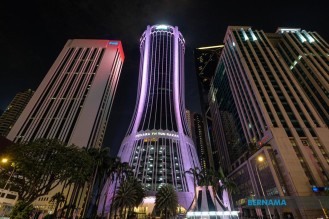
The entire process for Lembaga Tabung Haji (TH) to acquire a 30 per cent stake in Putrajaya Perdana Bhd in 2014 unfolded during a period when the construction firm remained under the control of Low Taek Jho, or Jho Low, through his vehicle Utama Banking Group Bhd (UBG Bhd), according to sworn testimony revealed in Parliament. Finance Minister II Datuk Seri Amir Hamzah Azizan presented this account to the Dewan Rakyat during a special sitting convened to examine findings from a Royal Commission of Inquiry into TH's management and operations, shedding fresh light on one of the most controversial deals in the sovereign wealth fund's investment history.
Central to the minister's statement was testimony from Putrajaya Perdana director Datuk Rosman Abdullah, recorded during the SRC International legal proceedings, which established that SRC International had transferred RM170 million to a Putrajaya Perdana subsidiary known as Putra Perdana Construction across three separate tranches between July and August 2014. This timeline carries significance for Malaysian taxpayers and TH depositors because it demonstrates active financial flows connected to Jho Low's network during the precise window when TH was evaluating its investment decision. The testimony further indicated that Putrajaya Perdana remained under Jho Low's effective control through UBG until the sale was formally completed on April 13, 2015—several months after TH had already committed its funds.
The chronological sequence of approvals underscores how the transaction progressed without the typical safeguards one would expect for an investment of this magnitude. TH's Investment Panel greenlit the proposal on July 24, 2014, followed by board approval on August 25 and ministerial sign-off on August 27. The sale and purchase agreement itself was executed on December 3, 2014. Every single approval step, Amir Hamzah emphasised, occurred during the period when testimony suggests Putrajaya Perdana remained under Jho Low's influence via UBG. Although the minister was careful to note that courts have made no formal finding regarding Jho Low's beneficial ownership at that time, the alignment of dates raises troubling questions about oversight and due diligence at Malaysia's largest Islamic savings institution.
Yet the financial anomalies surrounding the deal extend well beyond the timing of approvals. A 2023 fact-finding report revealed that TH's Investment Panel specifically requested the management identify the ultimate shareholder of the seller on July 24, 2014—the very day the Investment Panel approved the transaction. Remarkably, no record exists of management responding to this critical request, and the transaction proceeded regardless. This gap in due diligence represents a fundamental breach of standard corporate governance, particularly for an organisation managing deposits from hundreds of thousands of Malaysian pilgrims. The absence of documented shareholder verification is especially troubling given what is now known about the networks through which Jho Low operated and the subsequent discovery of his links to various financial schemes.
The valuation assigned to TH's stake presents another layer of concern for investors and policymakers. TH's own Research Division initially disagreed with the RM206 million valuation placed on the 30 per cent stake, instead estimating its true value at between RM124 million and RM155 million. Yet the Investment Panel ultimately approved RM193.5 million without any written justification for the significant upward revision or for expanding the stake from the originally discussed 25 per cent to 30 per cent. This departure from the research team's recommendations, combined with the lack of documented rationale, suggests either exceptional confidence in the deal's fundamentals or a troubling breakdown in the governance structure that should have prevented such decisions.
What makes the valuation particularly problematic is the pricing history that emerged during parliamentary questioning. The seller, through the investment vehicle Cendana Destini Sdn Bhd, had acquired the entire equity stake in Putrajaya Perdana for RM260 million back in 2012—just two years before selling the stake to TH. This means that a 30 per cent stake valued at roughly RM78 million in 2012 was suddenly worth RM193.5 million by 2014, an increase of approximately 148 per cent or nearly three times the original value. Such dramatic appreciation in valuation within such a short timeframe, without corresponding operational improvements or market developments, warrants serious scrutiny about whether TH's investment committee was adequately assessing market realities.
Tangible failures in TH's due diligence process further compound these governance failures. The fact-finding assessment revealed that the required due diligence was conducted only after all approvals had been obtained—an inverted sequence that renders such investigation largely meaningless as a decision-making tool. The Investment Panel and board of directors never reviewed the due diligence findings before signing the agreement, suggesting TH's institutional safeguards were either non-functional or simply ignored. The 2023 assessment additionally found that four other TH investments similarly failed to undergo required due diligence, with recommendations from the Risk Management Department routinely sidelined or inadequately addressed.
The promised returns that formed the basis of the investment have entirely failed to materialise. TH was assured that Putrajaya Perdana would be relisted on the stock exchange within a year of the investment and that the company would achieve profits of RM86 million in 2015. Neither promise was fulfilled, leaving the fund holding a deteriorating asset with no clear exit strategy or path to recovery. When TH eventually exercised a put option in March 2018 to demand that the seller repurchase the shares for RM210.7 million, payment was not forthcoming. By the end of financial year 2024, TH had written off the entire RM193.5 million investment as a total loss, representing a devastating blow to the organisation's financial position and a stark reminder of the consequences of inadequate oversight.
TH is now pursuing recovery through the courts, having filed a writ and obtaining a Mareva injunction to freeze relevant assets. Court-directed mediation was scheduled even as the minister made his parliamentary statement, with the full trial not expected until June 23, 2027. This protracted legal battle underscores the complexity of untangling transactions that appear to have involved multiple layers of entities and opaque ownership structures. For Malaysian investors and TH depositors, the litigation represents a slow path toward potential accountability, though full recovery remains uncertain.
The emergence of these details carries broader implications for how Malaysia's major financial institutions manage public and religious endowment funds. The Putrajaya Perdana investment exemplifies a pattern of institutional failure—weak shareholder verification, overturned valuation assessments without documentation, approval sequences that ignore due diligence results, and the absence of meaningful challenge to questionable decisions. While Amir Hamzah emphasised that courts have made no formal finding regarding Jho Low's beneficial ownership during the approval period, the testimony and timeline suggest that TH's decision-makers either were insufficiently informed about the company's true ownership or chose to proceed despite knowing the risks. Either scenario represents a serious breach of fiduciary duty to the millions of Malaysians whose savings and religious contributions are entrusted to TH's stewardship.

