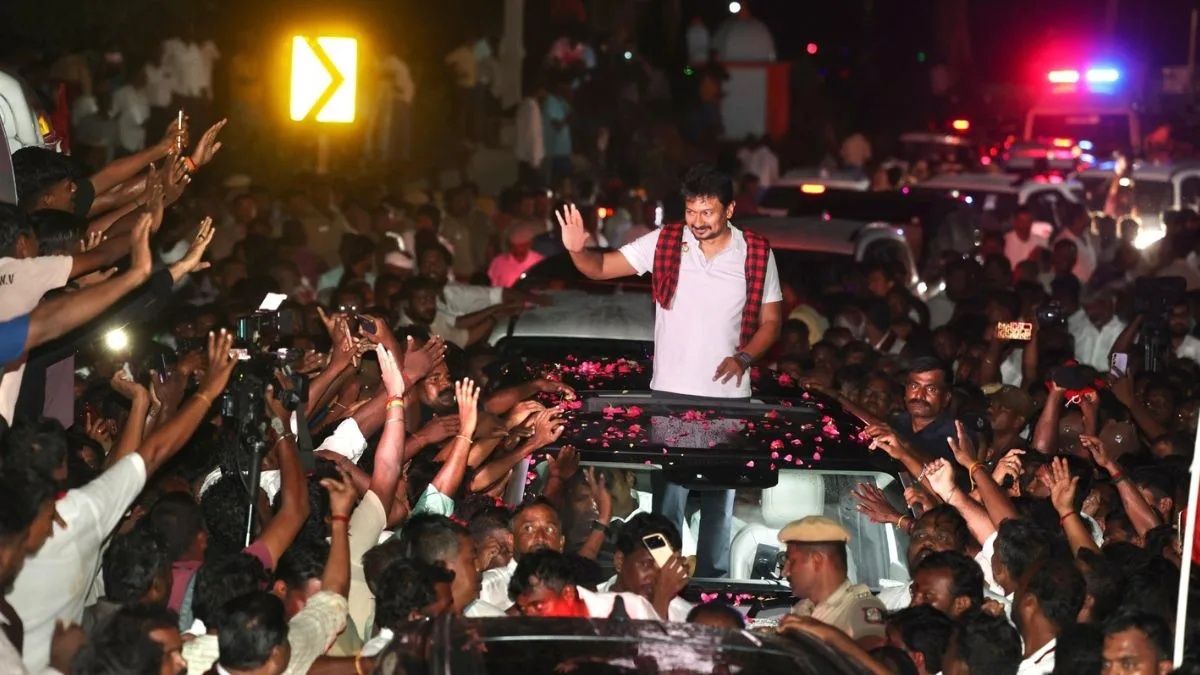
Udhayanidhi Stalin, the Leader of Opposition in Tamil Nadu, walked free on station bail late Tuesday evening after prolonged police interrogation regarding statements he made that were construed as offensive references to actress Trisha Krishnan. The former deputy chief minister's release marked an escalation in the political tensions roiling the southern state since the unexpected rise of Chief Minister Vijay and his newly formed AIADMK-rival party, the TVK, which has intensified its confrontation with the long-dominant DMK.
The circumstances leading to Stalin's arrest illuminate the fraught relationship between Tamil Nadu's ruling dispensation and the opposition DMK. During a farmers' advocacy event in Thanjavur district, Stalin was articulating grievances about the state's water rights dispute with Karnataka and the controversial Mekedatu dam project that threatens water flows into Tamil Nadu. When someone in the crowd invoked the name of Trisha, described as close to Chief Minister Vijay, Stalin responded with a statement that observers interpreted as carrying sexual innuendo: "Wherever water comes, whether it comes or not, water should come there." The seeming double entendre triggered an immediate political firestorm.
Government ministers and TVK functionaries rapidly characterised the remark as verbal harassment and the objectification of a woman, weaponising the charge to undermine Stalin. The ruling party escalated by filing a formal police complaint and approaching the National Commission for Women, a body that investigates gender-based misconduct allegations. This stratagem enabled authorities to arrest Stalin from his residence on Wednesday morning, transforming a contentious political statement into a criminal matter with potential gender harassment dimensions.
Thousands of DMK loyalists converged on the Sengipatti police station where Stalin remained in custody, transforming the venue into a political battleground. The gathering itself became a statement of opposition strength, with supporters chanting slogans critical of Chief Minister Vijay and his administration. The visual spectacle of a major political figure being detained, combined with the mobilisation of party cadres, underscored the widening chasm between Tamil Nadu's political factions and suggested that law enforcement had become entangled in partisan manoeuvrings.
At a press conference immediately following his release, Stalin vehemently rejected accusations that his words carried derogatory or malicious content. He insisted his comments were directed solely at articulating farmers' concerns regarding water scarcity and Karnataka's infrastructure ambitions. Stalin's defence rested on the assertion that his remarks possessed singular, literal meaning and that any interpretation suggesting otherwise constituted deliberate mischaracterisation. He framed the arrest not as a legitimate law enforcement action but as a calculated distraction strategy deployed by the Vijay government to deflect attention from policy failures and administrative missteps.
This incident reflects the volatility of Tamil Nadu's political landscape following last year's state elections, when Vijay's unexpectedly strong electoral performance fractured the traditional bipolar contest between the DMK and AIADMK. Vijay's emergence as a significant political force has forced the DMK to reassess its opposition strategy, while simultaneously raising stakes in the competition for political advantage. The TVK government's willingness to utilise law enforcement machinery against opposition figures suggests it perceives the DMK as a substantive electoral threat that must be blunted through multiple channels.
For Malaysian observers, the Tamil Nadu situation offers instructive parallels regarding how political rivalry can instrumentalise legal and regulatory institutions. The involvement of the National Commission for Women—ostensibly an impartial body dedicated to women's rights—in a nakedly partisan dispute demonstrates how gender protection mechanisms can be weaponised for political purposes. This pattern carries implications for how gender-related complaints are processed across South Asia, potentially diluting the seriousness with which genuine harassment allegations are treated when they become entangled with partisan politics.
The Cauvery water dispute underlying Stalin's original comments remains a perennial source of inter-state tension in South India, with Tamil Nadu's agricultural and drinking water security dependent on Karnataka's dam release policies. Stalin's invocation of water scarcity reflected genuine grievances affecting millions of Tamil Nadu farmers who face periodic drought conditions. By transforming Stalin's clumsy or provocative metaphor into a criminal matter, the government arguably deflected substantive debate about water management and agricultural policy into a personalised controversy centring on an actress tangentially connected to the chief minister.
The station bail outcome suggests that investigating authorities recognised the weakness of charges that could withstand judicial scrutiny. Rather than pursuing formal custody or presenting the matter before a magistrate, the police released Stalin on station bail—the least restrictive option short of complete release without conditions. This procedural choice may reflect judicial sensitivity to accusations that law enforcement had become overly politicised, or it may simply constitute standard practice in cases where initial investigation yields insufficient evidence for more severe detention.
Staling's characterisation of the Vijay administration as "nothing more than a circus" rather than legitimate government indicated the depth of DMK alienation from the ruling dispensation. His explicit rejection of fear regarding the arrest signal to party workers that the DMK intends to continue aggressive opposition politics without self-censorship or strategic retreat. Whether such rhetorical pugnacity translates into electoral recovery for the DMK remains uncertain, but his release emboldened supporters who viewed the entire episode as governmental overreach.
The implications of this episode extend beyond Tamil Nadu's borders. Democratic institutions across South Asia face recurring pressure when partisan competition intensifies. When political rivals perceive electoral vulnerability, they increasingly resort to weaponising investigative and legal processes against opponents. Malaysia's own political history includes instances where law enforcement became entangled with factional competition, illustrating how democratic safeguards require constant vigilance and institutional independence from partisan interference. The Tamil Nadu case demonstrates that even well-established democracies struggle to maintain this separation when stakes rise and political actors perceive existential threats.

