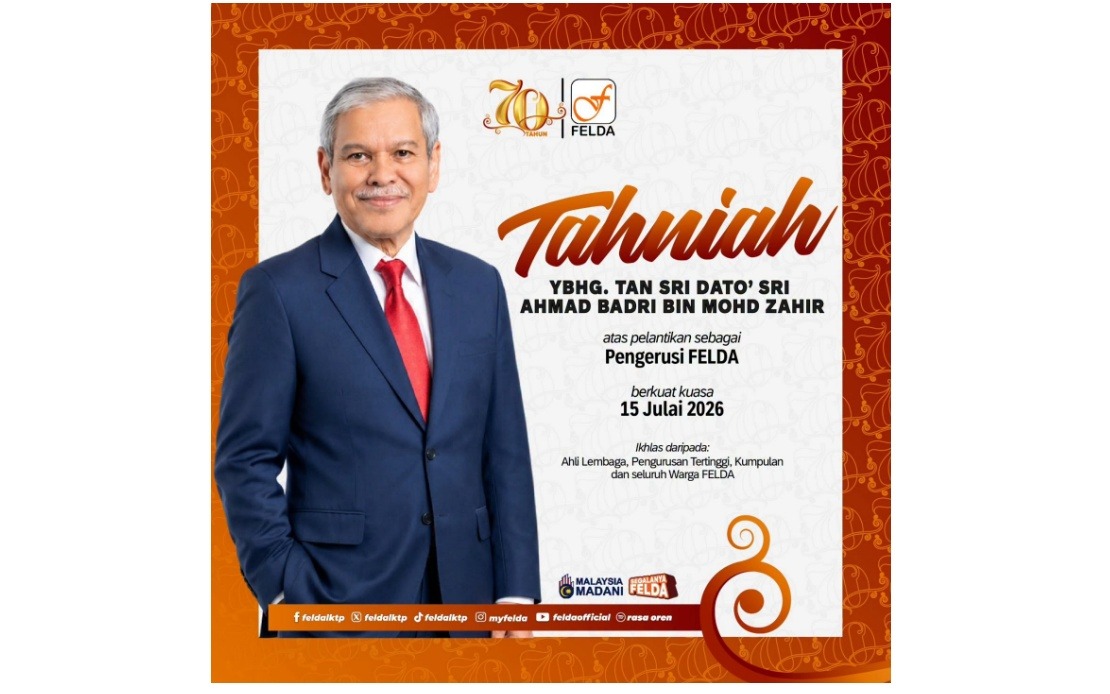
Tan Sri Ahmad Badri Mohd Zahir has been named the new chairman of the Federal Land Development Authority (FELDA), marking a significant leadership transition for one of Malaysia's most strategically important land development and settler-support agencies. The appointment, announced in Kuala Lumpur on July 15, represents the government's confidence in his proven track record of steering large institutional portfolios and advancing national economic priorities.
Ahmad Badri brings three decades of accumulated experience across both the public service and private corporate sectors, having begun his career with the Ministry of Finance in 1989. His trajectory through Malaysia's institutional ecosystem reflects a career spent navigating complex policy environments and large-scale organisational challenges. Between 2018 and 2020, he served as Treasury Secretary-General, a position that places him at the apex of Malaysia's fiscal management and budgetary architecture, responsible for advising government on all matters of public expenditure and revenue.
Prior to his appointment at FELDA, Ahmad Badri held the chairmanship of the Employees Provident Fund (EPF), Asia's largest mandatory provident fund system serving over 17 million contributors. His tenure at the EPF positioned him at the centre of retirement income security and social protection policy, crucial concerns for Malaysia's ageing workforce. His presence on the board of Bank Negara Malaysia during his time at the central bank would have exposed him to macroeconomic management and financial stability frameworks that directly influence investor confidence and sectoral health.
Ahmad Badri's portfolio of directorships and board memberships across key national institutions demonstrates how such leadership roles function as nodes within Malaysia's institutional governance network. His involvement with Permodalan Nasional Berhad (PNB), the nation's sovereign wealth fund, and Tenaga Nasional Berhad (TNB), the dominant electricity utility, indicate familiarity with managing strategic assets and stakeholder relationships spanning from individual savers to industrial consumers. Currently, he chairs RHB Bank Bhd and the Malaysian Rubber Board (LGM) while maintaining a directorship at Sime Darby Bhd, spanning the financial services, agricultural commodity, and diversified industrial sectors.
His educational credentials underscore a commitment to understanding business systems at an advanced level. Ahmad Badri holds a Master of Business Administration from the University of Hull in the United Kingdom, supplemented by a bachelor's degree in Estate Management from Universiti Teknologi MARA (UiTM). The combination of estate management training and graduate business education aligns logically with stewardship of FELDA, which manages millions of hectares and directly serves settler communities across vast agricultural landholdings.
FELDA's institutional mandate spans land development, settlers' welfare, and agricultural productivity across the Malaysian peninsula. The authority oversees the livelihoods of more than three million settlers and their dependents who occupy FELDA schemes established through decades of national development policy. These settlers, predominantly smallholder farmers engaged in palm oil, rubber, and other commodity production, represent a politically significant and economically vulnerable demographic whose prosperity connects directly to commodity prices, rural infrastructure investment, and market access.
The appointment signals FELDA's commitment to pursuing organisational transformation amid shifting global economic realities. Commodity-dependent economies face mounting pressure to diversify income streams and enhance value addition. Ahmad Badri's assignment includes accelerating FELDA's transformation agenda while strengthening economic sustainability for settlers. This dual mandate—pursuing modernisation while preserving settler welfare—reflects tension between competing priorities that have characterised FELDA's evolution since its establishment in 1956.
Government statements emphasise that Ahmad Badri's leadership will concentrate on governance strengthening and management excellence. These phrases typically signal intention to improve transparency, accountability, and operational efficiency—areas where large state enterprises often face scrutiny. Effective governance becomes particularly important at FELDA given its scale, the diversity of stakeholder interests, and the agency's periodic encounters with questions about corporate accountability and settler representation.
The appointment also addresses FELDA's alignment with Malaysia's broader sustainability and inclusivity frameworks. State agencies increasingly face expectations to advance environmental stewardship while maintaining social equity. FELDA's agricultural operations span millions of hectares; the sector's environmental footprint and contribution to biodiversity concerns occupy significant space within Malaysia's climate and sustainability discourse. Ahmad Badri's mandate explicitly references "sustainable and inclusive development goals," suggesting leadership will navigate these tensions deliberately.
For Malaysian settlers within FELDA schemes, Ahmad Badri's ascension carries practical implications for the trajectory of agricultural support services, rural infrastructure investment, and market linkages. His extensive background navigating Malaysia's policy corridors and institutional hierarchies positions him to advocate effectively for settler interests within government resource allocation processes. Similarly, his familiarity with financial sector dynamics may influence FELDA's approach to settler financing and agricultural credit mechanisms.
Regionally, FELDA's transformation carries relevance for Southeast Asia's broader agricultural and land policy debates. As neighbouring countries grapple with land use conflicts, smallholder productivity, and commodity market integration, FELDA's institutional model and management approaches offer comparative lessons. Ahmad Badri's stewardship will shape how Malaysia's land development authority navigates these shared regional challenges while maintaining commitment to settler communities who depend fundamentally on FELDA's performance.

