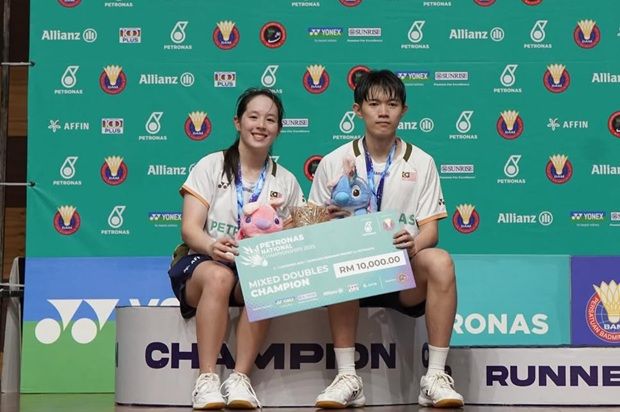
Twenty-year-old Malaysian mixed doubles shuttler Clarissa San is poised to embark on what promises to be a career-defining moment at next week's Japan Open, one of badminton's most prestigious tournaments. Her unlikely path to this opportunity came through an unexpected reshuffle of partnerships, with Tang Jie stepping in as her new partner following an anterior cruciate ligament injury sustained by regular doubles partner Toh Ee Wei, who is currently undergoing rehabilitation in Melbourne. Despite the unconventional circumstances that have landed her at this elite stage, Clarissa approaches the challenge with a refreshingly measured outlook, armed with the counsel of Tang Jie and mixed doubles head coach Nova Widianto to keep her composure amidst the intensity of one of the BWF World Tour's premier events.
The partnership between Tang Jie and Clarissa represents a significant step up in competitive calibre for the Selangor-born player, whose breakthrough moment comes at a tournament where elite international pairs typically converge. Rather than imposing unrealistic targets on herself, Clarissa has consciously chosen to focus on executing the fundamental strategies and techniques she has refined during recent training sessions. This grounded approach reflects maturity beyond her years, particularly given the magnitude of competing at a level where marginal improvements in execution often determine winners from losers. The opening contest will pit the pairing against Taiwan's Yang Po-hsuan and Hu Ling-fang, a test that, whilst demanding, provides an immediate opportunity to calibrate their combined form against respected opposition.
What emerges as particularly instructive in Clarissa's narrative is the protective yet demanding role Tang Jie has assumed beyond mere on-court partnership. Acting simultaneously as mentor, guide, and what Clarissa describes as an "older brother," Tang Jie has functioned as a stabilising presence during the uncertainty that accompanies any player's maiden appearance at world-class tournaments. The emotional demands of such events frequently unsettle younger competitors, yet both Tang Jie and coach Nova have maintained consistent messaging centred on psychological resilience rather than unrealistic performance metrics. This deliberate emphasis on managing expectations and deriving enjoyment from the occasion addresses a challenge that derails many promising young athletes whose anxiety supersedes their technical capabilities.
Clarissa's candid admission that she harbours no inflated expectations regarding the Japan Open demonstrates an understanding that sustainable competitive development emerges from foundational mastery rather than immediate tournament success. By anchoring her ambitions to the technical execution she has developed in training, she has positioned herself to derive value even from potential defeats, transforming setbacks into learning opportunities. This mindset proves particularly valuable at tournaments where the calibre of opposition necessitates tactical flexibility and rapid adjustment to opponents' strategies. The subsequent tournament schedule, which includes three or four additional tournaments alongside Tang Jie, further suggests that this Japan Open appearance functions as a launching pad within a broader competitive arc rather than an isolated event.
The support structure surrounding Clarissa underscores the importance of adequate mentorship during pivotal career moments. Tang Jie's willingness to guide her through mistakes on court and provide constructive feedback reflects the collaborative culture increasingly prevalent within national badminton programmes. Rather than perceiving partnership as transactional, both players appear committed to mutual development, with Tang Jie understanding that supporting his partner's growth ultimately benefits their combined results. This approach contrasts sharply with less mature partnerships where individual ambition sometimes overwhelms collective objectives, frequently resulting in fractured chemistry and diminished performance.
The Malaysia contingent competing at the Japan Open extends beyond Tang Jie and Clarissa, with additional pairings likely to feature throughout the tournament draw. Jimmy Wong and Cheng Su Yin will challenge Japan's Yuichi Shimogami and Sayaka Hobara in their opening encounter, whilst the independent pair Goh Soon Huat and Shevon Lai Jemie face Americans Chen Zhi Yi and Francesca Corbett. Wong Tien Ci and Lim Chiew Sien confront a formidable opening test against China's fifth-seeded pairing Guo Xinwa and Chen Fanghui, a matchup that promises to test Malaysian technical proficiency against one of badminton's strongest nations.
For Malaysian badminton observers, Clarissa's emergence at this tournament carries broader significance regarding the development pipeline within the sport. The combination of competitive opportunity, supportive partnership, and measured expectations creates conditions conducive to sustainable player development. Her performance over the coming week will likely influence selection considerations for subsequent tournaments, yet the emphasis throughout her preparation has remained fixed on process rather than outcomes. This philosophical approach, championed by both Tang Jie and Nova, reflects evolving best practices in elite sports psychology, where intrinsic motivation and technical refinement supersede external result-fixation.
The Japan Open serves as a crucible for Malaysian mixed doubles ambitions at a tournament where regional and international excellence converge. Clarissa's participation, facilitated by circumstances beyond her control, nonetheless represents the type of opportunity that shapes careers during formative stages. The tactical and technical lessons she acquires, combined with exposure to world-class opposition and the mentorship of an experienced partner, will likely prove far more valuable than any single result achieved next week. Her journey exemplifies how crises within team structures, such as Toh Ee Wei's injury, occasionally create unexpected pathways for emerging talent to access elite competition.

