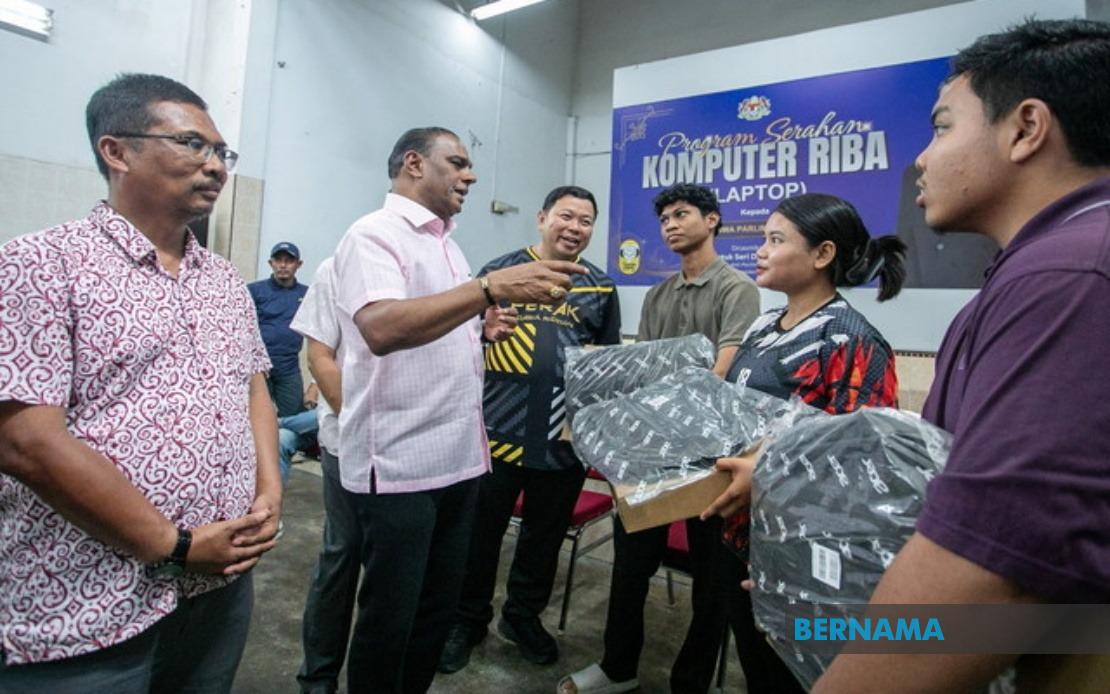
Forty-five university students from B40 households across the Tapah parliamentary constituency have received brand-new laptops as part of a long-established assistance programme designed to remove financial barriers to higher education. The initiative, which has distributed devices to more than 1,000 students since 2008, underscores growing recognition that digital access has transformed from a luxury into a fundamental educational requirement in Malaysia's increasingly technology-dependent learning environment.
Tapah Member of Parliament Datuk Seri M. Saravanan distributed the devices at a formal handover ceremony held at Mahatma Gandhi Hall in the constituency, emphasising the critical role that equipment access plays in determining educational outcomes for economically disadvantaged learners. The latest cohort of beneficiaries comprised a diverse cross-section of students across different qualification levels: 30 diploma holders, five certificate-level students, four matriculation-track participants, three degree programme enrollees, and one student each pursuing SPM, STPM, and foundation-level qualifications. This breadth reflects an understanding that financial hardship affects learners at every stage of tertiary education, not merely at university level.
Saravanan articulated the underlying logic of the programme with particular clarity, noting that laptops have ceased to function as optional tools that enhance convenience and instead have become indispensable infrastructure for contemporary academic success. University coursework across Malaysia increasingly assumes digital competency and device ownership—from submitting assignments electronically to accessing course materials through learning management systems and participating in online lectures. For B40 households, which struggle with basic living expenses, the prospect of purchasing a computer often becomes impossible despite its educational necessity. The Tapah initiative directly addresses this structural inequality by ensuring that family income level does not become an insurmountable obstacle to academic participation.
The selection methodology employed by the programme demonstrates commitment to ensuring resources reach genuinely eligible households rather than becoming misdirected through patronage or error. A dedicated committee evaluates each application using information gathered from the District Education Office (PPD) and consultations with local community leaders, creating a verification framework that cross-checks individual circumstances against multiple data sources. This approach reflects awareness that without rigorous assessment procedures, assistance programmes risk either excluding deserving candidates through bureaucratic inflexibility or dispersing support to ineligible beneficiaries through inadequate vetting.
Particularly significant has been the impact of improved educational access on indigenous youth trajectories in the Tapah constituency. Saravanan highlighted the transformation visible over the past two decades, during which Orang Asli young people have increasingly pursued tertiary education and subsequently entered professional careers as doctors, lawyers, and other specialists. This shift represents movement away from historical patterns of educational marginalisation and occupational limitation that constrained opportunities for indigenous communities. The role model effect of visible professional success within the Orang Asli community potentially encourages younger cohorts to envision similar pathways for themselves, creating positive feedback loops that gradually reshape educational and career expectations.
Among this year's recipients was eighteen-year-old Aidil Iskandar Ramlan, a former student of SMK Syeikh Abdul Ghani in Bidor, who will commence a Diploma in Public Administration at Universiti Teknologi MARA (UiTM) Raub in Pahang next month. For Aidil, whose father works as a security guard at a secondary school while his mother manages household responsibilities, the laptop acquisition eliminates a significant financial obstacle to his studies. He articulated clearly how the device would enable completion of academic assignments and engagement with study-related activities that increasingly demand digital capabilities. More importantly, Aidil recognised that the programme removed the need for his parents to incur substantial expenditure that would have created genuine hardship for his household.
Similarly, nineteen-year-old Ea Endry Iana Aslan, pursuing a Diploma in Early Childhood Education at FELCRA College, expressed gratitude for the financial relief the laptop provided to her family circumstances. For Ea, the device represents accessibility to tools that would otherwise remain financially unattainable, permitting her to engage fully with coursework rather than managing around equipment scarcity. Her framing of the assistance as burden-reduction for her entire household reflects the reality that in B40 families, individual student needs are necessarily considered within broader family economic constraints. The laptop programme thus functions not merely as individual student aid but as family-level economic relief during periods when household members pursue advancement through education.
The Tapah constituency programme operates within a broader Malaysian context where digital inequality has emerged as a significant dimension of educational disadvantage. Rural and low-income areas frequently experience lower technology penetration than urban and affluent regions, creating self-reinforcing cycles where limited access restricts skill development, which subsequently constrains employment opportunities and perpetuates economic marginalisation. Targeted technology distribution programmes address this pattern directly by channelling resources toward communities and households where market mechanisms have failed to ensure access. While individual initiatives like Tapah's effort cannot single-handedly resolve systemic inequality, they demonstrate feasible intervention models and build evidence supporting broader policy adoption.
The programme's sustained operation across sixteen years indicates both political commitment and practical viability at the constituency level. Unlike time-limited projects that create temporary relief, long-term initiatives build reliable expectations that permit families to structure educational and financial planning with greater confidence. Students and parents gain assurance that government support for disadvantaged learners represents consistent policy rather than occasional charity dependent on individual politicians' discretionary generosity. This consistency encourages fuller participation in available assistance schemes and reduces the stigma or uncertainty that sometimes inhibits eligible households from accessing support.
Looking forward, the success of the Tapah model suggests potential value in examining whether comparable programmes could be expanded or replicated across other constituencies facing similar educational access challenges. Malaysia's education system increasingly emphasises technology integration across primary, secondary, and tertiary levels, making device access progressively more consequential for learner outcomes. Ensuring that B40 households can participate in this technology-dependent educational environment without catastrophic financial stress represents both a social equity objective and an investment in human capital development that benefits broader economic productivity. The Tapah initiative, while modest in absolute scale, exemplifies how strategic resource allocation at the constituency level can meaningfully expand genuine educational opportunity.

