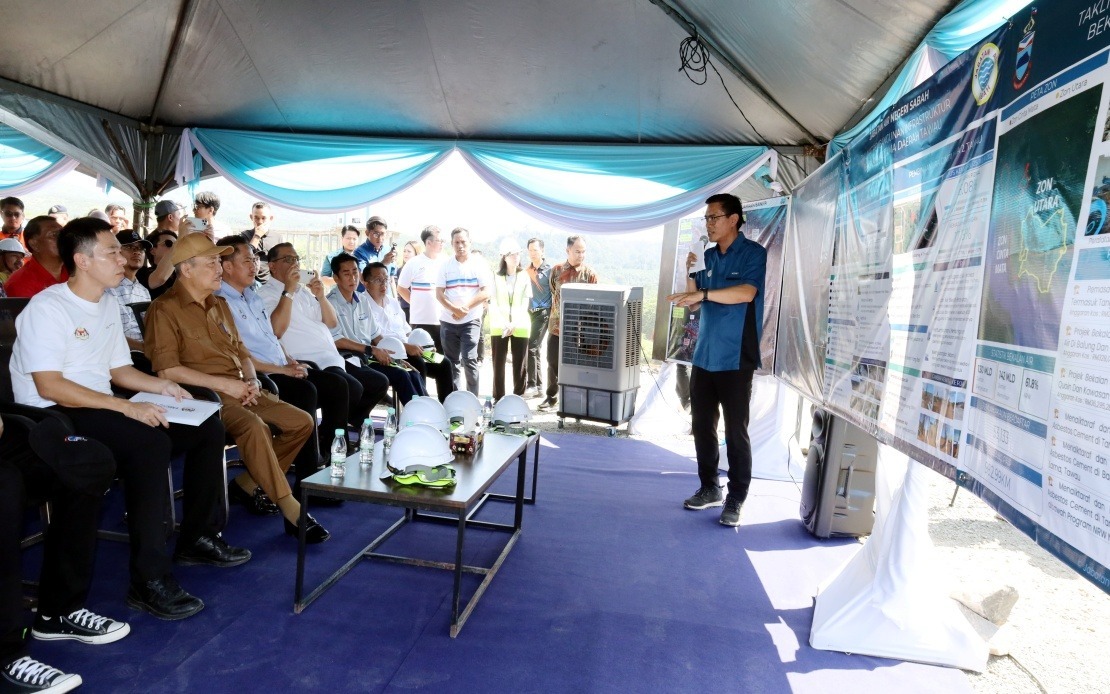
Sabah's persistently troubled water supply situation in Tawau appears set for a decisive turnaround, with state authorities targeting the final quarter of 2027 to complete a transformative RM450.5 million infrastructure initiative. Chief Minister Datuk Seri Hajiji Noor confirmed on his recent inspection of construction sites that the Tawau Water Supply Scheme Phase III remains on track despite setbacks, marking a significant milestone for a region that has grappled with chronic shortages for years.
The chief minister's remarks underscore the political urgency surrounding water security in Sabah's east coast districts, where inadequate supply has constrained economic activity and frustrated residents. By positioning the project as a legacy achievement of the current administration, Hajiji emphasised that while his government inherited the problem, it has taken decisive action through substantial capital allocation. This framing reflects broader concerns across Malaysia about water infrastructure deficits in secondary cities, where demand increasingly outpaces capacity despite decades of awareness.
The centrepiece of Phase III is a new dam designed to capture 30 million cubic metres of raw water, fundamentally reshaping Tawau's supply architecture. This facility will feed into the existing Cinta Mata 1 and Cinta Mata 2 Water Treatment Plants alongside the newer Utara WTP, collectively delivering 161 million litres daily once all components are operational. The scale of this combined capacity represents nearly 24 per cent above current demand, providing a meaningful buffer for population growth and industrial expansion.
As of late July, the Tawau Dam itself had progressed to 74.04 per cent completion, according to Rodney Tinggas, senior assistant director of the Sabah State Water Department's monitoring branch. Construction advances incrementally but steadily, though the contractor has sought deadline extensions—a common feature in large-scale Malaysian infrastructure projects. The state's commitment to absorbing any additional funding requirements signals serious intent to see the scheme finished, though such contingencies can strain already-tight state budgets.
The gap between current and required supply illuminates why this initiative has become urgent. Tawau presently produces only 130 million litres daily against a demand of 142 million litres—a shortfall that affects water pressure and reliability across the 53,133 registered accounts. This 12-million-litre deficit, though seemingly modest in percentage terms, compounds daily for households and businesses dependent on consistent supply, generating political friction and economic drag in an already economically vulnerable district.
The Cinta Mata 2 treatment plant, budgeted at RM299.9 million, represents the largest single component and carries particular significance. Designed to process 30 million litres daily, it had achieved just 16.08 per cent physical progress as of late July, with completion targeted for July 2028. This facility alone will serve approximately 42,000 consumers across Tawau and surrounding municipalities, making it strategically vital for regional development. The staggered completion timeline—with the treatment plant finishing months after the overall 2027 target—suggests that water availability will improve incrementally during the transition period.
Beyond domestic supply, the new dam will deliver secondary benefits by reducing downstream flooding, a concern that has periodically affected Tawau's vulnerable low-lying zones. This dual-purpose design reflects modern infrastructure thinking in tropical regions where water management must balance scarcity with excess. The 11.6 kilometres of 700-millimetre diameter raw water pipelines constitute the critical connecting tissue, transporting untreated water from the dam to treatment facilities with minimal loss—a logistical challenge that requires precise engineering in Sabah's terrain.
The Phase III scheme sits within a longer history of water infrastructure development in Tawau, representing institutional learning from earlier project cycles. Previous phases have established foundational treatment and distribution networks, but capacity constraints necessitated this expansion. That the state government now contemplates additional investment if required suggests political consensus around water security as a non-negotiable development priority, standing apart from more discretionary spending categories.
For Malaysian observers beyond Sabah, Tawau's experience offers instructive lessons about the persistent gap between infrastructure demand and implementation capacity, particularly in smaller urban centres. Major cities like Kuala Lumpur and George Town receive sustained investment and media attention, but secondary cities often languish with ageing facilities and deferred upgrades. Tawau's multi-billion-ringgit solution, while substantial, arrived only after years of documented shortage, illustrating how political pressure gradually translates into resource allocation.
The timeline to end-2027 remains aggressive given construction complexities, although the state's willingness to consider supplementary funding should provide contingency capacity. Regional observers will watch whether the project maintains momentum through potential economic cycles or contractor challenges, as delays cascade readily through interconnected infrastructure systems. Success would position Sabah as addressing one of Southeast Asia's remaining major water supply deficits in established population centres, validating long-term infrastructure planning in the region.
Tawau's transformation, pending completion, will eventually serve as a case study in whether deliberate, well-funded intervention can resolve deeply entrenched infrastructure deficits. The district's 53,000-plus water accounts represent genuine human demand that can no longer be deferred, making this RM450.5 million commitment less discretionary policy choice than necessary investment in regional stability. How effectively and speedily this scheme materialises will influence confidence in Sabah's broader governance capacity as it navigates the competing pressures of development and sustainability.

