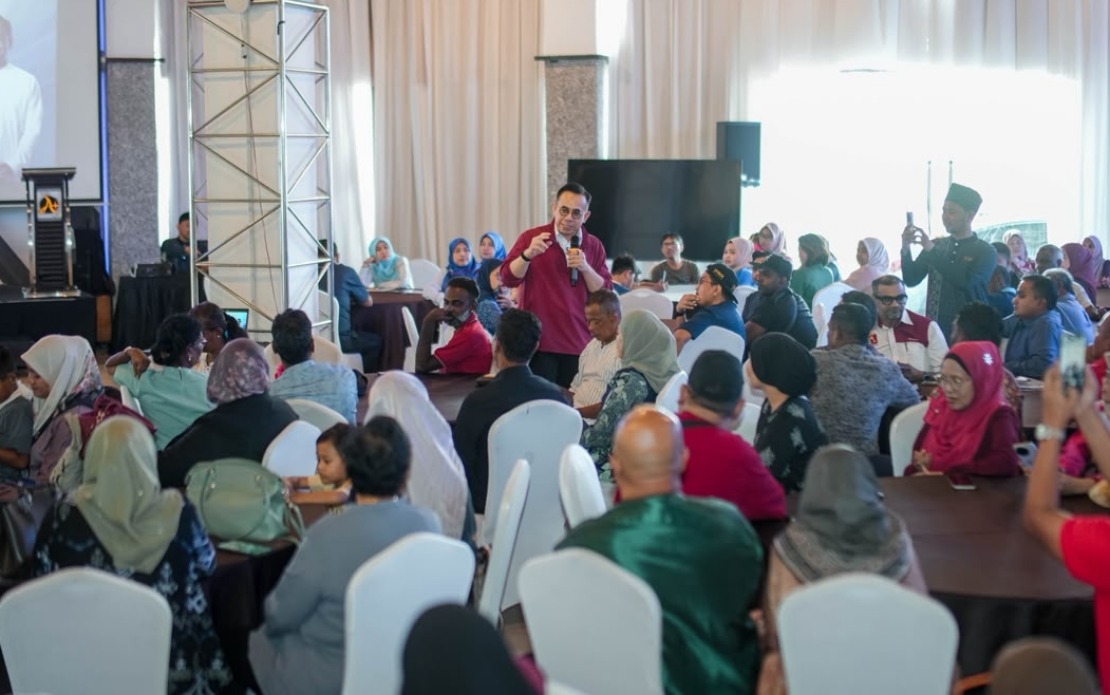
TEKUN Nasional has channelled RM36 million in financing to roughly 1,500 entrepreneurs across Negeri Sembilan through June this year, reflecting the state's share of a broader national funding initiative that has reached 25,600 business owners nationwide with RM540 million in total disbursements. Entrepreneur Development and Cooperatives Minister Steven Sim Chee Keong disclosed the figures during a visit to Seremban, highlighting the three-decade-old institution's continued relevance in nurturing Malaysia's entrepreneurial ecosystem at both state and regional levels.
Three decades since its establishment, TEKUN Nasional has positioned itself as a cornerstone of local enterprise development, yet Sim acknowledged that the organisation must remain responsive to practitioner feedback and address operational inefficiencies that may hinder entrepreneurs' access to capital. The minister's remarks follow a grassroots engagement session with TEKUN beneficiaries in Seremban, an exercise designed to harvest candid insights into the lived experiences of small business owners navigating the application, receipt, and repayment cycle. This direct-to-entrepreneur consultation approach signals the ministry's intent to ground policy refinements in authentic operational data rather than administrative assumptions alone.
Central to Sim's reform agenda is a commitment to dramatically accelerate approval turnaround times, particularly for smaller loan applications that form the backbone of micro-entrepreneurship. Financing requests of RM100,000 or below will henceforth receive decision letters—whether approval or rejection—within seven days, a timeline that represents a substantial compression of previous processing periods and reflects growing impatience with bureaucratic delays that can throttle business momentum. For applications in the micro-financing category of RM20,000 and below, the Ministry of Entrepreneur Development and Cooperatives (KUSKOP) has adopted an even more ambitious 24-hour decision target, acknowledging that entrepreneurs operating at subsistence margins cannot afford protracted waiting periods that compound their already constrained cash positions.
Sim stressed that accelerating approvals is only one half of the necessary reform equation; equally critical is the efficient disbursement of approved funds themselves. Entrepreneurs must not face scenarios where approval delays are followed by funding delays, a compounding frustration that undermines the entire purpose of rapid-access financing schemes. By tightening both decision and disbursement timelines, TEKUN aims to ensure that approved entrepreneurs can inject capital into their operations without experiencing the administrative lag that currently characterises many government lending programmes. This dual focus on speed reflects a recognition that capital velocity matters as much as capital access in the context of small business viability.
Perhaps the most symbolically significant element of Sim's announcement concerns the depoliticisation of TEKUN's application evaluation process. The minister explicitly repudiated the long-standing informal requirement that entrepreneurs secure letters of endorsement from political figures—a practice that has effectively gatekept access to government financing based on political affiliation rather than business merit. Sim declared that TEKUN financing decisions must proceed on the basis of professional, transparent assessment of applicant eligibility alone, with race, religion, and political alignment entirely irrelevant to the determination process. This explicit prohibition on support letters signals a departure from patronage-inflected lending practices that have historically skewed capital distribution and created extractive relationships between entrepreneurs and political patrons.
The minister's statement that entrepreneurs "wearing blue, green, or red"—a direct reference to Malaysia's competing political party colours—deserve equal consideration regardless of affiliation represents an unusually forthright acknowledgment of structural bias in government fund allocation. By naming these party colours explicitly, Sim placed on record a commitment to merit-based adjudication that transcends the partisan divides that have historically complicated entrepreneur access to TEKUN support. This rhetorical move, combined with operational reforms, suggests a deliberate effort to rebuild institutional credibility among entrepreneurs who may have previously viewed TEKUN as a patronage mechanism rather than a merit-based development tool. For practitioners across the political spectrum, this clarification offers some assurance that financing decisions will not become collateral damage in Malaysia's intense electoral competition.
The ministry is simultaneously expanding its targeted support mechanisms for underrepresented entrepreneur communities, particularly Indian Malaysian business owners. The Indian Community Entrepreneur Development Scheme (SPUMI) has received a funding boost from RM30 million to RM50 million, while the Indian Community Entrepreneur Financing Package (MUDRA) commands RM220 million in total financing availability for the current fiscal year. These parallel initiatives acknowledge that generic financing schemes may inadequately address the distinctive capital access barriers faced by entrepreneurs from minority communities and reflect a policy intention to engineer more inclusive economic participation across Malaysia's demographically diverse society. For Negeri Sembilan specifically, where Indian Malaysians comprise a significant proportion of the state population, these expanded allocations carry particular relevance.
Sim's framing of entrepreneurial development as a fundamentally non-racial enterprise carries important implications for how Malaysia conceptualises economic policy and competitive positioning. He argued that when Malaysian companies venture onto international markets, they compete as Malaysian entities rather than as representatives of particular ethnic or religious communities, implying that parochial capital allocation strategies undermines collective economic competitiveness. This argument—that intra-Malaysian ethnic divisions become liabilities rather than organising principles in the context of global commerce—subtly reframes diversity as a strategic asset rather than a managed problem. The minister's assertion that "if we fail, we fail together" conveys a zero-sum perspective on national economic performance that may resonate with businesses experiencing competitive pressures from regional and global rivals.
For Negeri Sembilan entrepreneurs and the broader Malaysian business community, these announcements represent a potential inflection point in how development financing is administered and distributed. The combination of accelerated approval timelines, explicit depoliticisation safeguards, and targeted community-specific financing schemes suggests a ministry attempting to simultaneously address three distinct failure modes in the current system: bureaucratic sluggishness, political gatekeeping, and exclusionary targeting. Whether these reforms will translate into measurable improvements in capital access velocity and entrepreneur outcomes across demographic lines will depend substantially on implementation rigour and the extent to which field-level TEKUN staff and ministry officials internalise these normative commitments about merit-based, rapid-turnaround financing. The next six to twelve months will prove instructive in assessing whether these pronouncements evolve into embedded operational practice or remain aspiration unmoored from institutional reality.

