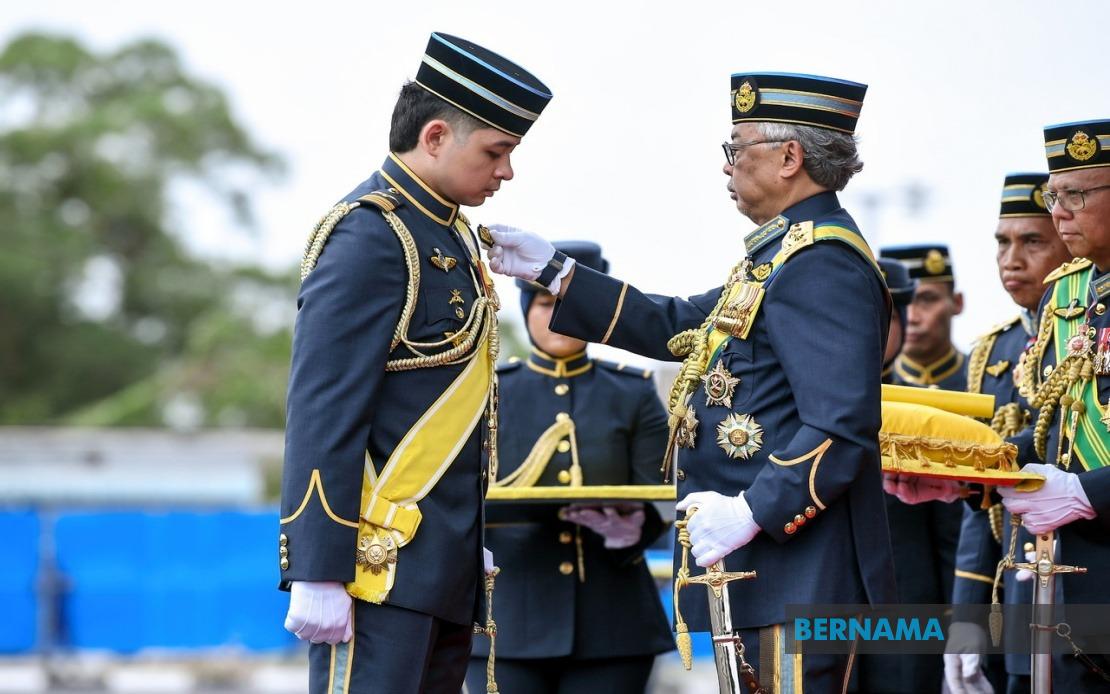
The Tengku Mahkota of Pahang, Tengku Hassanal Ibrahim Alam Shah Ibni Al-Sultan Abdullah Ri'ayatuddin Al-Mustafa Billah Shah, has achieved a significant milestone by becoming the first member of the royal family to successfully complete the Basic Helicopter Flying Course at the Royal Malaysian Air Force Air College in Alor Setar. The historic accomplishment underscores the royal family's commitment to active participation in the country's defence establishment and marks a moment of considerable symbolic importance for the institution.
The flying wings were presented during a formal parade ceremony held at the Air College's parade ground, where the Sultan of Pahang, Al-Sultan Abdullah Ri'ayatuddin Al-Mustafa Billah Shah, conferred the prestigious qualification on all graduates. In his capacity as Colonel-in-Chief of the Royal Malaysian Air Force, the Sultan presided over the occasion as a total of 40 graduates received recognition for their achievements. This included the Tengku Mahkota alongside 39 other personnel drawn from Malaysia's three armed forces services, comprising 37 newly qualified pilots and two weapons systems officers.
The Tengku Mahkota's training programme ran from early June through the end of July, focusing on practical helicopter operations using the EC120B Colibri aircraft. Throughout the intensive course, he demonstrated proficiency across the full range of required competencies. His performance encompassed the Basic Handling Test, which assesses fundamental flight control and aircraft management, the Instrument Flying Test that validates ability to navigate and operate using cockpit instruments alone, the Final Navigation Test requiring precision route-finding, and the Final Handling Test that confirms overall flying capability. Completion of all four assessment components signifies mastery of essential helicopter piloting skills and represents a rigorous standard.
The graduation ceremony reflected the breadth of the Air College's training operations, bringing together participants from four distinct flying courses. These included not only the helicopter programmes in which the Tengku Mahkota participated, but also a basic fixed-wing flying course and a weapons systems officer specialization course. This range demonstrates the institution's role in developing the full spectrum of air force personnel, from pilots of various aircraft types to the specialists who manage weapons systems during operations. The diversity of graduates highlighted the comprehensive nature of Malaysian military aviation training.
General Tan Sri Muhamad Norazlan Aris, the Royal Malaysian Air Force Chief, delivered remarks emphasizing the human dimensions underpinning each graduate's achievement. He characterized their success as the product of sustained personal effort, competitive drive, psychological fortitude, and strict adherence to military discipline throughout their training. The General's observations reflected the demanding nature of pilot training programmes, which require not merely technical knowledge but also the mental resilience to perform under pressure and the self-discipline necessary to maintain safety standards in inherently risky operations.
In addressing the graduates directly, the Air Force Chief stressed the profound transition they now faced. The presentation of flying wings, he explained, represented not a culmination but rather an opening into a new phase carrying substantially greater responsibility. The wings themselves, worn prominently on the uniform, embody recognition by the service and nation of the wearer's qualification and trustworthiness in performing complex aerial operations. This symbolic weight extends beyond mere technical certification to encompass a covenant of professional commitment.
The General's address also acknowledged the vital supporting role played by family members and loved ones throughout the training journey. He recognized that behind each graduate stood parents and relatives providing emotional encouragement and spiritual support, often through worry and sacrifice during the demanding training period. This recognition reflects the comprehensive nature of military training, which affects not only the individuals undergoing instruction but also extends to the entire family unit through separation, stress, and uncertainty about eventual outcomes.
For Malaysian readers and regional observers, the Tengku Mahkota's achievement carries significance beyond the immediate military context. It signals the royal family's active engagement with the institutional structures of national defence, demonstrating a hands-on commitment that extends to personal participation in demanding professional training. Such involvement by senior royalty in military institutions can strengthen bonds between the civilian royal institution and the uniformed services, fostering mutual understanding and respect. It also establishes important precedent regarding the expectations placed upon members of the royal household regarding national service obligations.
The broader context of this achievement also speaks to Malaysia's continued investment in developing indigenous military aviation capacity. The RMAF Air College's operations represent substantial institutional capability for training pilots and air force specialists entirely within the country. Rather than depending exclusively on foreign military training establishments, Malaysia maintains its own rigorous programme capable of producing graduates who meet international standards. This self-sufficiency in military aviation training contributes to national defence autonomy and reduces dependency on external military institutions.
The recognition of six outstanding graduates for excellence in flying, academics, discipline, and leadership adds another dimension to the ceremony's importance. These awards signal that within the cohort of 40 graduates, particular individuals demonstrated exceptional capability or commitment across multiple dimensions. Such recognition schemes serve to establish benchmarks of excellence within military organizations and motivate continuous improvement in performance standards. They also identify candidates potentially suited for advanced training or accelerated career development pathways.
The EC120B Colibri helicopters used throughout the training programme represent modern, capable aircraft suitable for training purposes while maintaining commonality with military operations. This choice ensures that graduates receive instruction on equipment directly relevant to operational assignments they will subsequently undertake. The helicopter's characteristics, including its handling qualities and systems, provide appropriate complexity for building pilot competence and judgment while remaining manageable for trainees in early career stages.
Looking forward, the completion of this course cohort contributes to maintaining and replenishing the Royal Malaysian Air Force's pilot population. The service requires continuous inflow of newly qualified aviators to replace those advancing into command positions, transitioning to staff assignments, or departing from service. This graduation ceremony therefore represents not merely a ceremonial moment but an essential component of the service's personnel management strategy and operational sustainability.
The Tengku Mahkota's participation and success in this programme may also influence perspectives on the role of royal family members in contemporary Malaysian society. By demonstrating willingness to undergo challenging professional training alongside military personnel of substantially junior rank, the heir to the Pahang throne underscores the principle that royal status does not exempt individuals from standard requirements or expectations. This accessible approach to royal duty may enhance public perception of the royal institution's relevance and contribution to national life beyond ceremonial functions.

