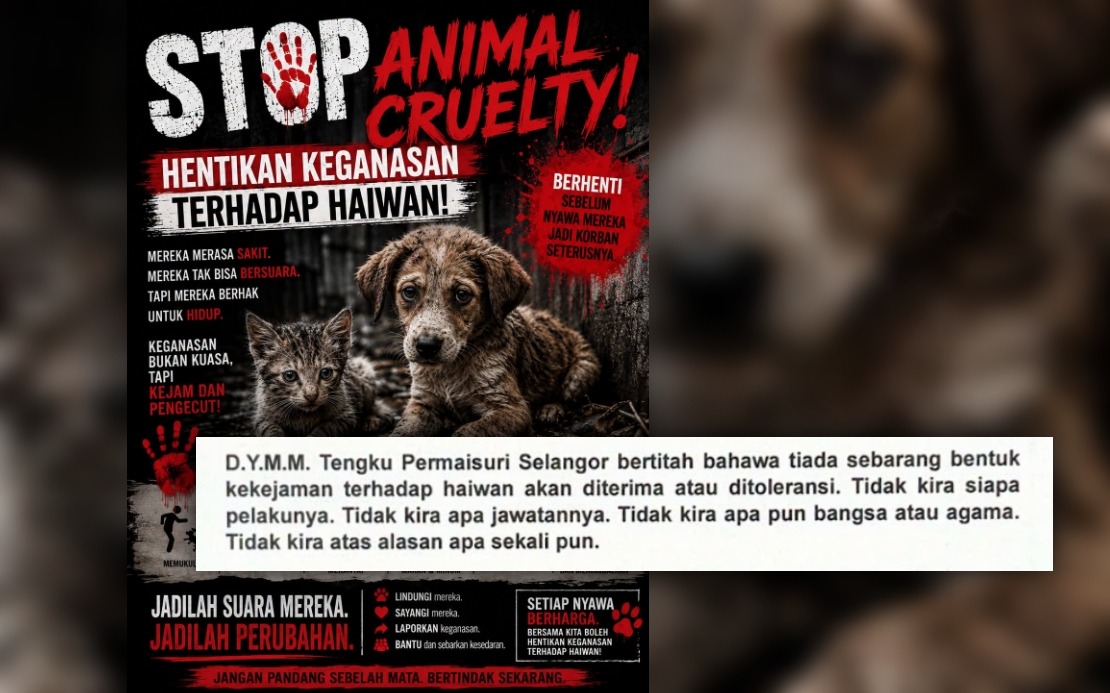
Tengku Permaisuri Norashikin of Selangor has publicly rebuked the escalating violence against animals, declaring that the recent wave of cruelty incidents targeting pets and strays — predominantly dogs and cats — represents a fundamental breach of compassion and lawfulness that cannot be ignored. The Royal Patron of the Stray Free Selangor initiative lodged her protest through an official palace statement, responding to mounting public anger expressed across social media platforms in the wake of multiple documented cases of animal abuse.
The Tengku Permaisuri's intervention carries particular weight in the Malaysian context, where royal pronouncements on civic matters shape public discourse and government policy responsiveness. Her emphasis that animal cruelty violates both legal statutes and moral principles underscores a philosophical position increasingly shared by urban Malaysians, particularly younger generations who view animal welfare as integral to social progress rather than peripheral to national priorities.
Central to her address is a direct call for the federal government to undertake a comprehensive review of penalties embedded within the Animal Welfare Act 2015. The Tengku Permaisuri contends that existing punitive frameworks lack sufficient deterrent power and that law enforcement agencies demonstrate inconsistency in prosecuting violations. This assessment aligns with longstanding complaints from animal rights organizations across Malaysia, which have documented numerous cases where perpetrators receive minimal sentences or administrative warnings despite causing severe suffering.
Notably, the palace statement extends accountability beyond individual offenders to encompass institutional actors. The Tengku Permaisuri explicitly stipulated that enforcement personnel and government officers remain subject to identical legal consequences as ordinary citizens, signalling concern that some abuses may involve state agents or officials acting with impunity. This transparency-oriented stance reflects heightened public expectations that royal institutions champion systemic accountability rather than selective justice.
The underlying principle articulated by the Tengku Permaisuri — that animal welfare serves as a barometer for civilizational advancement — represents a sophisticated philosophical position gaining traction in Southeast Asia. She asserts that societies unable to extend compassion toward vulnerable creatures inevitably erode their capacity for human compassion, a thesis resonating with psychological and sociological research linking animal cruelty to broader ethical deterioration.
Her Royal Highness simultaneously articulated an aspirational framework anchored on three pillars: fostering community-wide compassion toward animals, translating empathy into actionable protection mechanisms, and embedding animal welfare within comprehensive nation-building initiatives. This multidimensional approach recognizes that legislative tools alone prove insufficient without corresponding shifts in social attitudes, institutional practices, and educational curricula.
The recommendations presented encompass foundational interventions beginning in childhood education, where formal curricula should cultivate respect for sentient beings from formative stages. Public awareness campaigns would reinforce messaging that individual kindness toward animals matters substantively, countering cultural narratives that dismiss such concerns as frivolous or sentimental. Community engagement mechanisms would distribute responsibility across civil society, government bodies, and local authorities rather than concentrating enforcement burdens on specialized agencies.
The Tengku Permaisuri invoked a tripartite value system — "Compassion. Care. Community." — as an aspirational social contract for Selangor and, by extension, Malaysia. This formulation transcends conventional animal welfare discourse by positioning animal protection within broader frameworks of social cohesion and collective identity, making it palatable to audiences concerned with nation-building rather than exclusively animal-centric constituencies.
For Malaysian policymakers, the royal intervention carries unmistakable implications. Selangor, as Malaysia's most economically developed state and home to sprawling metropolitan areas, functions as a bellwether for social policy experimentation. Legislative reforms originating in the state assembly often gain momentum at federal level, and the Tengku Permaisuri's explicit advocacy provides political cover for lawmakers considering Animal Welfare Act amendments that enhance penalties or establish dedicated prosecution units.
Regionally, the statement reflects evolving perspectives on animal welfare across Southeast Asia, where rapid urbanization and demographic shifts toward younger, more globally-connected populations are generating heightened concern for animal protection. Singapore and Thailand have implemented increasingly stringent animal cruelty legislation, and Malaysia risks reputational damage if perceived as lagging behind neighboring jurisdictions on animal welfare standards.
The palace statement also implicitly critiques governance failures by emphasizing the need for inter-agency coordination. The fragmentation of animal welfare responsibilities across the Department of Veterinary Services, local municipal authorities, and various enforcement bodies has historically enabled inconsistent application of existing laws. The Tengku Permaisuri's call for "close cooperation among the government, local authorities, relevant agencies, animal welfare organisations and the public" signals frustration with bureaucratic silos and advocates for integrated governance structures.
Equally significant is the Tengku Permaisuri's assertion that strength and civilizational maturity manifest through protection of the vulnerable rather than domination over them. This reframing challenges cultural narratives sometimes invoked to justify animal exploitation or dismissal of welfare concerns as Western impositions. By grounding animal compassion in Islamic ethical traditions — referencing "Allah's creations" — the palace statement anchors protection principles within Malaysian religious and cultural frameworks, preempting accusations of cultural inappropriateness.
Looking forward, the Tengku Permaisuri's intervention has triggered expectations that tangible legislative and institutional reforms will follow her pronouncement. Animal welfare advocates anticipate concrete timelines for Animal Welfare Act amendments, establishment of specialized prosecution units, and integration of animal protection curricula into national educational standards. The palace statement's specificity regarding enforcement failures and recommendations suggests that continued inaction would represent a direct rebuff of royal guidance, creating political pressure on the Selangor state government and federal authorities to demonstrate responsiveness through measurable policy changes.

